

404
C Quantum Field Theory
For giving a short intuition, the BV formalism can be interpreted as providing a
(anti)canonical structure in the Lagrangian formalism, the role of the Hamiltonian
being played by the action.
C.3.1 Properties of Gauge Algebra
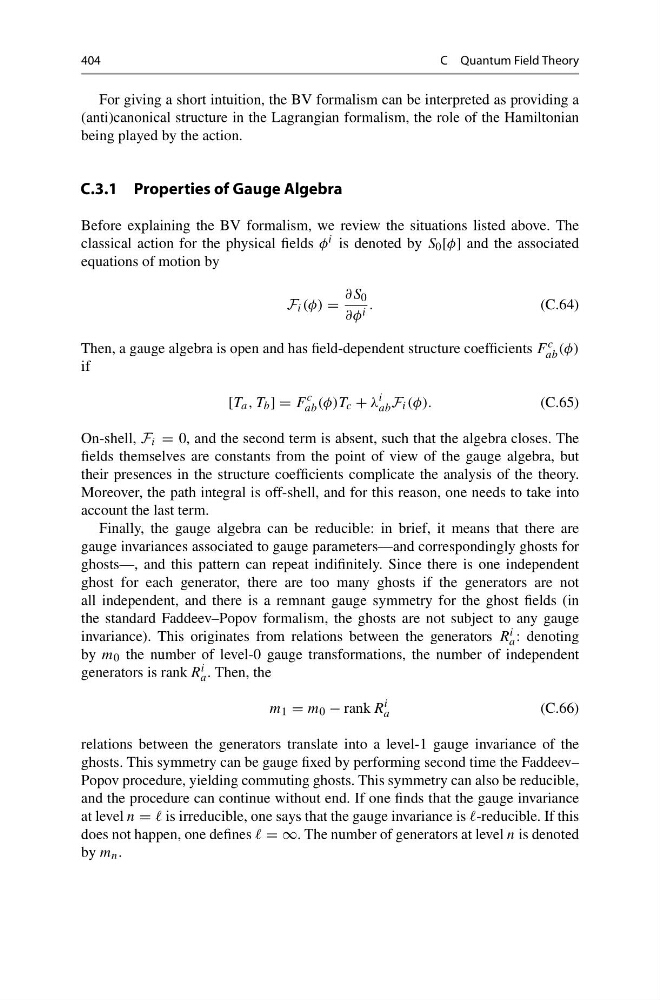
Before explaining the BV formalism, we review the situations listed above. The
classical action for the physical fields φ i is denoted by S 0 [φ] and the associated
equations of motion by
F i (φ) =
∂S 0
∂φ i .
(C.64)
Then, a gauge algebra is open and has field-dependent structure coefficients F c
ab (φ)
if
[T a , T b ] = F
c
ab (φ)T c + λ
i
ab F i (φ).
(C.65)
On-shell, F i = 0, and the second term is absent, such that the algebra closes. The
fields themselves are constants from the point of view of the gauge algebra, but
their presences in the structure coefficients complicate the analysis of the theory.
Moreover, the path integral is off-shell, and for this reason, one needs to take into
account the last term.
Finally, the gauge algebra can be reducible: in brief, it means that there are
gauge invariances associated to gauge parameters—and correspondingly ghosts for
ghosts—, and this pattern can repeat indifinitely. Since there is one independent
ghost for each generator, there are too many ghosts if the generators are not
all independent, and there is a remnant gauge symmetry for the ghost fields (in
the standard Faddeev–Popov formalism, the ghosts are not subject to any gauge
invariance). This originates from relations between the generators R i
a : denoting
by m 0 the number of level-0 gauge transformations, the number of independent
generators is rank R i
a . Then, the
m 1 = m 0 − rank R
i
a
(C.66)
relations between the generators translate into a level-1 gauge invariance of the
ghosts. This symmetry can be gauge fixed by performing second time the Faddeev–
Popov procedure, yielding commuting ghosts. This symmetry can also be reducible,
and the procedure can continue without end. If one finds that the gauge invariance
at level n = is irreducible, one says that the gauge invariance is -reducible. If this
does not happen, one defines = ∞. The number of generators at level n is denoted
by m n .
C Quantum Field Theory
For giving a short intuition, the BV formalism can be interpreted as providing a
(anti)canonical structure in the Lagrangian formalism, the role of the Hamiltonian
being played by the action.
C.3.1 Properties of Gauge Algebra
Before explaining the BV formalism, we review the situations listed above. The
classical action for the physical fields φ i is denoted by S 0 [φ] and the associated
equations of motion by
F i (φ) =
∂S 0
∂φ i .
(C.64)
Then, a gauge algebra is open and has field-dependent structure coefficients F c
ab (φ)
if
[T a , T b ] = F
c
ab (φ)T c + λ
i
ab F i (φ).
(C.65)
On-shell, F i = 0, and the second term is absent, such that the algebra closes. The
fields themselves are constants from the point of view of the gauge algebra, but
their presences in the structure coefficients complicate the analysis of the theory.
Moreover, the path integral is off-shell, and for this reason, one needs to take into
account the last term.
Finally, the gauge algebra can be reducible: in brief, it means that there are
gauge invariances associated to gauge parameters—and correspondingly ghosts for
ghosts—, and this pattern can repeat indifinitely. Since there is one independent
ghost for each generator, there are too many ghosts if the generators are not
all independent, and there is a remnant gauge symmetry for the ghost fields (in
the standard Faddeev–Popov formalism, the ghosts are not subject to any gauge
invariance). This originates from relations between the generators R i
a : denoting
by m 0 the number of level-0 gauge transformations, the number of independent
generators is rank R i
a . Then, the
m 1 = m 0 − rank R
i
a
(C.66)
relations between the generators translate into a level-1 gauge invariance of the
ghosts. This symmetry can be gauge fixed by performing second time the Faddeev–
Popov procedure, yielding commuting ghosts. This symmetry can also be reducible,
and the procedure can continue without end. If one finds that the gauge invariance
at level n = is irreducible, one says that the gauge invariance is -reducible. If this
does not happen, one defines = ∞. The number of generators at level n is denoted
by m n .