

406
C Quantum Field Theory
level of the action (classical level) and how the sets of fields and antifields are
defined.
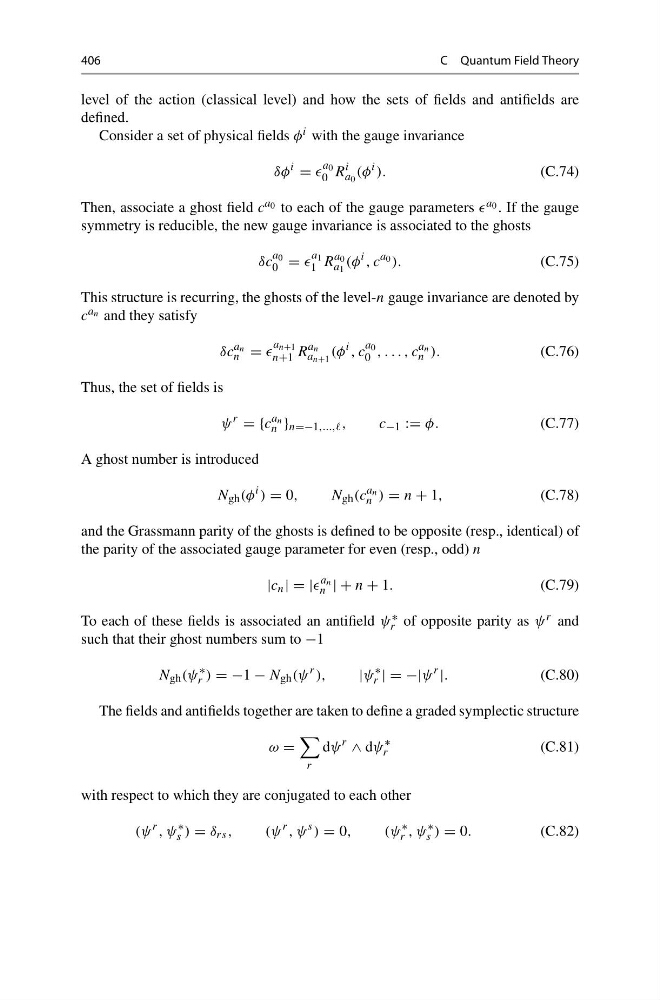
Consider a set of physical fields φ i with the gauge invariance
δφ
i
=
a 0
0 R
i
a 0
(φ
i ).
(C.74)
Then, associate a ghost field c a 0 to each of the gauge parameters a 0 . If the gauge
symmetry is reducible, the new gauge invariance is associated to the ghosts
δc
a 0
0 =
a 1
1 R
a 0
a 1
(φ
i , c
a 0 ).
(C.75)
This structure is recurring, the ghosts of the level-n gauge invariance are denoted by
c a n and they satisfy
δc
a n
n =
a n+1
n+1 R
a n
a n+1
(φ
i , c
a 0
0 , . . . , c
a n
n ).
(C.76)
Thus, the set of fields is
ψ
r
= {c
a n
n } n=−1,...,, ,
c −1 := φ.
(C.77)
A ghost number is introduced
N gh (φ
i ) = 0,
N gh (c
a n
n ) = n + 1,
(C.78)
and the Grassmann parity of the ghosts is defined to be opposite (resp., identical) of
the parity of the associated gauge parameter for even (resp., odd) n
|c n | = |
a n
n | + n + 1.
(C.79)
To each of these fields is associated an antifield ψ ∗
r of opposite parity as ψ r and
such that their ghost numbers sum to −1
N gh (ψ
∗
r ) = −1 − N gh (ψ
r ),
|ψ
∗
r | = −|ψ
r
|.
(C.80)
The fields and antifields together are taken to define a graded symplectic structure
ω =
r
dψ
r
∧ dψ
∗
r
(C.81)
with respect to which they are conjugated to each other
(ψ
r , ψ
∗
s ) = δ rs ,
(ψ
r , ψ
s ) = 0,
(ψ
∗
r , ψ
∗
s ) = 0.
(C.82)
C Quantum Field Theory
level of the action (classical level) and how the sets of fields and antifields are
defined.
Consider a set of physical fields φ i with the gauge invariance
δφ
i
=
a 0
0 R
i
a 0
(φ
i ).
(C.74)
Then, associate a ghost field c a 0 to each of the gauge parameters a 0 . If the gauge
symmetry is reducible, the new gauge invariance is associated to the ghosts
δc
a 0
0 =
a 1
1 R
a 0
a 1
(φ
i , c
a 0 ).
(C.75)
This structure is recurring, the ghosts of the level-n gauge invariance are denoted by
c a n and they satisfy
δc
a n
n =
a n+1
n+1 R
a n
a n+1
(φ
i , c
a 0
0 , . . . , c
a n
n ).
(C.76)
Thus, the set of fields is
ψ
r
= {c
a n
n } n=−1,...,, ,
c −1 := φ.
(C.77)
A ghost number is introduced
N gh (φ
i ) = 0,
N gh (c
a n
n ) = n + 1,
(C.78)
and the Grassmann parity of the ghosts is defined to be opposite (resp., identical) of
the parity of the associated gauge parameter for even (resp., odd) n
|c n | = |
a n
n | + n + 1.
(C.79)
To each of these fields is associated an antifield ψ ∗
r of opposite parity as ψ r and
such that their ghost numbers sum to −1
N gh (ψ
∗
r ) = −1 − N gh (ψ
r ),
|ψ
∗
r | = −|ψ
r
|.
(C.80)
The fields and antifields together are taken to define a graded symplectic structure
ω =
r
dψ
r
∧ dψ
∗
r
(C.81)
with respect to which they are conjugated to each other
(ψ
r , ψ
∗
s ) = δ rs ,
(ψ
r , ψ
s ) = 0,
(ψ
∗
r , ψ
∗
s ) = 0.
(C.82)