

396
C Quantum Field Theory
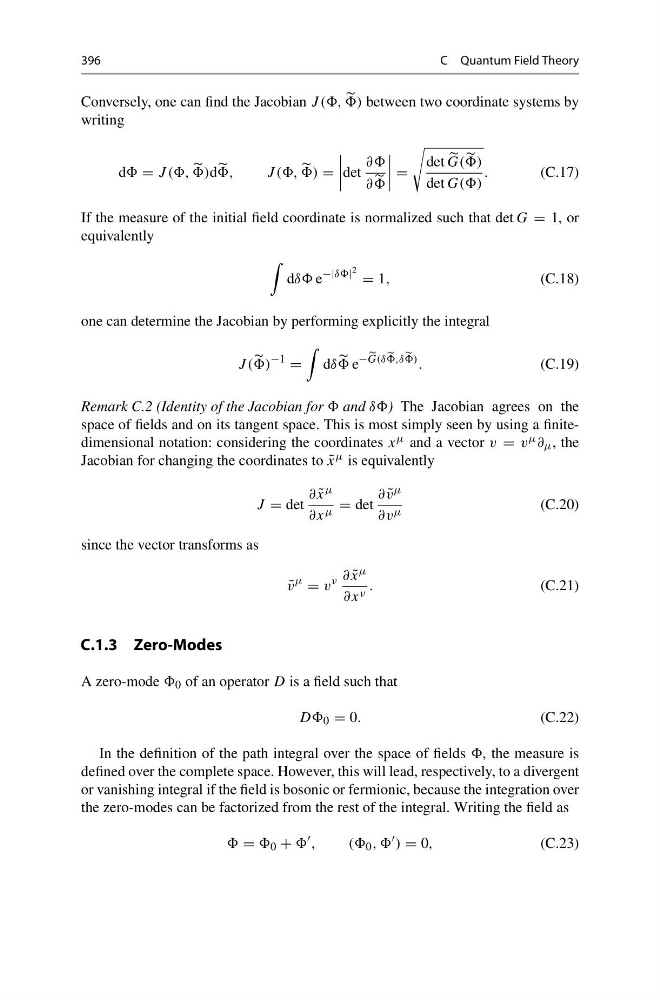
Conversely, one can find the Jacobian J ((,
) between two coordinate systems by
writing
d = J ((,
)d
,
J ((,
) =
det
∂∂
∂
=
det
G(
)
det G(()
.
(C.17)
If the measure of the initial field coordinate is normalized such that det G = 1, or
equivalently
dδδ e
−|δδ| 2 = 1,
(C.18)
one can determine the Jacobian by performing explicitly the integral
J (
)
−1
=
dδ
e
−
G(δ
,δ
) .
(C.19)
Remark C.2 (Identity of the Jacobian for and δδ) The Jacobian agrees on the
space of fields and on its tangent space. This is most simply seen by using a finitedimensional notation: considering the coordinates x μ and a vector v = v μ ∂ μ , the
Jacobian for changing the coordinates to ˜
x μ is equivalently
J = det
∂ ˜
x μ
∂x μ = det
∂ ˜
v μ
∂v μ
(C.20)
since the vector transforms as
˜
v
μ
= v
ν ∂ ˜
x μ
∂x ν .
(C.21)
C.1.3 Zero-Modes
A zero-mode 0 of an operator D is a field such that
DD 0 = 0.
(C.22)
In the definition of the path integral over the space of fields , the measure is
defined over the complete space. However, this will lead, respectively, to a divergent
or vanishing integral if the field is bosonic or fermionic, because the integration over
the zero-modes can be factorized from the rest of the integral. Writing the field as
= 0 +
,
(( 0 , ,
) = 0,
(C.23)
C Quantum Field Theory
Conversely, one can find the Jacobian J ((,
) between two coordinate systems by
writing
d = J ((,
)d
,
J ((,
) =
det
∂∂
∂
=
det
G(
)
det G(()
.
(C.17)
If the measure of the initial field coordinate is normalized such that det G = 1, or
equivalently
dδδ e
−|δδ| 2 = 1,
(C.18)
one can determine the Jacobian by performing explicitly the integral
J (
)
−1
=
dδ
e
−
G(δ
,δ
) .
(C.19)
Remark C.2 (Identity of the Jacobian for and δδ) The Jacobian agrees on the
space of fields and on its tangent space. This is most simply seen by using a finitedimensional notation: considering the coordinates x μ and a vector v = v μ ∂ μ , the
Jacobian for changing the coordinates to ˜
x μ is equivalently
J = det
∂ ˜
x μ
∂x μ = det
∂ ˜
v μ
∂v μ
(C.20)
since the vector transforms as
˜
v
μ
= v
ν ∂ ˜
x μ
∂x ν .
(C.21)
C.1.3 Zero-Modes
A zero-mode 0 of an operator D is a field such that
DD 0 = 0.
(C.22)
In the definition of the path integral over the space of fields , the measure is
defined over the complete space. However, this will lead, respectively, to a divergent
or vanishing integral if the field is bosonic or fermionic, because the integration over
the zero-modes can be factorized from the rest of the integral. Writing the field as
= 0 +
,
(( 0 , ,
) = 0,
(C.23)