

C Quantum Field Theory
395
However, it can be simpler to work with a Gaussian measure by considering only
the quadratic terms in S and expanding the rest in a power series. In particular, the
partition function is defined from the classical action S cl by
Z =
d e
−S cl (() .
(C.11)
Given an operator D, its adjoint D † is defined with respect to the metric as
G(δδ, Dδδ) = G(D
† δδ, δδ).
(C.12)
The free-field measure is such that the metric on the field space is independent
from the field itself: G(X) = G 0 . In particular, this implies that the metric is flat
and its determinant can be absorbed in the measure, setting det G 0 = 1. In this case,
the measure is invariant under shift of the field:
→ + ε
(C.13)
such that
d e
−
1
2 |+ε| 2 =
d e
−
1
2 || 2 .
(C.14)
This property allows to complete squares and shift integration variables (for
example, to generate a perturbative expansion and to derive the propagator).
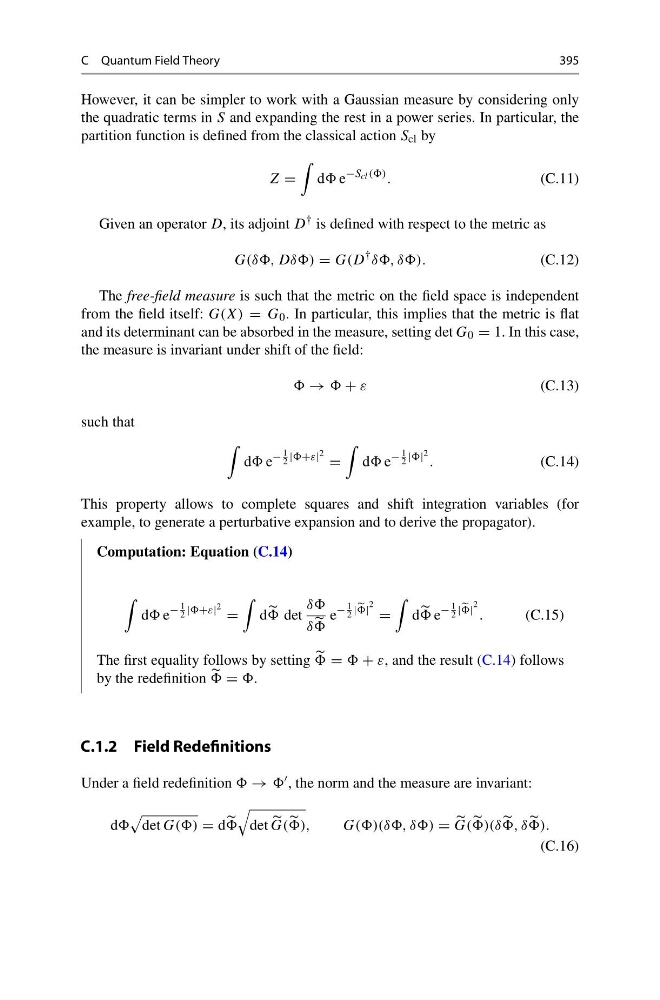
Computation: Equation (C.14)
d e
−
1
2 |+ε| 2 =
d
det
δδ
δ
e
−
1
2 |
|
2 =
d
e
−
1
2 |
|
2
.
(C.15)
The first equality follows by setting
= + ε, and the result (C.14) follows
by the redefinition
= .
C.1.2 Field Redefinitions
Under a field redefinition → , the norm and the measure are invariant:
d
det G(() = d
det
G(
),
G(()(δδ, δδ) =
G(
)(δ
δ
).
(C.16)
395
However, it can be simpler to work with a Gaussian measure by considering only
the quadratic terms in S and expanding the rest in a power series. In particular, the
partition function is defined from the classical action S cl by
Z =
d e
−S cl (() .
(C.11)
Given an operator D, its adjoint D † is defined with respect to the metric as
G(δδ, Dδδ) = G(D
† δδ, δδ).
(C.12)
The free-field measure is such that the metric on the field space is independent
from the field itself: G(X) = G 0 . In particular, this implies that the metric is flat
and its determinant can be absorbed in the measure, setting det G 0 = 1. In this case,
the measure is invariant under shift of the field:
→ + ε
(C.13)
such that
d e
−
1
2 |+ε| 2 =
d e
−
1
2 || 2 .
(C.14)
This property allows to complete squares and shift integration variables (for
example, to generate a perturbative expansion and to derive the propagator).
Computation: Equation (C.14)
d e
−
1
2 |+ε| 2 =
d
det
δδ
δ
e
−
1
2 |
|
2 =
d
e
−
1
2 |
|
2
.
(C.15)
The first equality follows by setting
= + ε, and the result (C.14) follows
by the redefinition
= .
C.1.2 Field Redefinitions
Under a field redefinition → , the norm and the measure are invariant:
d
det G(() = d
det
G(
),
G(()(δδ, δδ) =
G(
)(δ
δ
).
(C.16)