

15.3 Classical Gauge Invariant Theory
319
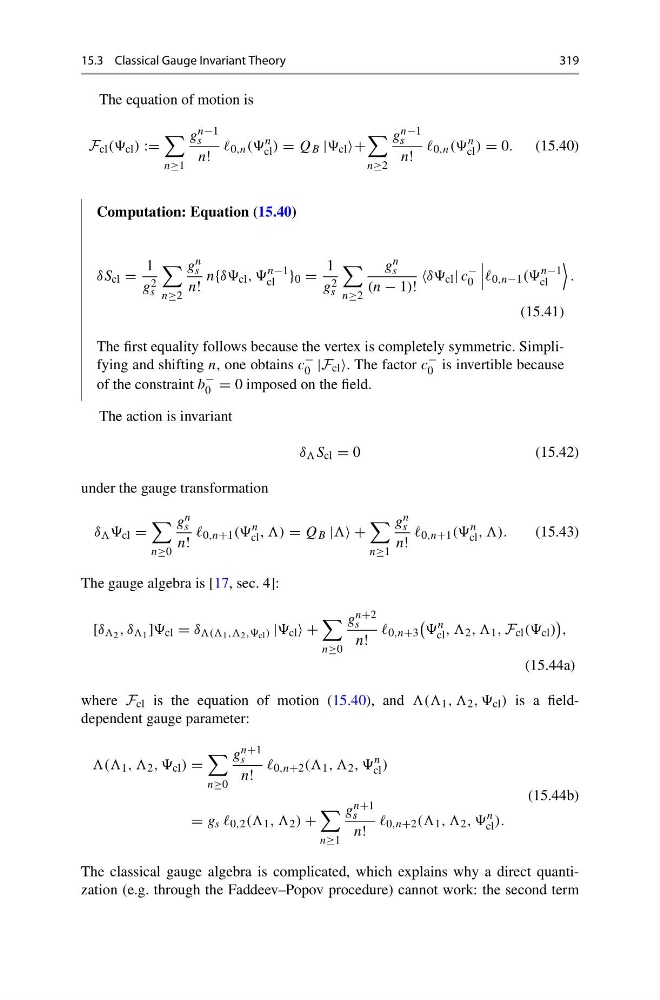
The equation of motion is
F cl (( cl ) :=
n≥1
g n−1
s
n!
0,n ((
n
cl ) = Q B | cl +
n≥2
g n−1
s
n!
0,n ((
n
cl ) = 0.
(15.40)
Computation: Equation (15.40)
δS cl =
1
g 2
s
n≥2
g n
s
n!
n{δδ cl , ,
n−1
cl } 0 =
1
g 2
s
n≥2
g n
s
(n − 1)!
δδ cl | c
−
0
0,n−1((
n−1
cl
.
(15.41)
The first equality follows because the vertex is completely symmetric. Simplifying and shifting n, one obtains c
−
0 |F cl . The factor c
−
0 is invertible because
of the constraint b
−
0 = 0 imposed on the field.
The action is invariant
δ S cl = 0
(15.42)
under the gauge transformation
δ cl =
n≥0
g n
s
n!
0,n+1 ((
n
cl , ,) = Q B | +
n≥1
g n
s
n!
0,n+1 ((
n
cl , ,).
(15.43)
The gauge algebra is [17, sec. 4]:
[δ 2 , δ 1 ] cl = δ (( 1 ,, 2 ,, cl ) | cl +
n≥0
g n+2
s
n!
0,n+3
n
cl , , 2 , , 1 , F cl (( cl )
,
(15.44a)
where F cl is the equation of motion (15.40), and (( 1 , , 2 , , cl ) is a fielddependent gauge parameter:
(( 1 , , 2 , , cl ) =
n≥0
g n+1
s
n!
0,n+2 (( 1 , , 2 , ,
n
cl )
= g s 0,2 (( 1 , , 2 ) +
n≥1
g n+1
s
n!
0,n+2 (( 1 , , 2 , ,
n
cl ).
(15.44b)
The classical gauge algebra is complicated, which explains why a direct quantization (e.g. through the Faddeev–Popov procedure) cannot work: the second term
319
The equation of motion is
F cl (( cl ) :=
n≥1
g n−1
s
n!
0,n ((
n
cl ) = Q B | cl +
n≥2
g n−1
s
n!
0,n ((
n
cl ) = 0.
(15.40)
Computation: Equation (15.40)
δS cl =
1
g 2
s
n≥2
g n
s
n!
n{δδ cl , ,
n−1
cl } 0 =
1
g 2
s
n≥2
g n
s
(n − 1)!
δδ cl | c
−
0
0,n−1((
n−1
cl
.
(15.41)
The first equality follows because the vertex is completely symmetric. Simplifying and shifting n, one obtains c
−
0 |F cl . The factor c
−
0 is invertible because
of the constraint b
−
0 = 0 imposed on the field.
The action is invariant
δ S cl = 0
(15.42)
under the gauge transformation
δ cl =
n≥0
g n
s
n!
0,n+1 ((
n
cl , ,) = Q B | +
n≥1
g n
s
n!
0,n+1 ((
n
cl , ,).
(15.43)
The gauge algebra is [17, sec. 4]:
[δ 2 , δ 1 ] cl = δ (( 1 ,, 2 ,, cl ) | cl +
n≥0
g n+2
s
n!
0,n+3
n
cl , , 2 , , 1 , F cl (( cl )
,
(15.44a)
where F cl is the equation of motion (15.40), and (( 1 , , 2 , , cl ) is a fielddependent gauge parameter:
(( 1 , , 2 , , cl ) =
n≥0
g n+1
s
n!
0,n+2 (( 1 , , 2 , ,
n
cl )
= g s 0,2 (( 1 , , 2 ) +
n≥1
g n+1
s
n!
0,n+2 (( 1 , , 2 , ,
n
cl ).
(15.44b)
The classical gauge algebra is complicated, which explains why a direct quantization (e.g. through the Faddeev–Popov procedure) cannot work: the second term