

320
15 Closed String Field Theory
in (15.44a) indicates that the algebra is open (it closes only on-shell), while the first
term is a gauge transformation with a field-dependent parameter. As reviewed in
Appendix C.3, both properties require using the BV formalism for the quantization,
and the latter is performed in Sect. 15.4. An important point is that if the theory had
only cubic interactions, i.e. if
∀n ≥ 4 : V 0,4 (V 1 , . . . , V n ) = 0, , g,n−1 (V 1 , . . . , V n−1 ) = 0, (cubic theory),
(15.45)
then the algebra closes off-shell and (( 1 , , 2 , , cl ) becomes field independent.
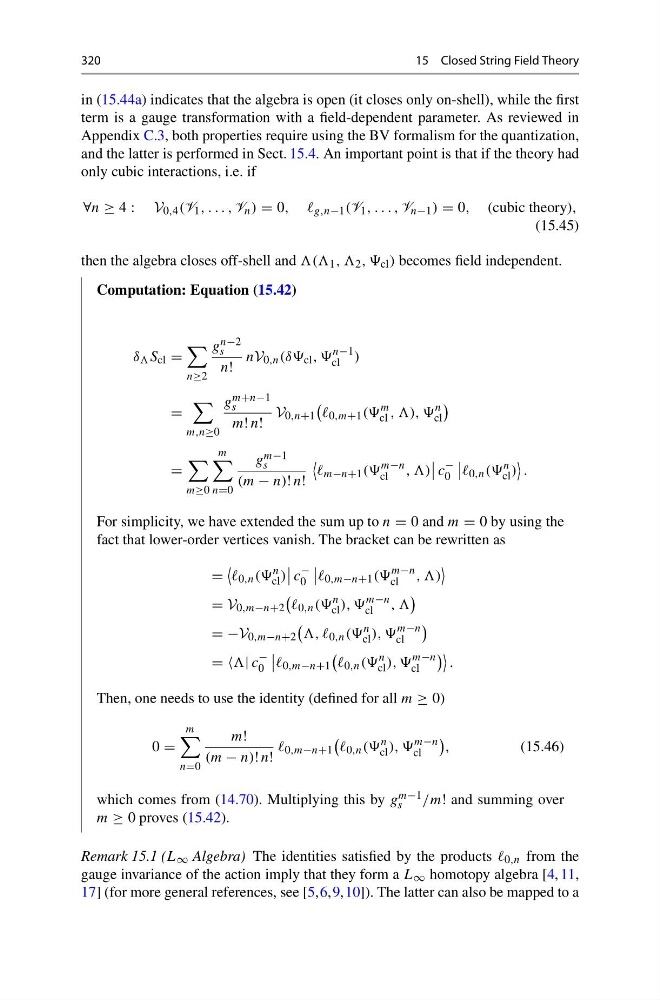
Computation: Equation (15.42)
δ S cl =
n≥2
g n−2
s
n!
nV 0,n (δδ cl , ,
n−1
cl )
=
m,n≥0
g m+n−1
s
m! n!
V 0,n+1
0,m+1 ((
m
cl , ,), ,
n
cl
=
m≥0
m
n=0
g m−1
s
(m − n)! n!
m−n+1 ((
m−n
cl
, ,)
c
−
0
0,n ((
n
cl )
.
For simplicity, we have extended the sum up to n = 0 and m = 0 by using the
fact that lower-order vertices vanish. The bracket can be rewritten as
=
0,n ((
n
cl )
c
−
0
0,m−n+1 ((
m−n
cl
, ,)
= V 0,m−n+2
0,n ((
n
cl ), ,
m−n
cl
, ,
= −V 0,m−n+2
, , 0,n ((
n
cl ), ,
m−n
cl
= | c
−
0
0,m−n+1
0,n ((
n
cl ), ,
m−n
cl
.
Then, one needs to use the identity (defined for all m ≥ 0)
0 =
m
n=0
m!
(m − n)! n!
0,m−n+1
0,n ((
n
cl ), ,
m−n
cl
,
(15.46)
which comes from (14.70). Multiplying this by g m−1
s
/m! and summing over
m ≥ 0 proves (15.42).
Remark 15.1 (L ∞ Algebra) The identities satisfied by the products 0,n from the
gauge invariance of the action imply that they form a L ∞ homotopy algebra [4, 11,
17] (for more general references, see [5,6,9,10]). The latter can also be mapped to a
15 Closed String Field Theory
in (15.44a) indicates that the algebra is open (it closes only on-shell), while the first
term is a gauge transformation with a field-dependent parameter. As reviewed in
Appendix C.3, both properties require using the BV formalism for the quantization,
and the latter is performed in Sect. 15.4. An important point is that if the theory had
only cubic interactions, i.e. if
∀n ≥ 4 : V 0,4 (V 1 , . . . , V n ) = 0, , g,n−1 (V 1 , . . . , V n−1 ) = 0, (cubic theory),
(15.45)
then the algebra closes off-shell and (( 1 , , 2 , , cl ) becomes field independent.
Computation: Equation (15.42)
δ S cl =
n≥2
g n−2
s
n!
nV 0,n (δδ cl , ,
n−1
cl )
=
m,n≥0
g m+n−1
s
m! n!
V 0,n+1
0,m+1 ((
m
cl , ,), ,
n
cl
=
m≥0
m
n=0
g m−1
s
(m − n)! n!
m−n+1 ((
m−n
cl
, ,)
c
−
0
0,n ((
n
cl )
.
For simplicity, we have extended the sum up to n = 0 and m = 0 by using the
fact that lower-order vertices vanish. The bracket can be rewritten as
=
0,n ((
n
cl )
c
−
0
0,m−n+1 ((
m−n
cl
, ,)
= V 0,m−n+2
0,n ((
n
cl ), ,
m−n
cl
, ,
= −V 0,m−n+2
, , 0,n ((
n
cl ), ,
m−n
cl
= | c
−
0
0,m−n+1
0,n ((
n
cl ), ,
m−n
cl
.
Then, one needs to use the identity (defined for all m ≥ 0)
0 =
m
n=0
m!
(m − n)! n!
0,m−n+1
0,n ((
n
cl ), ,
m−n
cl
,
(15.46)
which comes from (14.70). Multiplying this by g m−1
s
/m! and summing over
m ≥ 0 proves (15.42).
Remark 15.1 (L ∞ Algebra) The identities satisfied by the products 0,n from the
gauge invariance of the action imply that they form a L ∞ homotopy algebra [4, 11,
17] (for more general references, see [5,6,9,10]). The latter can also be mapped to a