

318
15 Closed String Field Theory
15.3 Classical Gauge Invariant Theory
In the previous section, we have found the gauge fixed action (15.24). Since
the complete gauge invariant quantum action has a complicated structure, it is
instructive to first focus on the classical action (15.29). The full action is discussed
in Sect. 15.4.
The gauge fixing is removed by relaxing the b
+
0 = 0 constraint on the field (the
other constraints must be kept in order to have well-defined the interactions). The
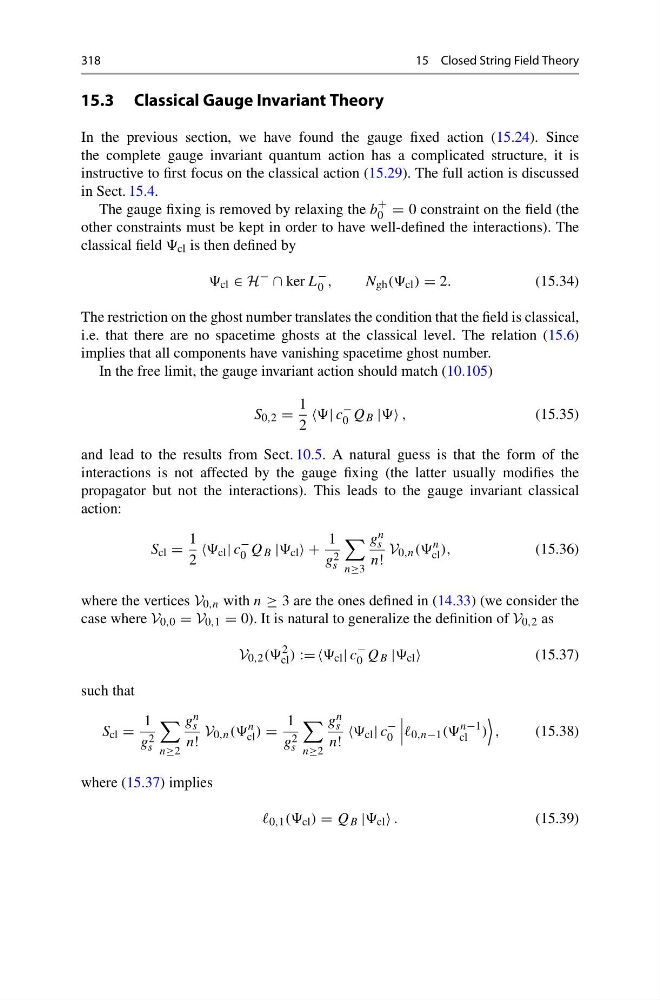
classical field cl is then defined by
cl ∈ H
−
∩ ker L
−
0 ,
N gh (( cl ) = 2.
(15.34)
The restriction on the ghost number translates the condition that the field is classical,
i.e. that there are no spacetime ghosts at the classical level. The relation (15.6)
implies that all components have vanishing spacetime ghost number.
In the free limit, the gauge invariant action should match (10.105)
S 0,2 =
1
2
| c
−
0 Q B | ,
(15.35)
and lead to the results from Sect. 10.5. A natural guess is that the form of the
interactions is not affected by the gauge fixing (the latter usually modifies the
propagator but not the interactions). This leads to the gauge invariant classical
action:
S cl =
1
2
cl | c
−
0 Q B | cl +
1
g 2
s
n≥3
g n
s
n!
V 0,n ((
n
cl ),
(15.36)
where the vertices V 0,n with n ≥ 3 are the ones defined in (14.33) (we consider the
case where V 0,0 = V 0,1 = 0). It is natural to generalize the definition of V 0,2 as
V 0,2 ((
2
cl ) := = cl | c
−
0 Q B | cl
(15.37)
such that
S cl =
1
g 2
s
n≥2
g n
s
n!
V 0,n ((
n
cl ) =
1
g 2
s
n≥2
g n
s
n!
cl | c
−
0
0,n−1((
n−1
cl )
,
(15.38)
where (15.37) implies
0,1 (( cl ) = Q B | cl .
(15.39)
15 Closed String Field Theory
15.3 Classical Gauge Invariant Theory
In the previous section, we have found the gauge fixed action (15.24). Since
the complete gauge invariant quantum action has a complicated structure, it is
instructive to first focus on the classical action (15.29). The full action is discussed
in Sect. 15.4.
The gauge fixing is removed by relaxing the b
+
0 = 0 constraint on the field (the
other constraints must be kept in order to have well-defined the interactions). The
classical field cl is then defined by
cl ∈ H
−
∩ ker L
−
0 ,
N gh (( cl ) = 2.
(15.34)
The restriction on the ghost number translates the condition that the field is classical,
i.e. that there are no spacetime ghosts at the classical level. The relation (15.6)
implies that all components have vanishing spacetime ghost number.
In the free limit, the gauge invariant action should match (10.105)
S 0,2 =
1
2
| c
−
0 Q B | ,
(15.35)
and lead to the results from Sect. 10.5. A natural guess is that the form of the
interactions is not affected by the gauge fixing (the latter usually modifies the
propagator but not the interactions). This leads to the gauge invariant classical
action:
S cl =
1
2
cl | c
−
0 Q B | cl +
1
g 2
s
n≥3
g n
s
n!
V 0,n ((
n
cl ),
(15.36)
where the vertices V 0,n with n ≥ 3 are the ones defined in (14.33) (we consider the
case where V 0,0 = V 0,1 = 0). It is natural to generalize the definition of V 0,2 as
V 0,2 ((
2
cl ) := = cl | c
−
0 Q B | cl
(15.37)
such that
S cl =
1
g 2
s
n≥2
g n
s
n!
V 0,n ((
n
cl ) =
1
g 2
s
n≥2
g n
s
n!
cl | c
−
0
0,n−1((
n−1
cl )
,
(15.38)
where (15.37) implies
0,1 (( cl ) = Q B | cl .
(15.39)