

240
11 Introduction to Off-Shell String Theory
This shows that the propagator can be rewritten as
= −
2b 0 ¯
b 0
L 0 + ¯
L 0
δ L 0 , ¯
L 0
=
b
+
0
L
+
0
b
−
0 δ L
−
0 ,0 ,
(11.20)
where L
±
0 = L 0 ± ¯
L 0 and b
±
0 = b 0 ± ¯
b 0 . The sign is added by anticipating
the normalization to be derived later. Its properties will be studied in detail in
Sect. 14.2.2.
Taking the basis states φ r := φ α (k) to be eigenstates of L 0 and ¯
L 0
L 0 |φ α (k) = ¯
L 0 |φ α (k) =
α
4
(k
2
+ m
2
α ) |φ α (k)
(11.21)
allows to rewrite the last term of F
(s)
0,4 as
αβ (k) =
d 2 q
|q| 2
φ
c
α (k)q
L 0 ¯
q
¯
L 0 b 0 ¯
b 0 φ
c
β (−k)
=
M αβ (k)
k 2 + m 2
α
.
(11.22)
The finite-dimensional matrix M αβ gives the overlap of states of identical masses:
M αβ (k) :=
2
α φ
c
α (k)| b
+
0 b
−
0 |φ
c
β (−k) .
(11.23)
The propagator depends only on one momentum because k|k ∼ δ (D) (k − k ).
This is exactly the standard propagator one finds in QFT, and this justifies the above
claim. The contribution F
(s)
0,4 to the amplitude can be seen as a s-channel Feynman
graph obtained by gluing two cubic fundamental vertices with a propagator. We will
see later the interpretation in terms of Riemann surfaces.
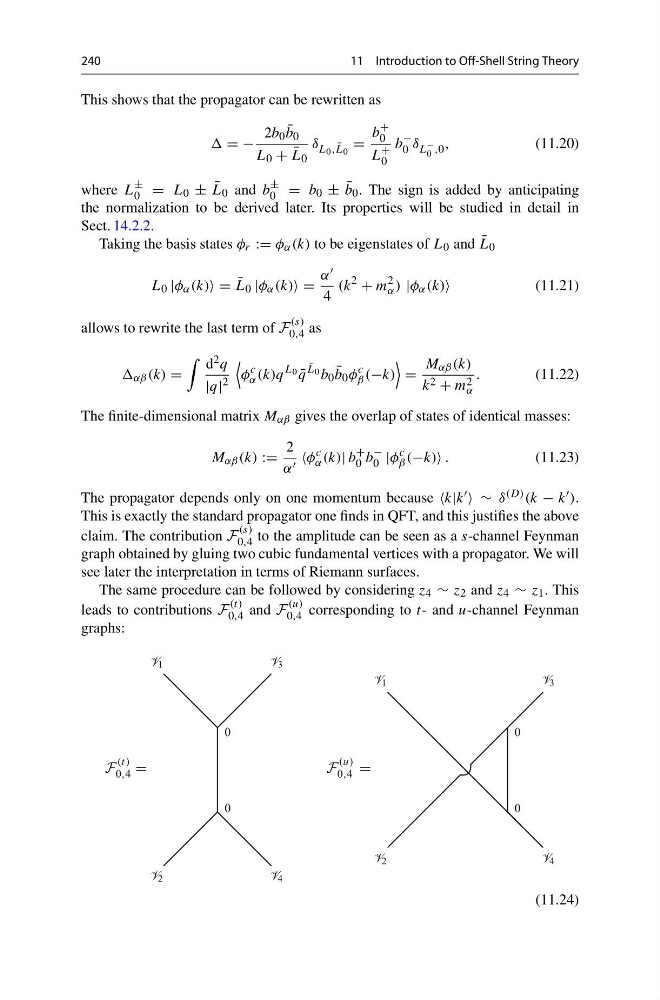
The same procedure can be followed by considering z 4 ∼ z 2 and z 4 ∼ z 1 . This
leads to contributions F
(t)
0,4 and F
(u)
0,4 corresponding to t- and u-channel Feynman
graphs:
0
0
0
0
F
(u)
0,4
F
(t )
0,4 =
=
1
3
2
4
2
4
1
3
(11.24)
11 Introduction to Off-Shell String Theory
This shows that the propagator can be rewritten as
= −
2b 0 ¯
b 0
L 0 + ¯
L 0
δ L 0 , ¯
L 0
=
b
+
0
L
+
0
b
−
0 δ L
−
0 ,0 ,
(11.20)
where L
±
0 = L 0 ± ¯
L 0 and b
±
0 = b 0 ± ¯
b 0 . The sign is added by anticipating
the normalization to be derived later. Its properties will be studied in detail in
Sect. 14.2.2.
Taking the basis states φ r := φ α (k) to be eigenstates of L 0 and ¯
L 0
L 0 |φ α (k) = ¯
L 0 |φ α (k) =
α
4
(k
2
+ m
2
α ) |φ α (k)
(11.21)
allows to rewrite the last term of F
(s)
0,4 as
αβ (k) =
d 2 q
|q| 2
φ
c
α (k)q
L 0 ¯
q
¯
L 0 b 0 ¯
b 0 φ
c
β (−k)
=
M αβ (k)
k 2 + m 2
α
.
(11.22)
The finite-dimensional matrix M αβ gives the overlap of states of identical masses:
M αβ (k) :=
2
α φ
c
α (k)| b
+
0 b
−
0 |φ
c
β (−k) .
(11.23)
The propagator depends only on one momentum because k|k ∼ δ (D) (k − k ).
This is exactly the standard propagator one finds in QFT, and this justifies the above
claim. The contribution F
(s)
0,4 to the amplitude can be seen as a s-channel Feynman
graph obtained by gluing two cubic fundamental vertices with a propagator. We will
see later the interpretation in terms of Riemann surfaces.
The same procedure can be followed by considering z 4 ∼ z 2 and z 4 ∼ z 1 . This
leads to contributions F
(t)
0,4 and F
(u)
0,4 corresponding to t- and u-channel Feynman
graphs:
0
0
0
0
F
(u)
0,4
F
(t )
0,4 =
=
1
3
2
4
2
4
1
3
(11.24)