

11.1 Motivations
239
This expression is more satisfactory because all vertex operators are accompanied
with c ghost insertions and none of the arguments are integrated over. But, in fact,
even better can be achieved.
Inserting two complete sets of states {φ r } (see Sect. 11.2) inside this expression
gives (restoring a generic z 3 -dependence):
F
(s)
0,4 = =c ¯
cV 1 (z 1 )c ¯
cV 2 (z 2 )φ r (0) c ¯
cV 3 (z 3 )c ¯
cV 4 (y 4 )φ s (0)
×
d 2 q
|q| 2
φ
c
r q
L 0 ¯
q
¯
L 0 b 0 ¯
b 0 φ
c
s
,
(11.15)
where the sum over r and s is implicit. The conjugate states φ c
r are defined by
φ c
r |φ s = δ rs . The first two terms are cubic interactions (11.8), and the last term
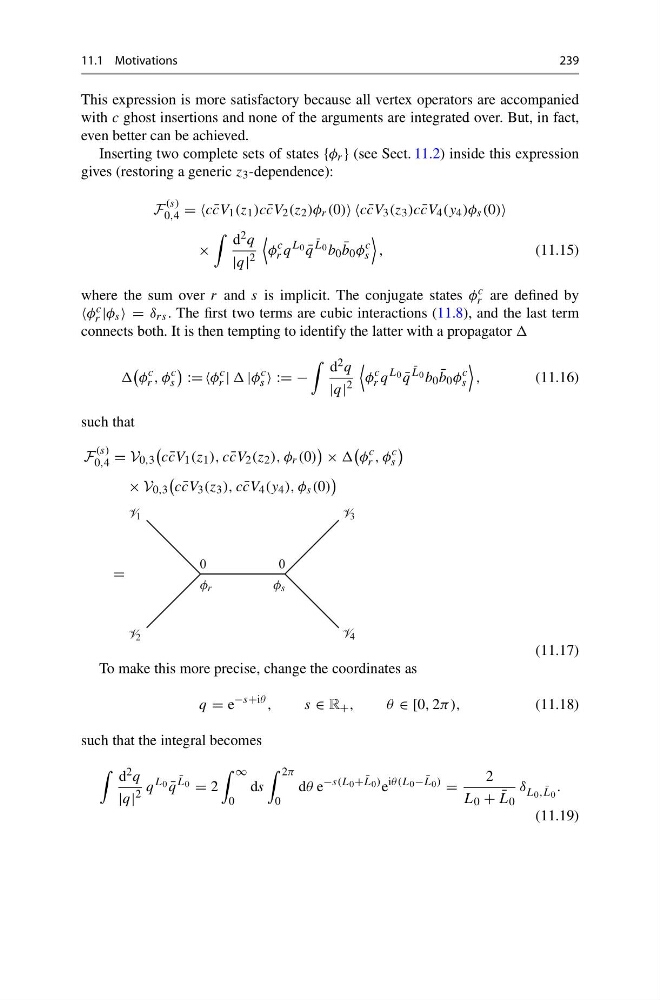
connects both. It is then tempting to identify the latter with a propagator
φ
c
r , φ
c
s
:= =φ
c
r | |φ
c
s := −
d 2 q
|q| 2
φ
c
r q
L 0 ¯
q
¯
L 0 b 0 ¯
b 0 φ
c
s
,
(11.16)
such that
F
(s)
0,4 = V 0,3
c ¯
cV 1 (z 1 ), c ¯
cV 2 (z 2 ), φ r (0)
×
φ
c
r , φ
c
s
× V 0,3
c ¯
cV 3 (z 3 ), c ¯
cV 4 (y 4 ), φ s (0)
φ s
φ r
0
0
=
2
4
3
1
(11.17)
To make this more precise, change the coordinates as
q = e
−s+iθ ,
s ∈ R + ,
θ ∈ [0, 2π),
(11.18)
such that the integral becomes
d 2 q
|q| 2 q
L 0 ¯
q
¯
L 0 = 2
∞
0
ds
2π
0
dθ e
−s(L 0 + ¯
L 0 ) e
iθ(L 0 − ¯
L 0 )
=
2
L 0 + ¯
L 0
δ L 0 , ¯
L 0
.
(11.19)
239
This expression is more satisfactory because all vertex operators are accompanied
with c ghost insertions and none of the arguments are integrated over. But, in fact,
even better can be achieved.
Inserting two complete sets of states {φ r } (see Sect. 11.2) inside this expression
gives (restoring a generic z 3 -dependence):
F
(s)
0,4 = =c ¯
cV 1 (z 1 )c ¯
cV 2 (z 2 )φ r (0) c ¯
cV 3 (z 3 )c ¯
cV 4 (y 4 )φ s (0)
×
d 2 q
|q| 2
φ
c
r q
L 0 ¯
q
¯
L 0 b 0 ¯
b 0 φ
c
s
,
(11.15)
where the sum over r and s is implicit. The conjugate states φ c
r are defined by
φ c
r |φ s = δ rs . The first two terms are cubic interactions (11.8), and the last term
connects both. It is then tempting to identify the latter with a propagator
φ
c
r , φ
c
s
:= =φ
c
r | |φ
c
s := −
d 2 q
|q| 2
φ
c
r q
L 0 ¯
q
¯
L 0 b 0 ¯
b 0 φ
c
s
,
(11.16)
such that
F
(s)
0,4 = V 0,3
c ¯
cV 1 (z 1 ), c ¯
cV 2 (z 2 ), φ r (0)
×
φ
c
r , φ
c
s
× V 0,3
c ¯
cV 3 (z 3 ), c ¯
cV 4 (y 4 ), φ s (0)
φ s
φ r
0
0
=
2
4
3
1
(11.17)
To make this more precise, change the coordinates as
q = e
−s+iθ ,
s ∈ R + ,
θ ∈ [0, 2π),
(11.18)
such that the integral becomes
d 2 q
|q| 2 q
L 0 ¯
q
¯
L 0 = 2
∞
0
ds
2π
0
dθ e
−s(L 0 + ¯
L 0 ) e
iθ(L 0 − ¯
L 0 )
=
2
L 0 + ¯
L 0
δ L 0 , ¯
L 0
.
(11.19)