

238
11 Introduction to Off-Shell String Theory
corresponding to collisions of punctures in the integration process. Moreover,
the expression does not look symmetric: it would be more satisfactory if all the
insertions were accompanied by ghost insertions and if all the puncture locations
were treated on an equal footing.
Example 11.1: Tachyons
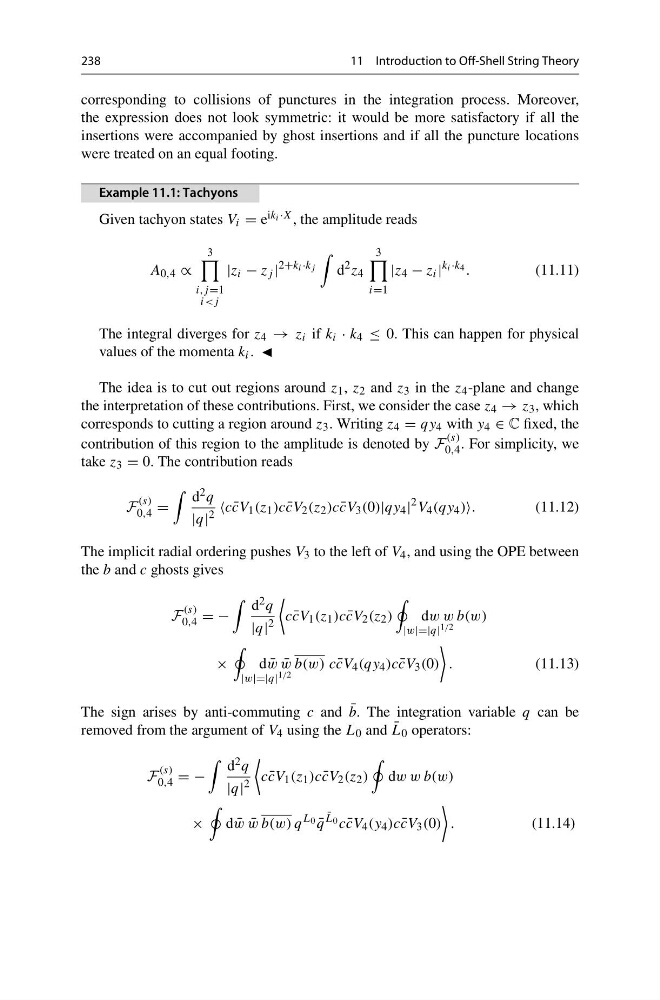
Given tachyon states V i = e ik i ·X , the amplitude reads
A 0,4 ∝
3
i,j =1
i
2+k i ·k j
d
2 z 4
3
i=1
|z 4 − z i |
k i ·k 4 .
(11.11)
The integral diverges for z 4 → z i if k i · k 4 ≤ 0. This can happen for physical
values of the momenta k i .
The idea is to cut out regions around z 1 , z 2 and z 3 in the z 4 -plane and change
the interpretation of these contributions. First, we consider the case z 4 → z 3 , which
corresponds to cutting a region around z 3 . Writing z 4 = qy 4 with y 4 ∈ C fixed, the
contribution of this region to the amplitude is denoted by F
(s)
0,4 . For simplicity, we
take z 3 = 0. The contribution reads
F
(s)
0,4 =
d 2 q
|q| 2 c ¯
cV 1 (z 1 )c ¯
cV 2 (z 2 )c ¯
cV 3 (0)|qy 4 |
2 V 4 (qy 4 ).
(11.12)
The implicit radial ordering pushes V 3 to the left of V 4 , and using the OPE between
the b and c ghosts gives
F
(s)
0,4 = −
d 2 q
|q| 2
c ¯
cV 1 (z 1 )c ¯
cV 2 (z 2 )
|w|=|q| 1/2
dw w b(w)
×
|w|=|q| 1/2
d ¯
w ¯
w b(w) c ¯
cV 4 (qy 4 )c ¯
cV 3 (0)
.
(11.13)
The sign arises by anti-commuting c and ¯
b. The integration variable q can be
removed from the argument of V 4 using the L 0 and ¯
L 0 operators:
F
(s)
0,4 = −
d 2 q
|q| 2
c ¯
cV 1 (z 1 )c ¯
cV 2 (z 2 )
dw w b(w)
×
d ¯
w ¯
w b(w) q
L 0 ¯
q
¯
L 0 c ¯
cV 4 (y 4 )c ¯
cV 3 (0)
.
(11.14)
11 Introduction to Off-Shell String Theory
corresponding to collisions of punctures in the integration process. Moreover,
the expression does not look symmetric: it would be more satisfactory if all the
insertions were accompanied by ghost insertions and if all the puncture locations
were treated on an equal footing.
Example 11.1: Tachyons
Given tachyon states V i = e ik i ·X , the amplitude reads
A 0,4 ∝
3
i,j =1
i
2+k i ·k j
d
2 z 4
3
i=1
|z 4 − z i |
k i ·k 4 .
(11.11)
The integral diverges for z 4 → z i if k i · k 4 ≤ 0. This can happen for physical
values of the momenta k i .
The idea is to cut out regions around z 1 , z 2 and z 3 in the z 4 -plane and change
the interpretation of these contributions. First, we consider the case z 4 → z 3 , which
corresponds to cutting a region around z 3 . Writing z 4 = qy 4 with y 4 ∈ C fixed, the
contribution of this region to the amplitude is denoted by F
(s)
0,4 . For simplicity, we
take z 3 = 0. The contribution reads
F
(s)
0,4 =
d 2 q
|q| 2 c ¯
cV 1 (z 1 )c ¯
cV 2 (z 2 )c ¯
cV 3 (0)|qy 4 |
2 V 4 (qy 4 ).
(11.12)
The implicit radial ordering pushes V 3 to the left of V 4 , and using the OPE between
the b and c ghosts gives
F
(s)
0,4 = −
d 2 q
|q| 2
c ¯
cV 1 (z 1 )c ¯
cV 2 (z 2 )
|w|=|q| 1/2
dw w b(w)
×
|w|=|q| 1/2
d ¯
w ¯
w b(w) c ¯
cV 4 (qy 4 )c ¯
cV 3 (0)
.
(11.13)
The sign arises by anti-commuting c and ¯
b. The integration variable q can be
removed from the argument of V 4 using the L 0 and ¯
L 0 operators:
F
(s)
0,4 = −
d 2 q
|q| 2
c ¯
cV 1 (z 1 )c ¯
cV 2 (z 2 )
dw w b(w)
×
d ¯
w ¯
w b(w) q
L 0 ¯
q
¯
L 0 c ¯
cV 4 (y 4 )c ¯
cV 3 (0)
.
(11.14)