

11.1 Motivations
237
from which we get
f
i −→
f
i
(cf i + d) 2 ,
f i − f j −→
f i − f j
(cf i + d)(cf j + d)
.
(11.7)
All together, this implies the invariance of the 3-point amplitude since the factors in
the denominator cancel. When the states are on-shell h i = 0, the dependence in the
local coordinate cancels, showing that the latter is non-physical.
One can ask how Feynman graphs can be constructed in string theory. By
definition, the amplitude is the sum of Feynman graphs contributing at that order in
the loop expansion and for the given number of external legs. The Feynman graphs
are themselves built from a set of Feynman rules. These correspond to the data of
the fundamental interactions together with the definition of a propagator. Since a
tree-level cubic interaction is the interaction of the lowest order, it makes sense to
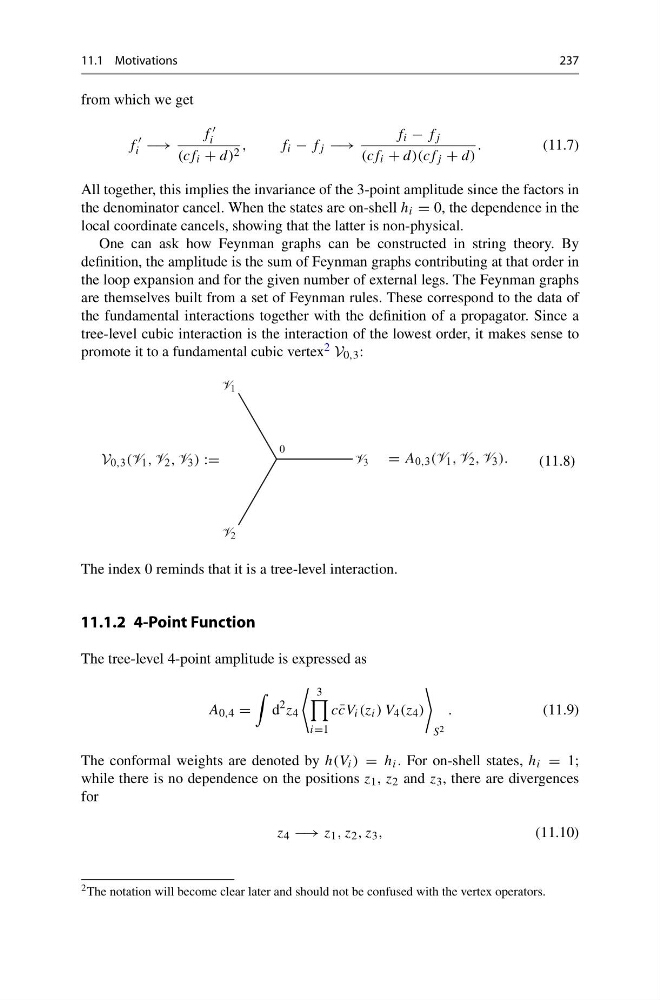
promote it to a fundamental cubic vertex 2 V 0,3 :
(11.8)
The index 0 reminds that it is a tree-level interaction.
11.1.2 4-Point Function
The tree-level 4-point amplitude is expressed as
A 0,4 =
d
2 z 4
3
i=1
c ¯
cV i (z i ) V 4 (z 4 )
S 2
.
(11.9)
The conformal weights are denoted by h(V i ) = h i . For on-shell states, h i = 1;
while there is no dependence on the positions z 1 , z 2 and z 3 , there are divergences
for
z 4 −→ z 1 , z 2 , z 3 ,
(11.10)
2 The notation will become clear later and should not be confused with the vertex operators.
237
from which we get
f
i −→
f
i
(cf i + d) 2 ,
f i − f j −→
f i − f j
(cf i + d)(cf j + d)
.
(11.7)
All together, this implies the invariance of the 3-point amplitude since the factors in
the denominator cancel. When the states are on-shell h i = 0, the dependence in the
local coordinate cancels, showing that the latter is non-physical.
One can ask how Feynman graphs can be constructed in string theory. By
definition, the amplitude is the sum of Feynman graphs contributing at that order in
the loop expansion and for the given number of external legs. The Feynman graphs
are themselves built from a set of Feynman rules. These correspond to the data of
the fundamental interactions together with the definition of a propagator. Since a
tree-level cubic interaction is the interaction of the lowest order, it makes sense to
promote it to a fundamental cubic vertex 2 V 0,3 :
(11.8)
The index 0 reminds that it is a tree-level interaction.
11.1.2 4-Point Function
The tree-level 4-point amplitude is expressed as
A 0,4 =
d
2 z 4
3
i=1
c ¯
cV i (z i ) V 4 (z 4 )
S 2
.
(11.9)
The conformal weights are denoted by h(V i ) = h i . For on-shell states, h i = 1;
while there is no dependence on the positions z 1 , z 2 and z 3 , there are divergences
for
z 4 −→ z 1 , z 2 , z 3 ,
(11.10)
2 The notation will become clear later and should not be confused with the vertex operators.