

236
11 Introduction to Off-Shell String Theory
invariant under conformal transformations (6.38):
z −→ f g (z) =
az + b
cz + d
∈ SL(2, C)
(11.2)
(it transforms covariantly). This is a consequence of the punctures: the presence of
the latter modifies locally the metric, since they act as sources of negative curvature.
When performing a conformal transformation, the metric around the punctures
changes in a different way as away from them. This implies that the final result
depends on the metric chosen around the punctures. This looks puzzling because
the original path integral derivation (Chap. 3) indicates that the 3-point amplitude
should not depend on the locations of the operators because its moduli space is
empty (hence, all choices of z i should be equivalent).
The solution is to introduce local coordinates w i with a flat metric |dw i |
2 around
each puncture conventionally located at w i = 0. The local coordinates are defined
by the maps:
z = f i (w i ),
z i = f i (0).
(11.3)
This is also useful to characterize in a simpler way the dependence of off-shell
amplitudes rather than using the metric around the punctures (computations may be
more difficult with a general metric).
The expression of a local operator in the local coordinate system is found by
applying the corresponding change of coordinates (6.48):
f ◦ V (w) = f
(w)
h f (w)
¯
h V
f (w)
.
(11.4)
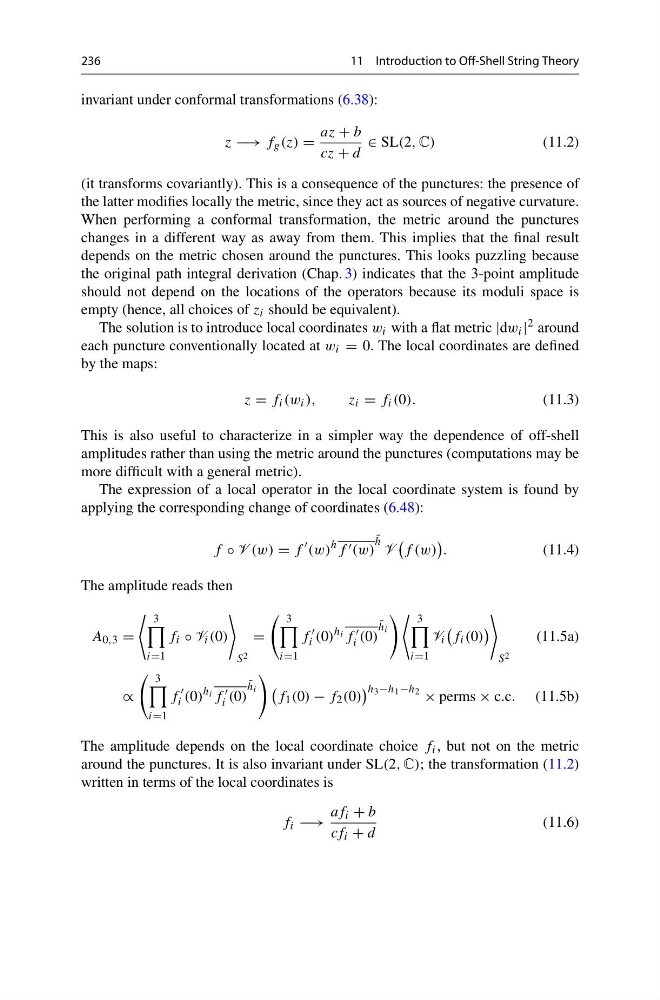
The amplitude reads then
A 0,3 =
3
i=1
f i ◦ V i (0)
S 2
=
3
i=1
f
i (0)
h i f
i (0)
¯
h i
3
i=1
V i
f i (0)
S 2
(11.5a)
∝
3
i=1
f
i (0)
h i f
i (0)
¯
h i
f 1 (0) − f 2 (0)
h 3 −h 1 −h 2 × perms × c.c. (11.5b)
The amplitude depends on the local coordinate choice f i , but not on the metric
around the punctures. It is also invariant under SL(2, C); the transformation (11.2)
written in terms of the local coordinates is
f i −→
af i + b
cf i + d
(11.6)
11 Introduction to Off-Shell String Theory
invariant under conformal transformations (6.38):
z −→ f g (z) =
az + b
cz + d
∈ SL(2, C)
(11.2)
(it transforms covariantly). This is a consequence of the punctures: the presence of
the latter modifies locally the metric, since they act as sources of negative curvature.
When performing a conformal transformation, the metric around the punctures
changes in a different way as away from them. This implies that the final result
depends on the metric chosen around the punctures. This looks puzzling because
the original path integral derivation (Chap. 3) indicates that the 3-point amplitude
should not depend on the locations of the operators because its moduli space is
empty (hence, all choices of z i should be equivalent).
The solution is to introduce local coordinates w i with a flat metric |dw i |
2 around
each puncture conventionally located at w i = 0. The local coordinates are defined
by the maps:
z = f i (w i ),
z i = f i (0).
(11.3)
This is also useful to characterize in a simpler way the dependence of off-shell
amplitudes rather than using the metric around the punctures (computations may be
more difficult with a general metric).
The expression of a local operator in the local coordinate system is found by
applying the corresponding change of coordinates (6.48):
f ◦ V (w) = f
(w)
h f (w)
¯
h V
f (w)
.
(11.4)
The amplitude reads then
A 0,3 =
3
i=1
f i ◦ V i (0)
S 2
=
3
i=1
f
i (0)
h i f
i (0)
¯
h i
3
i=1
V i
f i (0)
S 2
(11.5a)
∝
3
i=1
f
i (0)
h i f
i (0)
¯
h i
f 1 (0) − f 2 (0)
h 3 −h 1 −h 2 × perms × c.c. (11.5b)
The amplitude depends on the local coordinate choice f i , but not on the metric
around the punctures. It is also invariant under SL(2, C); the transformation (11.2)
written in terms of the local coordinates is
f i −→
af i + b
cf i + d
(11.6)