

11.2 Off-Shell States
241
In general, the sum of the three contributions F
(s,t,u)
0,4
does not reproduce the
full amplitude A 0,4 . Said differently, the regions cut in the z 4 -plane do not cover it
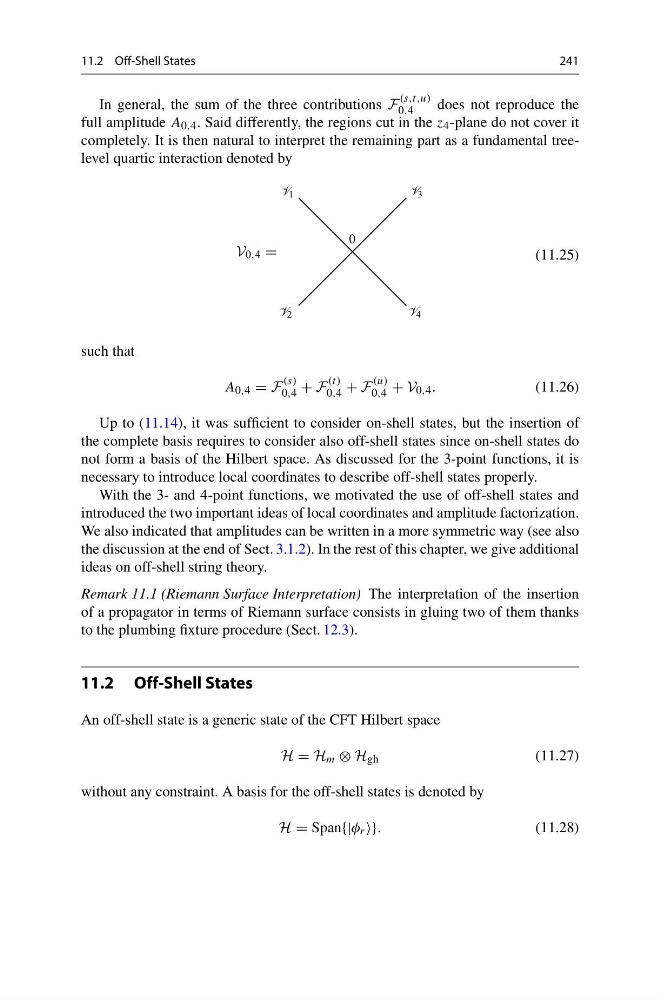
completely. It is then natural to interpret the remaining part as a fundamental treelevel quartic interaction denoted by
0
1
3
2
4
V 0,4 =
(11.25)
such that
A 0,4 = F
(s)
0,4 + F
(t)
0,4 + F
(u)
0,4 + V 0,4 .
(11.26)
Up to (11.14), it was sufficient to consider on-shell states, but the insertion of
the complete basis requires to consider also off-shell states since on-shell states do
not form a basis of the Hilbert space. As discussed for the 3-point functions, it is
necessary to introduce local coordinates to describe off-shell states properly.
With the 3- and 4-point functions, we motivated the use of off-shell states and
introduced the two important ideas of local coordinates and amplitude factorization.
We also indicated that amplitudes can be written in a more symmetric way (see also
the discussion at the end of Sect. 3.1.2). In the rest of this chapter, we give additional
ideas on off-shell string theory.
Remark 11.1 (Riemann Surface Interpretation) The interpretation of the insertion
of a propagator in terms of Riemann surface consists in gluing two of them thanks
to the plumbing fixture procedure (Sect. 12.3).
11.2 Off-Shell States
An off-shell state is a generic state of the CFT Hilbert space
H = H m ⊗ H gh
(11.27)
without any constraint. A basis for the off-shell states is denoted by
H = Span{|φ r }.
(11.28)
241
In general, the sum of the three contributions F
(s,t,u)
0,4
does not reproduce the
full amplitude A 0,4 . Said differently, the regions cut in the z 4 -plane do not cover it
completely. It is then natural to interpret the remaining part as a fundamental treelevel quartic interaction denoted by
0
1
3
2
4
V 0,4 =
(11.25)
such that
A 0,4 = F
(s)
0,4 + F
(t)
0,4 + F
(u)
0,4 + V 0,4 .
(11.26)
Up to (11.14), it was sufficient to consider on-shell states, but the insertion of
the complete basis requires to consider also off-shell states since on-shell states do
not form a basis of the Hilbert space. As discussed for the 3-point functions, it is
necessary to introduce local coordinates to describe off-shell states properly.
With the 3- and 4-point functions, we motivated the use of off-shell states and
introduced the two important ideas of local coordinates and amplitude factorization.
We also indicated that amplitudes can be written in a more symmetric way (see also
the discussion at the end of Sect. 3.1.2). In the rest of this chapter, we give additional
ideas on off-shell string theory.
Remark 11.1 (Riemann Surface Interpretation) The interpretation of the insertion
of a propagator in terms of Riemann surface consists in gluing two of them thanks
to the plumbing fixture procedure (Sect. 12.3).
11.2 Off-Shell States
An off-shell state is a generic state of the CFT Hilbert space
H = H m ⊗ H gh
(11.27)
without any constraint. A basis for the off-shell states is denoted by
H = Span{|φ r }.
(11.28)