

228
10 Free BRST String Field Theory
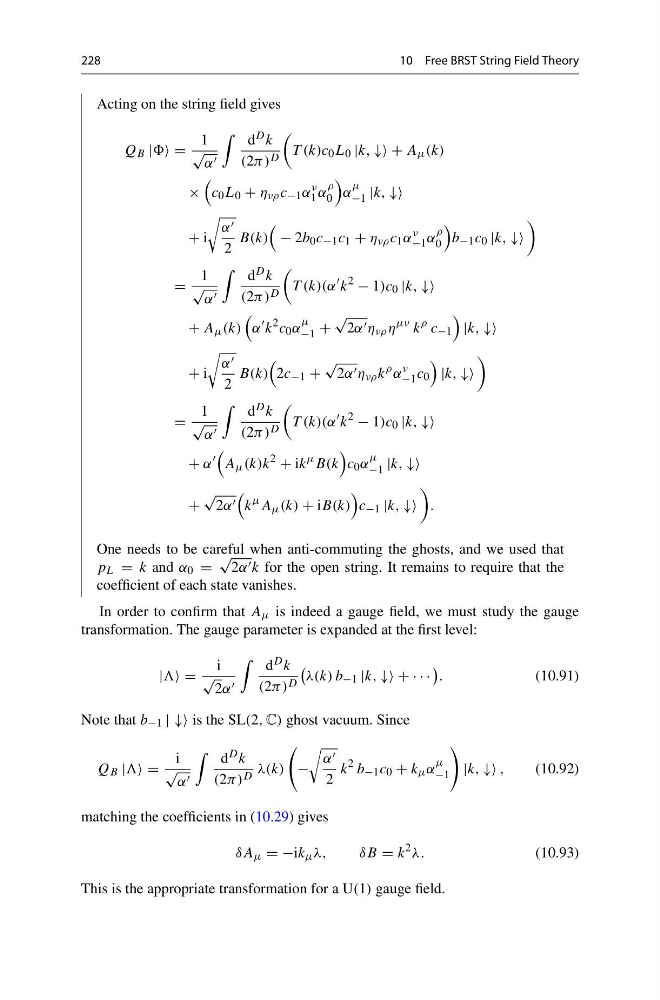
Acting on the string field gives
Q B | =
1
√
α
d D k
(2π) D
T (k)c 0 L 0 |k, ↓↓ + A μ (k)
×
c 0 L 0 + η νρ c −1 α
ν
1 α
ρ
0
α
μ
−1 |k, ↓↓
+ i
α
2
B(k)
− 2b 0 c −1 c 1 + η νρ c 1 α
ν
−1 α
ρ
0
b −1 c 0 |k, ↓↓
=
1
√
α
d D k
(2π) D
T (k)(α
k
2
− 1)c 0 |k, ↓↓
+ A μ (k)
α
k
2 c 0 α
μ
−1 +
√
2α η νρ η
μν k
ρ c −1
|k, ↓↓
+ i
α
2
B(k)
2c −1 +
√
2α η νρ k
ρ α
ν
−1 c 0
|k, ↓↓
=
1
√
α
d D k
(2π) D
T (k)(α
k
2
− 1)c 0 |k, ↓↓
+ α
A μ (k)k
2
+ ik
μ B(k
c 0 α
μ
−1 |k, ↓↓
+
√
2α
k
μ A μ (k) + iB(k)
c −1 |k, ↓↓
.
One needs to be careful when anti-commuting the ghosts, and we used that
p L = k and α 0 =
√
2α k for the open string. It remains to require that the
coefficient of each state vanishes.
In order to confirm that A μ is indeed a gauge field, we must study the gauge
transformation. The gauge parameter is expanded at the first level:
| =
i
√
2α
d D k
(2π) D
λ(k) b −1 |k, ↓↓ + · · ·
.
(10.91)
Note that b −1 | ↓↓ is the SL(2, C) ghost vacuum. Since
Q B | =
i
√
α
d D k
(2π) D λ(k)
−
α
2
k
2 b −1 c 0 + k μ α
μ
−1
|k, ↓↓ ,
(10.92)
matching the coefficients in (10.29) gives
δA μ = −ik μ λ,
δB = k
2 λ.
(10.93)
This is the appropriate transformation for a U(1) gauge field.
10 Free BRST String Field Theory
Acting on the string field gives
Q B | =
1
√
α
d D k
(2π) D
T (k)c 0 L 0 |k, ↓↓ + A μ (k)
×
c 0 L 0 + η νρ c −1 α
ν
1 α
ρ
0
α
μ
−1 |k, ↓↓
+ i
α
2
B(k)
− 2b 0 c −1 c 1 + η νρ c 1 α
ν
−1 α
ρ
0
b −1 c 0 |k, ↓↓
=
1
√
α
d D k
(2π) D
T (k)(α
k
2
− 1)c 0 |k, ↓↓
+ A μ (k)
α
k
2 c 0 α
μ
−1 +
√
2α η νρ η
μν k
ρ c −1
|k, ↓↓
+ i
α
2
B(k)
2c −1 +
√
2α η νρ k
ρ α
ν
−1 c 0
|k, ↓↓
=
1
√
α
d D k
(2π) D
T (k)(α
k
2
− 1)c 0 |k, ↓↓
+ α
A μ (k)k
2
+ ik
μ B(k
c 0 α
μ
−1 |k, ↓↓
+
√
2α
k
μ A μ (k) + iB(k)
c −1 |k, ↓↓
.
One needs to be careful when anti-commuting the ghosts, and we used that
p L = k and α 0 =
√
2α k for the open string. It remains to require that the
coefficient of each state vanishes.
In order to confirm that A μ is indeed a gauge field, we must study the gauge
transformation. The gauge parameter is expanded at the first level:
| =
i
√
2α
d D k
(2π) D
λ(k) b −1 |k, ↓↓ + · · ·
.
(10.91)
Note that b −1 | ↓↓ is the SL(2, C) ghost vacuum. Since
Q B | =
i
√
α
d D k
(2π) D λ(k)
−
α
2
k
2 b −1 c 0 + k μ α
μ
−1
|k, ↓↓ ,
(10.92)
matching the coefficients in (10.29) gives
δA μ = −ik μ λ,
δB = k
2 λ.
(10.93)
This is the appropriate transformation for a U(1) gauge field.