

10.4 Spacetime Action
229
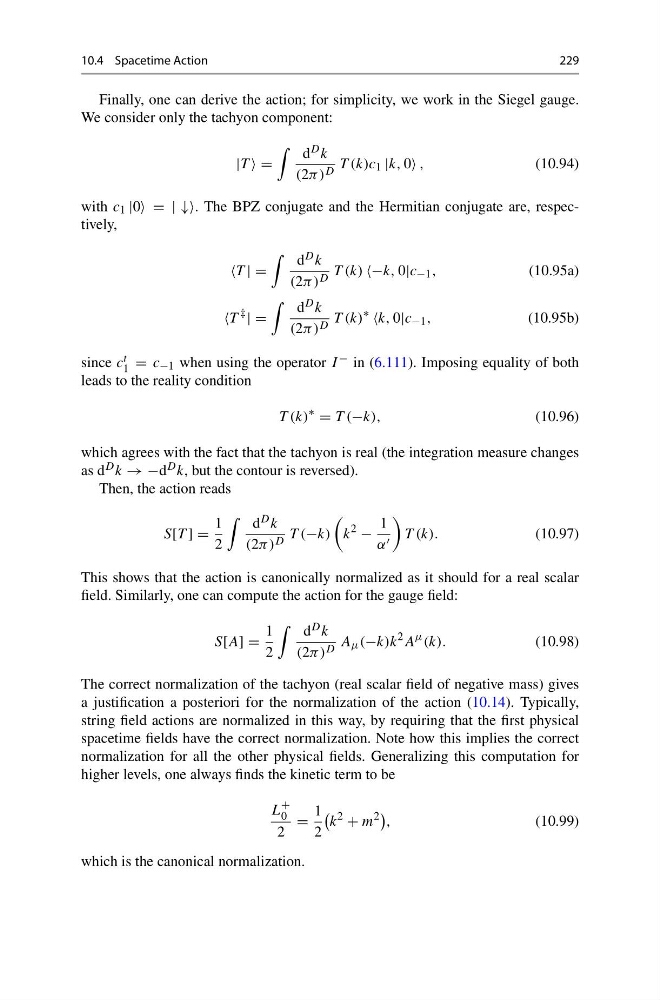
Finally, one can derive the action; for simplicity, we work in the Siegel gauge.
We consider only the tachyon component:
|T =
d D k
(2π) D T (k)c 1 |k, 0 ,
(10.94)
with c 1 |0 = | ↓↓. The BPZ conjugate and the Hermitian conjugate are, respectively,
T | =
d D k
(2π) D T (k) −k, 0|c −1 ,
(10.95a)
T
‡
| =
d D k
(2π) D T (k)
∗
k, 0|c −1 ,
(10.95b)
since c t
1 = c −1 when using the operator I − in (6.111). Imposing equality of both
leads to the reality condition
T (k)
∗
= T (−k),
(10.96)
which agrees with the fact that the tachyon is real (the integration measure changes
as d D k → −d D k, but the contour is reversed).
Then, the action reads
S[T ] =
1
2
d D k
(2π) D T (−k)
k
2
−
1
α
T (k).
(10.97)
This shows that the action is canonically normalized as it should for a real scalar
field. Similarly, one can compute the action for the gauge field:
S[A] =
1
2
d D k
(2π) D A μ (−k)k
2 A
μ (k).
(10.98)
The correct normalization of the tachyon (real scalar field of negative mass) gives
a justification a posteriori for the normalization of the action (10.14). Typically,
string field actions are normalized in this way, by requiring that the first physical
spacetime fields have the correct normalization. Note how this implies the correct
normalization for all the other physical fields. Generalizing this computation for
higher levels, one always finds the kinetic term to be
L
+
0
2
=
1
2
k
2
+ m
2
,
(10.99)
which is the canonical normalization.
229
Finally, one can derive the action; for simplicity, we work in the Siegel gauge.
We consider only the tachyon component:
|T =
d D k
(2π) D T (k)c 1 |k, 0 ,
(10.94)
with c 1 |0 = | ↓↓. The BPZ conjugate and the Hermitian conjugate are, respectively,
T | =
d D k
(2π) D T (k) −k, 0|c −1 ,
(10.95a)
T
‡
| =
d D k
(2π) D T (k)
∗
k, 0|c −1 ,
(10.95b)
since c t
1 = c −1 when using the operator I − in (6.111). Imposing equality of both
leads to the reality condition
T (k)
∗
= T (−k),
(10.96)
which agrees with the fact that the tachyon is real (the integration measure changes
as d D k → −d D k, but the contour is reversed).
Then, the action reads
S[T ] =
1
2
d D k
(2π) D T (−k)
k
2
−
1
α
T (k).
(10.97)
This shows that the action is canonically normalized as it should for a real scalar
field. Similarly, one can compute the action for the gauge field:
S[A] =
1
2
d D k
(2π) D A μ (−k)k
2 A
μ (k).
(10.98)
The correct normalization of the tachyon (real scalar field of negative mass) gives
a justification a posteriori for the normalization of the action (10.14). Typically,
string field actions are normalized in this way, by requiring that the first physical
spacetime fields have the correct normalization. Note how this implies the correct
normalization for all the other physical fields. Generalizing this computation for
higher levels, one always finds the kinetic term to be
L
+
0
2
=
1
2
k
2
+ m
2
,
(10.99)
which is the canonical normalization.