

7.1 Free Scalar
153
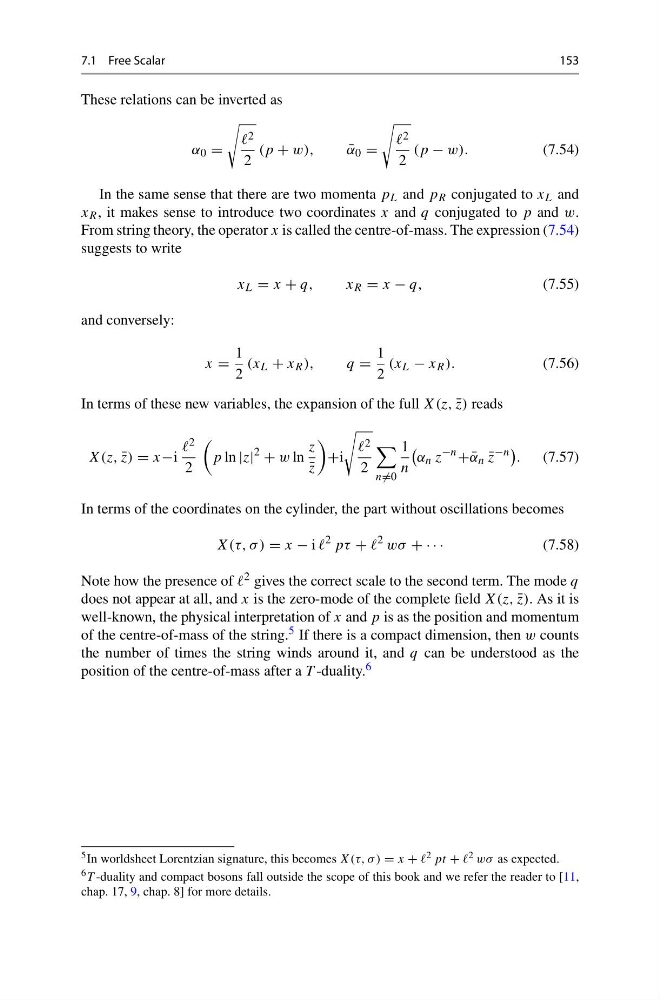
These relations can be inverted as
α 0 =
2
2
(p + w),
¯
α 0 =
2
2
(p − w).
(7.54)
In the same sense that there are two momenta p L and p R conjugated to x L and
x R , it makes sense to introduce two coordinates x and q conjugated to p and w.
From string theory, the operator x is called the centre-of-mass. The expression (7.54)
suggests to write
x L = x + q,
x R = x − q,
(7.55)
and conversely:
x =
1
2
(x L + x R ),
q =
1
2
(x L − x R ).
(7.56)
In terms of these new variables, the expansion of the full X(z, ¯
z) reads
X(z, ¯
z) = x−i
2
2
p ln |z|
2
+ w ln
z
¯
z
+i
2
2
n =0
1
n
α n z
−n
+ ¯
α n ¯
z
−n
.
(7.57)
In terms of the coordinates on the cylinder, the part without oscillations becomes
X(τ, σ ) = x − i
2 pτ +
2 wσ + · · ·
(7.58)
Note how the presence of 2 gives the correct scale to the second term. The mode q
does not appear at all, and x is the zero-mode of the complete field X(z, ¯
z). As it is
well-known, the physical interpretation of x and p is as the position and momentum
of the centre-of-mass of the string. 5 If there is a compact dimension, then w counts
the number of times the string winds around it, and q can be understood as the
position of the centre-of-mass after a T -duality. 6
5 In worldsheet Lorentzian signature, this becomes X(τ, σ ) = x + 2 pt + 2 wσ as expected.
6 T -duality and compact bosons fall outside the scope of this book and we refer the reader to [11,
chap. 17, 9, chap. 8] for more details.
153
These relations can be inverted as
α 0 =
2
2
(p + w),
¯
α 0 =
2
2
(p − w).
(7.54)
In the same sense that there are two momenta p L and p R conjugated to x L and
x R , it makes sense to introduce two coordinates x and q conjugated to p and w.
From string theory, the operator x is called the centre-of-mass. The expression (7.54)
suggests to write
x L = x + q,
x R = x − q,
(7.55)
and conversely:
x =
1
2
(x L + x R ),
q =
1
2
(x L − x R ).
(7.56)
In terms of these new variables, the expansion of the full X(z, ¯
z) reads
X(z, ¯
z) = x−i
2
2
p ln |z|
2
+ w ln
z
¯
z
+i
2
2
n =0
1
n
α n z
−n
+ ¯
α n ¯
z
−n
.
(7.57)
In terms of the coordinates on the cylinder, the part without oscillations becomes
X(τ, σ ) = x − i
2 pτ +
2 wσ + · · ·
(7.58)
Note how the presence of 2 gives the correct scale to the second term. The mode q
does not appear at all, and x is the zero-mode of the complete field X(z, ¯
z). As it is
well-known, the physical interpretation of x and p is as the position and momentum
of the centre-of-mass of the string. 5 If there is a compact dimension, then w counts
the number of times the string winds around it, and q can be understood as the
position of the centre-of-mass after a T -duality. 6
5 In worldsheet Lorentzian signature, this becomes X(τ, σ ) = x + 2 pt + 2 wσ as expected.
6 T -duality and compact bosons fall outside the scope of this book and we refer the reader to [11,
chap. 17, 9, chap. 8] for more details.