

152
7 CFT Systems
7.1.4 Mode Expansions
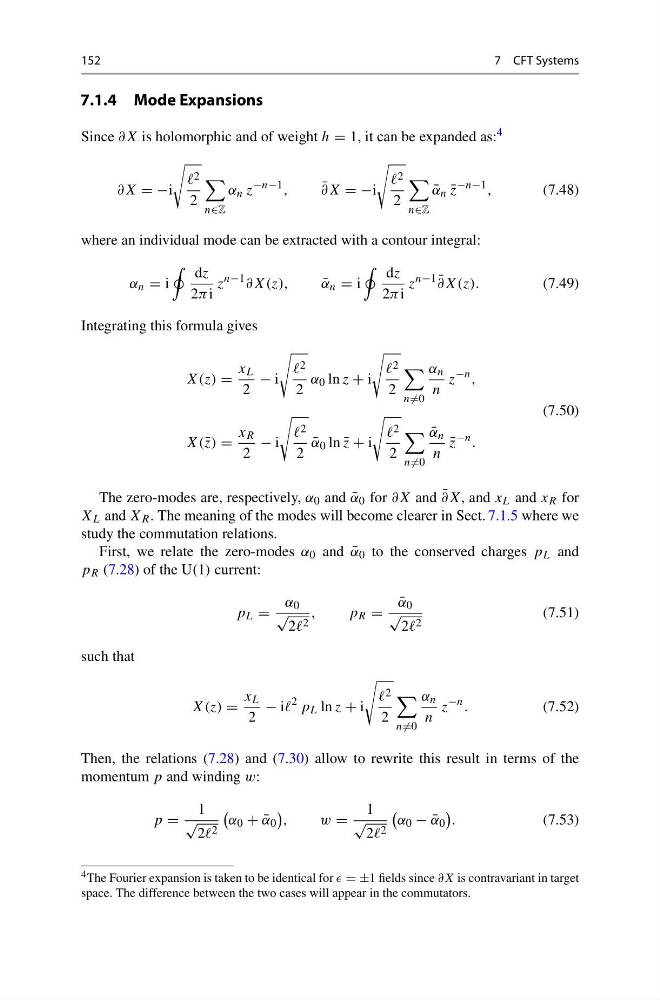
Since ∂X is holomorphic and of weight h = 1, it can be expanded as: 4
∂X = −i
2
2
n∈Z
α n z
−n−1 ,
¯
∂X = −i
2
2
n∈Z
¯
α n ¯
z
−n−1 ,
(7.48)
where an individual mode can be extracted with a contour integral:
α n = i
dz
2π i
z
n−1 ∂X(z),
¯
α n = i
dz
2π i
z
n−1 ¯
∂X(z).
(7.49)
Integrating this formula gives
X(z) =
x L
2
− i
2
2
α 0 ln z + i
2
2
n =0
α n
n
z
−n ,
X(¯ z) =
x R
2
− i
2
2
¯
α 0 ln ¯
z + i
2
2
n =0
¯
α n
n
¯
z
−n .
(7.50)
The zero-modes are, respectively, α 0 and ¯
α 0 for ∂X and ¯
∂X, and x L and x R for
X L and X R . The meaning of the modes will become clearer in Sect. 7.1.5 where we
study the commutation relations.
First, we relate the zero-modes α 0 and ¯
α 0 to the conserved charges p L and
p R (7.28) of the U(1) current:
p L =
α 0
√
2 2
,
p R =
¯
α 0
√
2 2
(7.51)
such that
X(z) =
x L
2
− i
2 p L ln z + i
2
2
n =0
α n
n
z
−n .
(7.52)
Then, the relations (7.28) and (7.30) allow to rewrite this result in terms of the
momentum p and winding w:
p =
1
√
2 2
α 0 + ¯
α 0
,
w=
1
√
2 2
α 0 − ¯
α 0
.
(7.53)
4 The Fourier expansion is taken to be identical for = ±1 fields since ∂X is contravariant in target
space. The difference between the two cases will appear in the commutators.
7 CFT Systems
7.1.4 Mode Expansions
Since ∂X is holomorphic and of weight h = 1, it can be expanded as: 4
∂X = −i
2
2
n∈Z
α n z
−n−1 ,
¯
∂X = −i
2
2
n∈Z
¯
α n ¯
z
−n−1 ,
(7.48)
where an individual mode can be extracted with a contour integral:
α n = i
dz
2π i
z
n−1 ∂X(z),
¯
α n = i
dz
2π i
z
n−1 ¯
∂X(z).
(7.49)
Integrating this formula gives
X(z) =
x L
2
− i
2
2
α 0 ln z + i
2
2
n =0
α n
n
z
−n ,
X(¯ z) =
x R
2
− i
2
2
¯
α 0 ln ¯
z + i
2
2
n =0
¯
α n
n
¯
z
−n .
(7.50)
The zero-modes are, respectively, α 0 and ¯
α 0 for ∂X and ¯
∂X, and x L and x R for
X L and X R . The meaning of the modes will become clearer in Sect. 7.1.5 where we
study the commutation relations.
First, we relate the zero-modes α 0 and ¯
α 0 to the conserved charges p L and
p R (7.28) of the U(1) current:
p L =
α 0
√
2 2
,
p R =
¯
α 0
√
2 2
(7.51)
such that
X(z) =
x L
2
− i
2 p L ln z + i
2
2
n =0
α n
n
z
−n .
(7.52)
Then, the relations (7.28) and (7.30) allow to rewrite this result in terms of the
momentum p and winding w:
p =
1
√
2 2
α 0 + ¯
α 0
,
w=
1
√
2 2
α 0 − ¯
α 0
.
(7.53)
4 The Fourier expansion is taken to be identical for = ±1 fields since ∂X is contravariant in target
space. The difference between the two cases will appear in the commutators.