

118
6 Conformal Field Theory on the Plane
choosing a normalization such that 1 = 1. The path integral defines the timeordered product (on the cylinder) of the corresponding operators.
Invariance under global transformations leads to strong constraints on the
correlation functions. For quasi-primary fields, they transform under SL(2, C) as
n
i=1
O i (z i , ¯
z i )
=
n
i=1
df
dz
(z i )
h i
df
d¯ z
(¯ z i )
¯
h i
×
n
i=1
O i
f (z i ), ¯
f (¯ z i )
.
(6.60)
Considering an infinitesimal variation (6.50) yields a differential equation for the
n-point function
δ
n
i=1
O i (z i , ¯
z i )
=
n
i=1
h i ∂ i v(z i ) + v(z i )∂ i + c.c.
n
i=1
O i (z i , ¯
z i )
= 0,
(6.61)
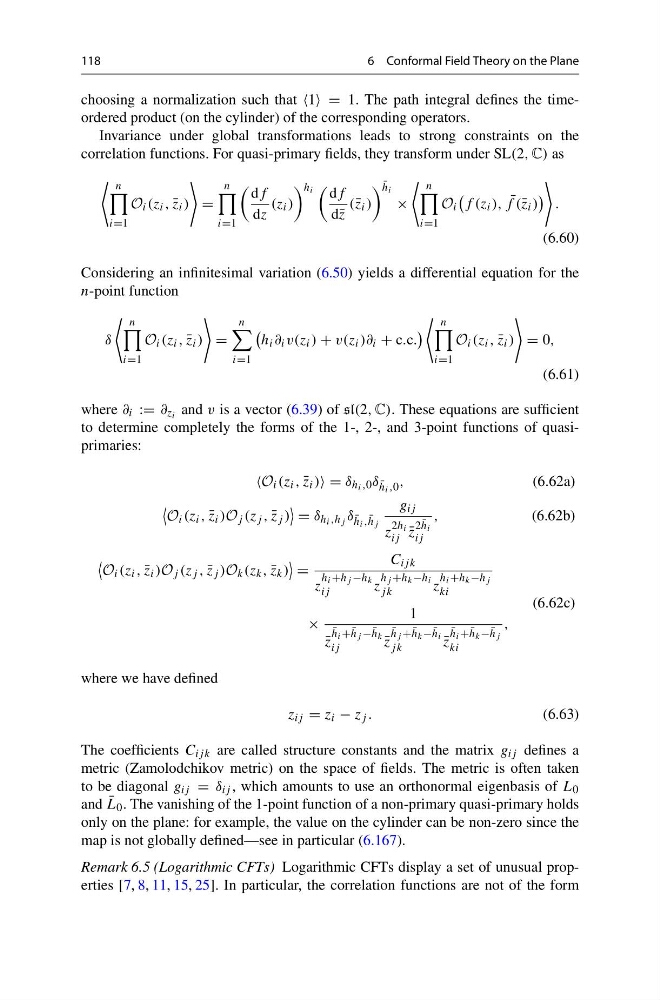
where ∂ i := ∂ z i and v is a vector (6.39) of sl(2, C). These equations are sufficient
to determine completely the forms of the 1-, 2-, and 3-point functions of quasiprimaries:
O i (z i , ¯
z i ) = δ h i ,0 δ ¯
h i ,0 ,
(6.62a)
O i (z i , ¯
z i )O j (z j , ¯
z j )
= δ h i ,h j δ ¯
h i , ¯
h j
g ij
z
2h i
ij ¯
z
2 ¯
h i
ij
,
(6.62b)
O i (z i , ¯
z i )O j (z j , ¯
z j )O k (z k , ¯
z k )
=
C ij k
z
h i +h j −h k
ij
z
h j +h k −h i
jk
z
h i +h k −h j
ki
×
1
¯
z
¯
h i + ¯
h j − ¯
h k
ij
¯
z
¯
h j + ¯
h k − ¯
h i
jk
¯
z
¯
h i + ¯
h k − ¯
h j
ki
,
(6.62c)
where we have defined
z ij = z i − z j .
(6.63)
The coefficients C ij k are called structure constants and the matrix g ij defines a
metric (Zamolodchikov metric) on the space of fields. The metric is often taken
to be diagonal g ij = δ ij , which amounts to use an orthonormal eigenbasis of L 0
and ¯
L 0 . The vanishing of the 1-point function of a non-primary quasi-primary holds
only on the plane: for example, the value on the cylinder can be non-zero since the
map is not globally defined—see in particular (6.167).
Remark 6.5 (Logarithmic CFTs) Logarithmic CFTs display a set of unusual properties [7, 8, 11, 15, 25]. In particular, the correlation functions are not of the form
6 Conformal Field Theory on the Plane
choosing a normalization such that 1 = 1. The path integral defines the timeordered product (on the cylinder) of the corresponding operators.
Invariance under global transformations leads to strong constraints on the
correlation functions. For quasi-primary fields, they transform under SL(2, C) as
n
i=1
O i (z i , ¯
z i )
=
n
i=1
df
dz
(z i )
h i
df
d¯ z
(¯ z i )
¯
h i
×
n
i=1
O i
f (z i ), ¯
f (¯ z i )
.
(6.60)
Considering an infinitesimal variation (6.50) yields a differential equation for the
n-point function
δ
n
i=1
O i (z i , ¯
z i )
=
n
i=1
h i ∂ i v(z i ) + v(z i )∂ i + c.c.
n
i=1
O i (z i , ¯
z i )
= 0,
(6.61)
where ∂ i := ∂ z i and v is a vector (6.39) of sl(2, C). These equations are sufficient
to determine completely the forms of the 1-, 2-, and 3-point functions of quasiprimaries:
O i (z i , ¯
z i ) = δ h i ,0 δ ¯
h i ,0 ,
(6.62a)
O i (z i , ¯
z i )O j (z j , ¯
z j )
= δ h i ,h j δ ¯
h i , ¯
h j
g ij
z
2h i
ij ¯
z
2 ¯
h i
ij
,
(6.62b)
O i (z i , ¯
z i )O j (z j , ¯
z j )O k (z k , ¯
z k )
=
C ij k
z
h i +h j −h k
ij
z
h j +h k −h i
jk
z
h i +h k −h j
ki
×
1
¯
z
¯
h i + ¯
h j − ¯
h k
ij
¯
z
¯
h j + ¯
h k − ¯
h i
jk
¯
z
¯
h i + ¯
h k − ¯
h j
ki
,
(6.62c)
where we have defined
z ij = z i − z j .
(6.63)
The coefficients C ij k are called structure constants and the matrix g ij defines a
metric (Zamolodchikov metric) on the space of fields. The metric is often taken
to be diagonal g ij = δ ij , which amounts to use an orthonormal eigenbasis of L 0
and ¯
L 0 . The vanishing of the 1-point function of a non-primary quasi-primary holds
only on the plane: for example, the value on the cylinder can be non-zero since the
map is not globally defined—see in particular (6.167).
Remark 6.5 (Logarithmic CFTs) Logarithmic CFTs display a set of unusual properties [7, 8, 11, 15, 25]. In particular, the correlation functions are not of the form