

6.3 Quantum CFTs
117
This is particularly fruitful as it extends the class of theories and parameter ranges
(e.g. Remark 6.2) which can be studied.
6.3.1 Virasoro Algebra
As discussed in Sect. 2.3.3, field measures in path integrals display a conformal
anomaly, meaning that they cannot be defined without introducing a scale. This
anomaly can be traded for a gravitational anomaly by introducing counter-terms in
the action [9, 13, sec. 3.2, 14, 17, 21, 24]. As a consequence, the Witt algebra (6.26)
is modified to its central extension, the Virasoro algebra. 7 The generators in both
sectors are denoted by {L n } and { ¯
L n } and are called Virasoro operators (or modes).
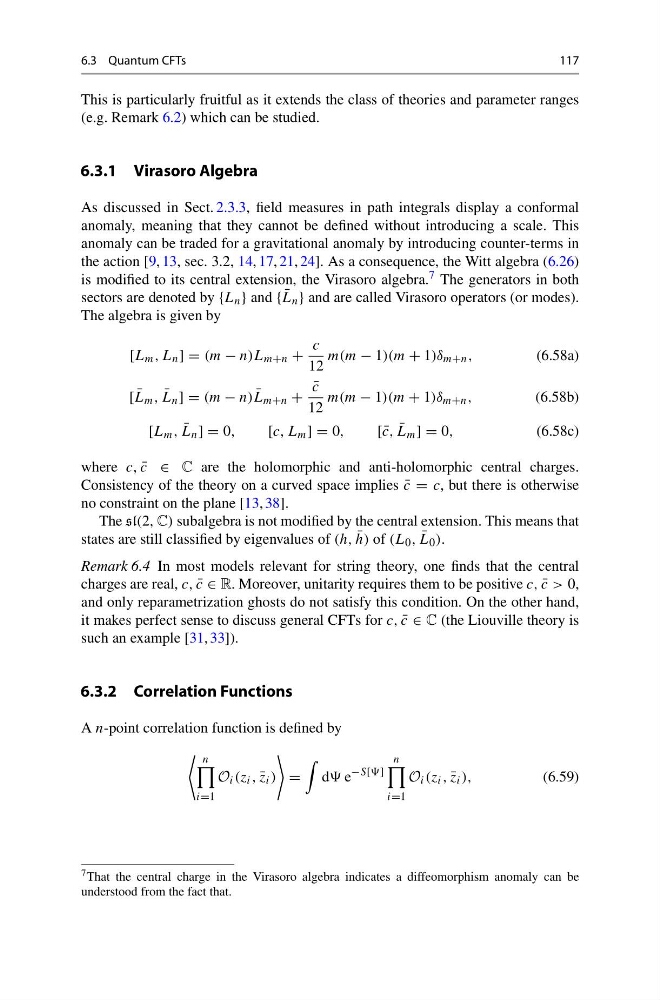
The algebra is given by
[L m , L n ] = (m − n)L m+n +
c
12
m(m − 1)(m + 1)δ m+n ,
(6.58a)
[ ¯
L m , ¯
L n ] = (m − n) ¯
L m+n +
¯
c
12
m(m − 1)(m + 1)δ m+n ,
(6.58b)
[L m , ¯
L n ] = 0,
[c, L m ] = 0,
[ ¯
c, ¯
L m ] = 0,
(6.58c)
where c, ¯
c ∈ C are the holomorphic and anti-holomorphic central charges.
Consistency of the theory on a curved space implies ¯
c = c, but there is otherwise
no constraint on the plane [13, 38].
The sl(2, C) subalgebra is not modified by the central extension. This means that
states are still classified by eigenvalues of (h, ¯
h) of (L 0 , ¯
L 0 ).
Remark 6.4 In most models relevant for string theory, one finds that the central
charges are real, c, ¯
c ∈ R. Moreover, unitarity requires them to be positive c, ¯
c > 0,
and only reparametrization ghosts do not satisfy this condition. On the other hand,
it makes perfect sense to discuss general CFTs for c, ¯
c ∈ C (the Liouville theory is
such an example [31, 33]).
6.3.2 Correlation Functions
A n-point correlation function is defined by
n
i=1
O i (z i , ¯
z i )
=
d e
−S[]
n
i=1
O i (z i , ¯
z i ),
(6.59)
7 That the central charge in the Virasoro algebra indicates a diffeomorphism anomaly can be
understood from the fact that.
117
This is particularly fruitful as it extends the class of theories and parameter ranges
(e.g. Remark 6.2) which can be studied.
6.3.1 Virasoro Algebra
As discussed in Sect. 2.3.3, field measures in path integrals display a conformal
anomaly, meaning that they cannot be defined without introducing a scale. This
anomaly can be traded for a gravitational anomaly by introducing counter-terms in
the action [9, 13, sec. 3.2, 14, 17, 21, 24]. As a consequence, the Witt algebra (6.26)
is modified to its central extension, the Virasoro algebra. 7 The generators in both
sectors are denoted by {L n } and { ¯
L n } and are called Virasoro operators (or modes).
The algebra is given by
[L m , L n ] = (m − n)L m+n +
c
12
m(m − 1)(m + 1)δ m+n ,
(6.58a)
[ ¯
L m , ¯
L n ] = (m − n) ¯
L m+n +
¯
c
12
m(m − 1)(m + 1)δ m+n ,
(6.58b)
[L m , ¯
L n ] = 0,
[c, L m ] = 0,
[ ¯
c, ¯
L m ] = 0,
(6.58c)
where c, ¯
c ∈ C are the holomorphic and anti-holomorphic central charges.
Consistency of the theory on a curved space implies ¯
c = c, but there is otherwise
no constraint on the plane [13, 38].
The sl(2, C) subalgebra is not modified by the central extension. This means that
states are still classified by eigenvalues of (h, ¯
h) of (L 0 , ¯
L 0 ).
Remark 6.4 In most models relevant for string theory, one finds that the central
charges are real, c, ¯
c ∈ R. Moreover, unitarity requires them to be positive c, ¯
c > 0,
and only reparametrization ghosts do not satisfy this condition. On the other hand,
it makes perfect sense to discuss general CFTs for c, ¯
c ∈ C (the Liouville theory is
such an example [31, 33]).
6.3.2 Correlation Functions
A n-point correlation function is defined by
n
i=1
O i (z i , ¯
z i )
=
d e
−S[]
n
i=1
O i (z i , ¯
z i ),
(6.59)
7 That the central charge in the Virasoro algebra indicates a diffeomorphism anomaly can be
understood from the fact that.