

116
6 Conformal Field Theory on the Plane
of R 2 . On the other hand, one finds that no global transformations are defined for
g > 1, and only the subgroup U(1) × U(1) survives for the torus.
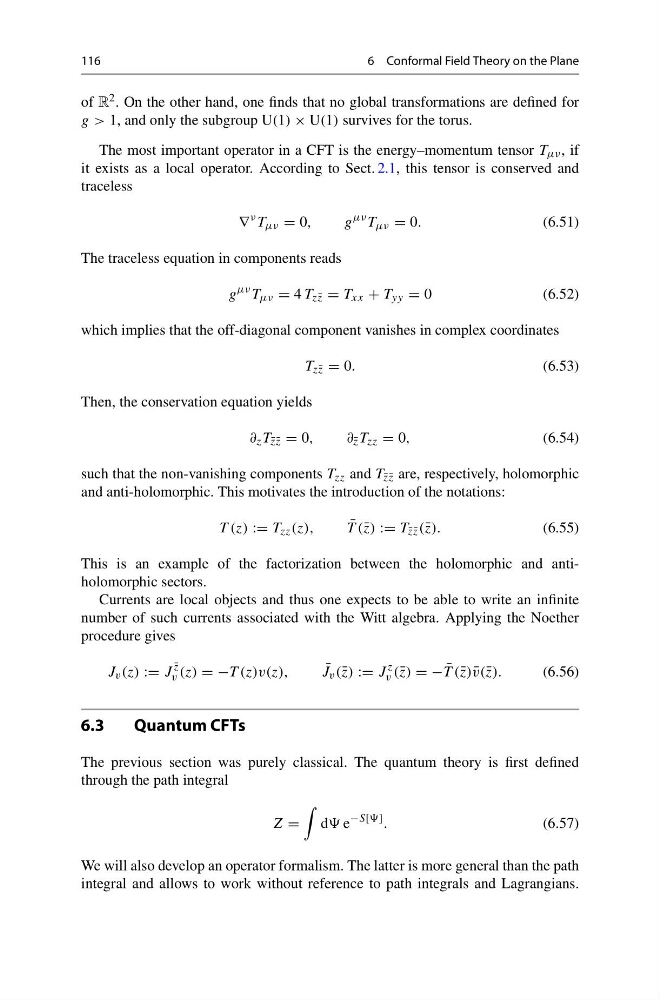
The most important operator in a CFT is the energy–momentum tensor T μν , if
it exists as a local operator. According to Sect. 2.1, this tensor is conserved and
traceless
∇
ν T μν = 0,
g
μν T μν = 0.
(6.51)
The traceless equation in components reads
g
μν T μν = 4 T z¯ z = T xx + T yy = 0
(6.52)
which implies that the off-diagonal component vanishes in complex coordinates
T z¯ z = 0.
(6.53)
Then, the conservation equation yields
∂ z T ¯
z¯ z = 0,
∂ ¯
z T zz = 0,
(6.54)
such that the non-vanishing components T zz and T ¯
z¯ z are, respectively, holomorphic
and anti-holomorphic. This motivates the introduction of the notations:
T (z) := T zz (z),
¯
T (¯ z) := T ¯
z¯ z (¯ z).
(6.55)
This is an example of the factorization between the holomorphic and antiholomorphic sectors.
Currents are local objects and thus one expects to be able to write an infinite
number of such currents associated with the Witt algebra. Applying the Noether
procedure gives
J v (z) := J
¯
z
v (z) = −T (z)v(z),
¯
J v (¯ z) := J
z
v (¯ z) = − ¯
T (¯ z) ¯
v(¯ z).
(6.56)
6.3
Quantum CFTs
The previous section was purely classical. The quantum theory is first defined
through the path integral
Z =
d e
−S[] .
(6.57)
We will also develop an operator formalism. The latter is more general than the path
integral and allows to work without reference to path integrals and Lagrangians.
6 Conformal Field Theory on the Plane
of R 2 . On the other hand, one finds that no global transformations are defined for
g > 1, and only the subgroup U(1) × U(1) survives for the torus.
The most important operator in a CFT is the energy–momentum tensor T μν , if
it exists as a local operator. According to Sect. 2.1, this tensor is conserved and
traceless
∇
ν T μν = 0,
g
μν T μν = 0.
(6.51)
The traceless equation in components reads
g
μν T μν = 4 T z¯ z = T xx + T yy = 0
(6.52)
which implies that the off-diagonal component vanishes in complex coordinates
T z¯ z = 0.
(6.53)
Then, the conservation equation yields
∂ z T ¯
z¯ z = 0,
∂ ¯
z T zz = 0,
(6.54)
such that the non-vanishing components T zz and T ¯
z¯ z are, respectively, holomorphic
and anti-holomorphic. This motivates the introduction of the notations:
T (z) := T zz (z),
¯
T (¯ z) := T ¯
z¯ z (¯ z).
(6.55)
This is an example of the factorization between the holomorphic and antiholomorphic sectors.
Currents are local objects and thus one expects to be able to write an infinite
number of such currents associated with the Witt algebra. Applying the Noether
procedure gives
J v (z) := J
¯
z
v (z) = −T (z)v(z),
¯
J v (¯ z) := J
z
v (¯ z) = − ¯
T (¯ z) ¯
v(¯ z).
(6.56)
6.3
Quantum CFTs
The previous section was purely classical. The quantum theory is first defined
through the path integral
Z =
d e
−S[] .
(6.57)
We will also develop an operator formalism. The latter is more general than the path
integral and allows to work without reference to path integrals and Lagrangians.