

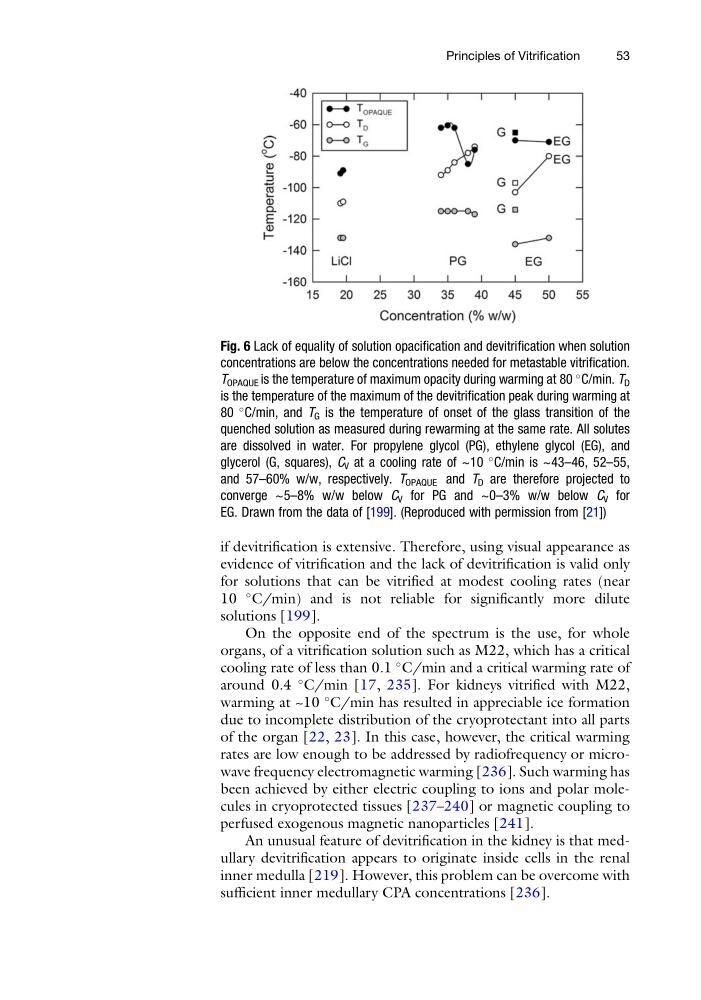
if devitrification is extensive. Therefore, using visual appearance as
evidence of vitrification and the lack of devitrification is valid only
for solutions that can be vitrified at modest cooling rates (near
10
C/min) and is not reliable for significantly more dilute
solutions [199].
On the opposite end of the spectrum is the use, for whole
organs, of a vitrification solution such as M22, which has a critical
cooling rate of less than 0.1
C/min and a critical warming rate of
around 0.4
C/min [17, 235]. For kidneys vitrified with M22,
warming at ~10
C/min has resulted in appreciable ice formation
due to incomplete distribution of the cryoprotectant into all parts
of the organ [22, 23]. In this case, however, the critical warming
rates are low enough to be addressed by radiofrequency or microwave frequency electromagnetic warming [236]. Such warming has
been achieved by either electric coupling to ions and polar molecules in cryoprotected tissues [237–240] or magnetic coupling to
perfused exogenous magnetic nanoparticles [241].
An unusual feature of devitrification in the kidney is that medullary devitrification appears to originate inside cells in the renal
inner medulla [219]. However, this problem can be overcome with
sufficient inner medullary CPA concentrations [236].
Fig. 6 Lack of equality of solution opacification and devitrification when solution
concentrations are below the concentrations needed for metastable vitrification.
T OPAQUE is the temperature of maximum opacity during warming at 80
C/min. T D
is the temperature of the maximum of the devitrification peak during warming at
80
C/min, and T G is the temperature of onset of the glass transition of the
quenched solution as measured during rewarming at the same rate. All solutes
are dissolved in water. For propylene glycol (PG), ethylene glycol (EG), and
glycerol (G, squares), C V at a cooling rate of ~10
C/min is ~43–46, 52–55,
and 57–60% w/w, respectively. T OPAQUE and T D are therefore projected to
converge ~5–8% w/w below C V for PG and ~0–3% w/w below C V for
EG. Drawn from the data of [199]. (Reproduced with permission from [21])
Principles of Vitrification
53
evidence of vitrification and the lack of devitrification is valid only
for solutions that can be vitrified at modest cooling rates (near
10
C/min) and is not reliable for significantly more dilute
solutions [199].
On the opposite end of the spectrum is the use, for whole
organs, of a vitrification solution such as M22, which has a critical
cooling rate of less than 0.1
C/min and a critical warming rate of
around 0.4
C/min [17, 235]. For kidneys vitrified with M22,
warming at ~10
C/min has resulted in appreciable ice formation
due to incomplete distribution of the cryoprotectant into all parts
of the organ [22, 23]. In this case, however, the critical warming
rates are low enough to be addressed by radiofrequency or microwave frequency electromagnetic warming [236]. Such warming has
been achieved by either electric coupling to ions and polar molecules in cryoprotected tissues [237–240] or magnetic coupling to
perfused exogenous magnetic nanoparticles [241].
An unusual feature of devitrification in the kidney is that medullary devitrification appears to originate inside cells in the renal
inner medulla [219]. However, this problem can be overcome with
sufficient inner medullary CPA concentrations [236].
Fig. 6 Lack of equality of solution opacification and devitrification when solution
concentrations are below the concentrations needed for metastable vitrification.
T OPAQUE is the temperature of maximum opacity during warming at 80
C/min. T D
is the temperature of the maximum of the devitrification peak during warming at
80
C/min, and T G is the temperature of onset of the glass transition of the
quenched solution as measured during rewarming at the same rate. All solutes
are dissolved in water. For propylene glycol (PG), ethylene glycol (EG), and
glycerol (G, squares), C V at a cooling rate of ~10
C/min is ~43–46, 52–55,
and 57–60% w/w, respectively. T OPAQUE and T D are therefore projected to
converge ~5–8% w/w below C V for PG and ~0–3% w/w below C V for
EG. Drawn from the data of [199]. (Reproduced with permission from [21])
Principles of Vitrification
53