

2.6 Antinucleation
and Specific Ice
Growth Inhibition
In recent years there has been growing interest in agents able to
inhibit ice nucleation or ice growth by specific molecular recognition of ice or ice nucleators, sometimes called “ice blockers.” Antifreeze proteins and antifreeze glycoproteins are natural examples,
but they are difficult to obtain in useful quantities and at affordable
cost for tissue cryopreservation applications. As alternatives, the
synthetic polymers polyvinyl alcohol (PVA) and polyglycerol
(PGL) have been recognized as ice growth and ice nucleation
inhibitors, respectively, for cryopreservation applications [50, 51],
with PGL specifically effective against heterogeneous nucleators of
bacterial origin. The utility of ice-blocking compounds is that they
can have large effects on ice formation even while present in small
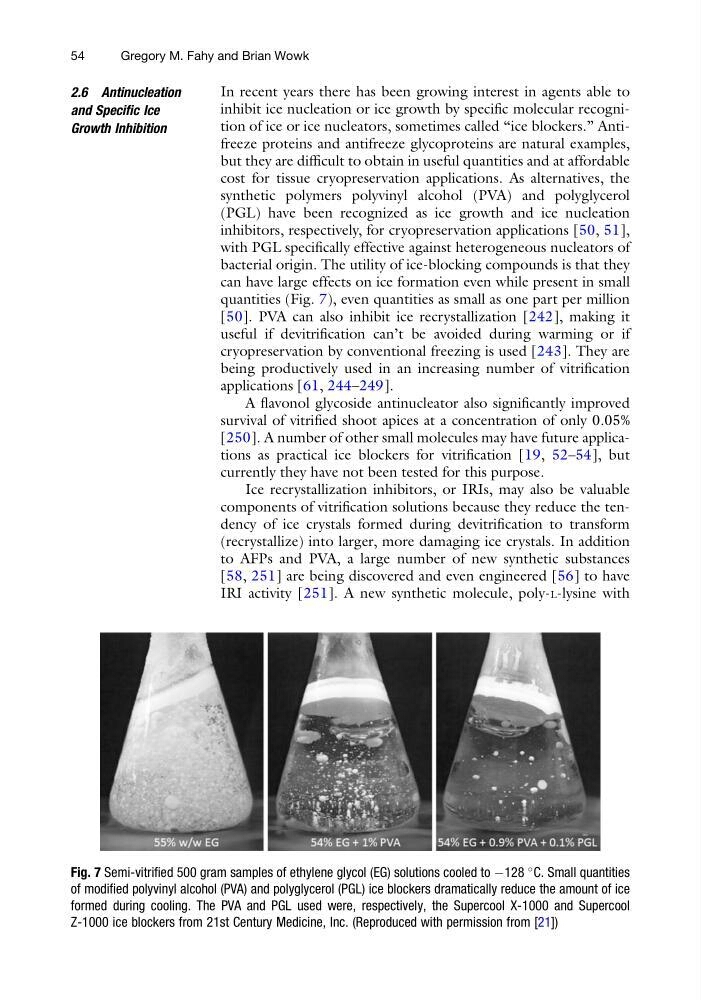
quantities (Fig. 7), even quantities as small as one part per million
[50]. PVA can also inhibit ice recrystallization [242], making it
useful if devitrification can’t be avoided during warming or if
cryopreservation by conventional freezing is used [243]. They are
being productively used in an increasing number of vitrification
applications [61, 244–249].
A flavonol glycoside antinucleator also significantly improved
survival of vitrified shoot apices at a concentration of only 0.05%
[250]. A number of other small molecules may have future applications as practical ice blockers for vitrification [19, 52–54], but
currently they have not been tested for this purpose.
Ice recrystallization inhibitors, or IRIs, may also be valuable
components of vitrification solutions because they reduce the tendency of ice crystals formed during devitrification to transform
(recrystallize) into larger, more damaging ice crystals. In addition
to AFPs and PVA, a large number of new synthetic substances
[58, 251] are being discovered and even engineered [56] to have
IRI activity [251]. A new synthetic molecule, poly-L-lysine with
Fig. 7 Semi-vitrified 500 gram samples of ethylene glycol (EG) solutions cooled to À128
C. Small quantities
of modified polyvinyl alcohol (PVA) and polyglycerol (PGL) ice blockers dramatically reduce the amount of ice
formed during cooling. The PVA and PGL used were, respectively, the Supercool X-1000 and Supercool
Z-1000 ice blockers from 21st Century Medicine, Inc. (Reproduced with permission from [21])
54
Gregory M. Fahy and Brian Wowk
and Specific Ice
Growth Inhibition
In recent years there has been growing interest in agents able to
inhibit ice nucleation or ice growth by specific molecular recognition of ice or ice nucleators, sometimes called “ice blockers.” Antifreeze proteins and antifreeze glycoproteins are natural examples,
but they are difficult to obtain in useful quantities and at affordable
cost for tissue cryopreservation applications. As alternatives, the
synthetic polymers polyvinyl alcohol (PVA) and polyglycerol
(PGL) have been recognized as ice growth and ice nucleation
inhibitors, respectively, for cryopreservation applications [50, 51],
with PGL specifically effective against heterogeneous nucleators of
bacterial origin. The utility of ice-blocking compounds is that they
can have large effects on ice formation even while present in small
quantities (Fig. 7), even quantities as small as one part per million
[50]. PVA can also inhibit ice recrystallization [242], making it
useful if devitrification can’t be avoided during warming or if
cryopreservation by conventional freezing is used [243]. They are
being productively used in an increasing number of vitrification
applications [61, 244–249].
A flavonol glycoside antinucleator also significantly improved
survival of vitrified shoot apices at a concentration of only 0.05%
[250]. A number of other small molecules may have future applications as practical ice blockers for vitrification [19, 52–54], but
currently they have not been tested for this purpose.
Ice recrystallization inhibitors, or IRIs, may also be valuable
components of vitrification solutions because they reduce the tendency of ice crystals formed during devitrification to transform
(recrystallize) into larger, more damaging ice crystals. In addition
to AFPs and PVA, a large number of new synthetic substances
[58, 251] are being discovered and even engineered [56] to have
IRI activity [251]. A new synthetic molecule, poly-L-lysine with
Fig. 7 Semi-vitrified 500 gram samples of ethylene glycol (EG) solutions cooled to À128
C. Small quantities
of modified polyvinyl alcohol (PVA) and polyglycerol (PGL) ice blockers dramatically reduce the amount of ice
formed during cooling. The PVA and PGL used were, respectively, the Supercool X-1000 and Supercool
Z-1000 ice blockers from 21st Century Medicine, Inc. (Reproduced with permission from [21])
54
Gregory M. Fahy and Brian Wowk