

cryopreservation methods yield acceptable survival rates, they typically use animal products and undefined factors, such as sera, complicating clinical applications of ASCs due to risks of immunological
reactions and of transmitting infectious diseases and prions. We
recently attempted to develop a clinical-grade cryopreservation
method by formulating a xeno-free- and chemically defined cryopreservation medium [19]. To mimic two beneficial aspects of
serum supplementations (i.e., antioxidative defense and shear stress
reduction), we added two antioxidants (i.e., glutathione and ascorbic acid) and three glass formers/polymers (i.e., trehalose, ficoll,
and polyvinyl alcohol [PVA]) to the defined cryopreservation
medium. Furthermore, we included two penetrating cryoprotectants (i.e., dimethyl sulfoxide [DMSO] and ethylene glycol [EG])
at a lower concentration and a calcium chelator (ethylene glycol
tetraacetic acid [EGTA]) to reduce the overall cryoprotectant toxicity [20]. Testing different components of this medium against the
conventional undefined cryopreservation medium (i.e., 10%
DMSO+10% DMEM/F12 + 80% serum) and unfrozen controls
revealed that the addition of two antioxidants along with 5% concentration of each penetrating cryoprotectant in the presence of
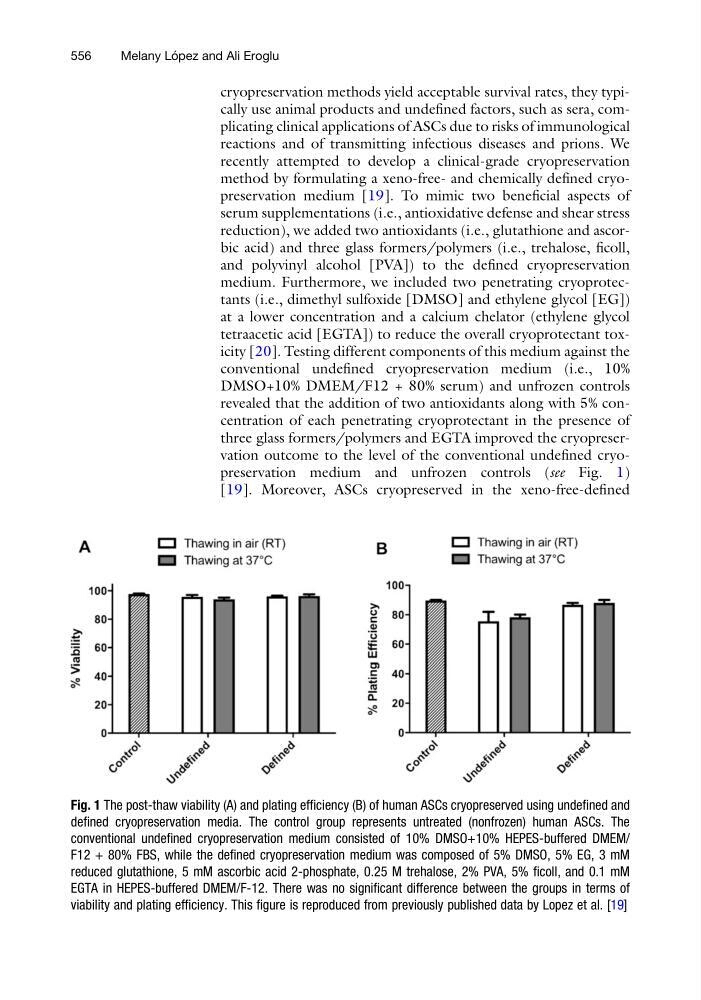
three glass formers/polymers and EGTA improved the cryopreservation outcome to the level of the conventional undefined cryopreservation medium and unfrozen controls (see Fig. 1)
[19]. Moreover, ASCs cryopreserved in the xeno-free-defined
Fig. 1 The post-thaw viability (A) and plating efficiency (B) of human ASCs cryopreserved using undefined and
defined cryopreservation media. The control group represents untreated (nonfrozen) human ASCs. The
conventional undefined cryopreservation medium consisted of 10% DMSO+10% HEPES-buffered DMEM/
F12 + 80% FBS, while the defined cryopreservation medium was composed of 5% DMSO, 5% EG, 3 mM
reduced glutathione, 5 mM ascorbic acid 2-phosphate, 0.25 M trehalose, 2% PVA, 5% ficoll, and 0.1 mM
EGTA in HEPES-buffered DMEM/F-12. There was no significant difference between the groups in terms of
viability and plating efficiency. This figure is reproduced from previously published data by Lopez et al. [19]
556
Melany Lo ´ pez and Ali Eroglu
reactions and of transmitting infectious diseases and prions. We
recently attempted to develop a clinical-grade cryopreservation
method by formulating a xeno-free- and chemically defined cryopreservation medium [19]. To mimic two beneficial aspects of
serum supplementations (i.e., antioxidative defense and shear stress
reduction), we added two antioxidants (i.e., glutathione and ascorbic acid) and three glass formers/polymers (i.e., trehalose, ficoll,
and polyvinyl alcohol [PVA]) to the defined cryopreservation
medium. Furthermore, we included two penetrating cryoprotectants (i.e., dimethyl sulfoxide [DMSO] and ethylene glycol [EG])
at a lower concentration and a calcium chelator (ethylene glycol
tetraacetic acid [EGTA]) to reduce the overall cryoprotectant toxicity [20]. Testing different components of this medium against the
conventional undefined cryopreservation medium (i.e., 10%
DMSO+10% DMEM/F12 + 80% serum) and unfrozen controls
revealed that the addition of two antioxidants along with 5% concentration of each penetrating cryoprotectant in the presence of
three glass formers/polymers and EGTA improved the cryopreservation outcome to the level of the conventional undefined cryopreservation medium and unfrozen controls (see Fig. 1)
[19]. Moreover, ASCs cryopreserved in the xeno-free-defined
Fig. 1 The post-thaw viability (A) and plating efficiency (B) of human ASCs cryopreserved using undefined and
defined cryopreservation media. The control group represents untreated (nonfrozen) human ASCs. The
conventional undefined cryopreservation medium consisted of 10% DMSO+10% HEPES-buffered DMEM/
F12 + 80% FBS, while the defined cryopreservation medium was composed of 5% DMSO, 5% EG, 3 mM
reduced glutathione, 5 mM ascorbic acid 2-phosphate, 0.25 M trehalose, 2% PVA, 5% ficoll, and 0.1 mM
EGTA in HEPES-buffered DMEM/F-12. There was no significant difference between the groups in terms of
viability and plating efficiency. This figure is reproduced from previously published data by Lopez et al. [19]
556
Melany Lo ´ pez and Ali Eroglu