

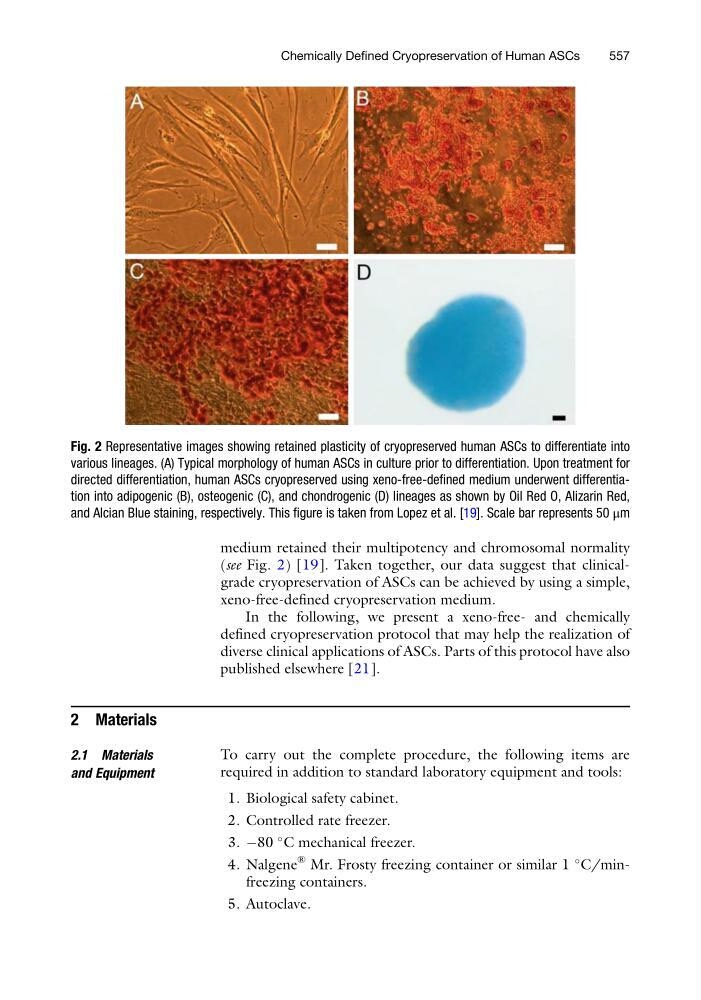
medium retained their multipotency and chromosomal normality
(see Fig. 2) [19]. Taken together, our data suggest that clinicalgrade cryopreservation of ASCs can be achieved by using a simple,
xeno-free-defined cryopreservation medium.
In the following, we present a xeno-free- and chemically
defined cryopreservation protocol that may help the realization of
diverse clinical applications of ASCs. Parts of this protocol have also
published elsewhere [21].
2 Materials
2.1 Materials
and Equipment
To carry out the complete procedure, the following items are
required in addition to standard laboratory equipment and tools:
1. Biological safety cabinet.
2. Controlled rate freezer.
3. À80
C mechanical freezer.
4. Nalgene
® Mr. Frosty freezing container or similar 1
C/minfreezing containers.
5. Autoclave.
Fig. 2 Representative images showing retained plasticity of cryopreserved human ASCs to differentiate into
various lineages. (A) Typical morphology of human ASCs in culture prior to differentiation. Upon treatment for
directed differentiation, human ASCs cryopreserved using xeno-free-defined medium underwent differentiation into adipogenic (B), osteogenic (C), and chondrogenic (D) lineages as shown by Oil Red O, Alizarin Red,
and Alcian Blue staining, respectively. This figure is taken from Lopez et al. [19]. Scale bar represents 50 μm
Chemically Defined Cryopreservation of Human ASCs
557
(see Fig. 2) [19]. Taken together, our data suggest that clinicalgrade cryopreservation of ASCs can be achieved by using a simple,
xeno-free-defined cryopreservation medium.
In the following, we present a xeno-free- and chemically
defined cryopreservation protocol that may help the realization of
diverse clinical applications of ASCs. Parts of this protocol have also
published elsewhere [21].
2 Materials
2.1 Materials
and Equipment
To carry out the complete procedure, the following items are
required in addition to standard laboratory equipment and tools:
1. Biological safety cabinet.
2. Controlled rate freezer.
3. À80
C mechanical freezer.
4. Nalgene
® Mr. Frosty freezing container or similar 1
C/minfreezing containers.
5. Autoclave.
Fig. 2 Representative images showing retained plasticity of cryopreserved human ASCs to differentiate into
various lineages. (A) Typical morphology of human ASCs in culture prior to differentiation. Upon treatment for
directed differentiation, human ASCs cryopreserved using xeno-free-defined medium underwent differentiation into adipogenic (B), osteogenic (C), and chondrogenic (D) lineages as shown by Oil Red O, Alizarin Red,
and Alcian Blue staining, respectively. This figure is taken from Lopez et al. [19]. Scale bar represents 50 μm
Chemically Defined Cryopreservation of Human ASCs
557