

quickly regain their original volume upon warming, thus preventing osmotic injury. The second component of a vitrification solution are disaccharides, for example, sucrose, which does not
penetrate the cell membrane, but helps to draw out more water
from cells by osmosis and therefore lessen the exposure time of the
cells to the toxic effects of the cryoprotectants. The
non-permeating sucrose also acts as an osmotic buffer to reduce
the osmotic shock that might otherwise result from the dilution of
the cryoprotectant after cryostorage. In addition, permeating
agents are able to bind with intracellular water, and therefore
water is very slowly removed from the cell. Hence the critical
intracellular salt concentration is reached at a lower temperature.
Removal of the cryoprotective agent during warming can present a
very real problem in terms of trying to reduce toxicity to the cells.
Firstly, because of the toxicity of the vitrification solutions, quick
dilution of them after warming is necessary; and secondly, during
dilution water permeates more rapidly into the cell than the cryoprotective additive that diffuses out. As a consequence of the excess
water inflow, the cells are threatened by injury from osmotic
swelling. In this situation the non-permeating sucrose acts as an
osmotic buffer to reduce the osmotic shock. During warming using
a high extracellular concentration of sucrose (e.g., 1.0 M) counterbalances the high concentration of the cryoprotectant agents in the
cell, as it reduces the difference in osmolarity between the intra- and
extracellular compartments. The high sucrose concentration cannot totally prevent the cell from swelling, but it can reduce the
speed and magnitude of swelling [15–17].
1.2 Blastocyst
Vitrification
in the Fertility Centers
of Illinois
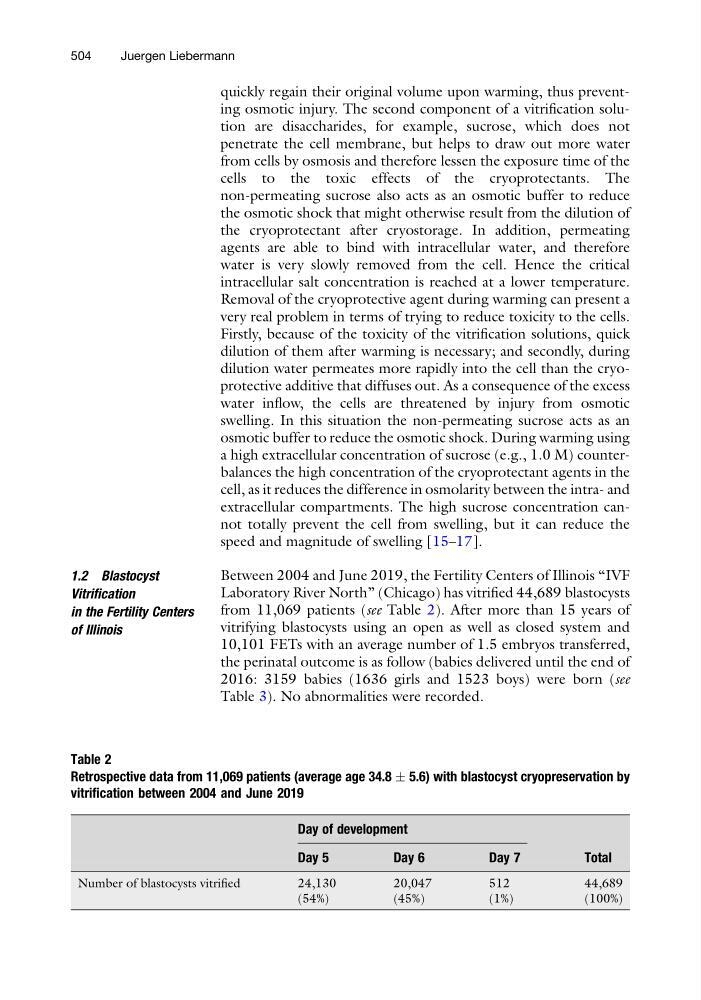
Between 2004 and June 2019, the Fertility Centers of Illinois “IVF
Laboratory River North” (Chicago) has vitrified 44,689 blastocysts
from 11,069 patients (see Table 2). After more than 15 years of
vitrifying blastocysts using an open as well as closed system and
10,101 FETs with an average number of 1.5 embryos transferred,
the perinatal outcome is as follow (babies delivered until the end of
2016: 3159 babies (1636 girls and 1523 boys) were born (see
Table 3). No abnormalities were recorded.
Table 2
Retrospective data from 11,069 patients (average age 34.8 Æ 5.6) with blastocyst cryopreservation by
vitrification between 2004 and June 2019
Day of development
Total
Day 5
Day 6
Day 7
Number of blastocysts vitrified
24,130
(54%)
20,047
(45%)
512
(1%)
44,689
(100%)
504
Juergen Liebermann
penetrate the cell membrane, but helps to draw out more water
from cells by osmosis and therefore lessen the exposure time of the
cells to the toxic effects of the cryoprotectants. The
non-permeating sucrose also acts as an osmotic buffer to reduce
the osmotic shock that might otherwise result from the dilution of
the cryoprotectant after cryostorage. In addition, permeating
agents are able to bind with intracellular water, and therefore
water is very slowly removed from the cell. Hence the critical
intracellular salt concentration is reached at a lower temperature.
Removal of the cryoprotective agent during warming can present a
very real problem in terms of trying to reduce toxicity to the cells.
Firstly, because of the toxicity of the vitrification solutions, quick
dilution of them after warming is necessary; and secondly, during
dilution water permeates more rapidly into the cell than the cryoprotective additive that diffuses out. As a consequence of the excess
water inflow, the cells are threatened by injury from osmotic
swelling. In this situation the non-permeating sucrose acts as an
osmotic buffer to reduce the osmotic shock. During warming using
a high extracellular concentration of sucrose (e.g., 1.0 M) counterbalances the high concentration of the cryoprotectant agents in the
cell, as it reduces the difference in osmolarity between the intra- and
extracellular compartments. The high sucrose concentration cannot totally prevent the cell from swelling, but it can reduce the
speed and magnitude of swelling [15–17].
1.2 Blastocyst
Vitrification
in the Fertility Centers
of Illinois
Between 2004 and June 2019, the Fertility Centers of Illinois “IVF
Laboratory River North” (Chicago) has vitrified 44,689 blastocysts
from 11,069 patients (see Table 2). After more than 15 years of
vitrifying blastocysts using an open as well as closed system and
10,101 FETs with an average number of 1.5 embryos transferred,
the perinatal outcome is as follow (babies delivered until the end of
2016: 3159 babies (1636 girls and 1523 boys) were born (see
Table 3). No abnormalities were recorded.
Table 2
Retrospective data from 11,069 patients (average age 34.8 Æ 5.6) with blastocyst cryopreservation by
vitrification between 2004 and June 2019
Day of development
Total
Day 5
Day 6
Day 7
Number of blastocysts vitrified
24,130
(54%)
20,047
(45%)
512
(1%)
44,689
(100%)
504
Juergen Liebermann