

Although initially reported in 1985 as a successful cryopreservation approach for mouse embryos [5], vitrification has taken a
backseat in human-assisted reproduction. One “drawback” considered by embryologists who are not familiar with the vitrification
technique is the use of high concentrations of cryoprotectants,
which does potentially mean that vitrification solutions are more
toxic than their counterpart solutions used for conventional slow
freezing. This is necessitated by the practical limit for the rate of
cooling, and the biological limit of tolerance of the cells for the
concentration of toxic cryoprotectants being used to achieve the
cryopreserved state. It is important to note that recently published
papers [11–14] have shown that the use of relatively high concentration of cryoprotectants such as 15% (v/v) ethylene glycol
(EG) used in an equimolar mixture with dimethyl sulfoxide
(DMSO) had no negative effect on the perinatal outcomes from
blastocyst transfers following vitrification when compared with
those from fresh blastocyst transfers.
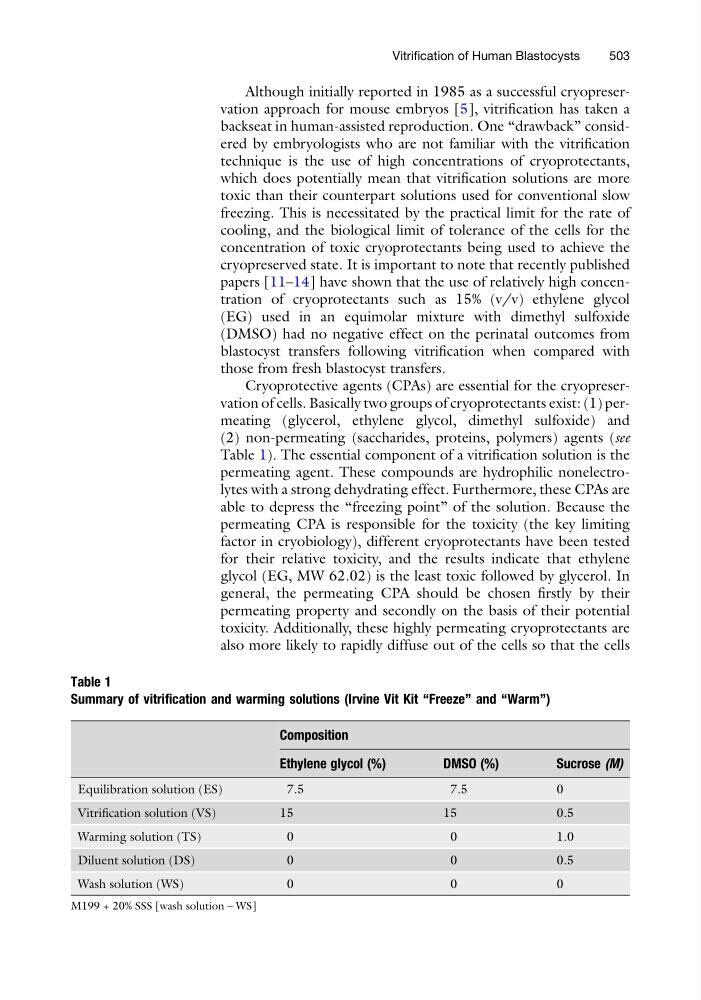
Cryoprotective agents (CPAs) are essential for the cryopreservation of cells. Basically two groups of cryoprotectants exist: (1) permeating (glycerol, ethylene glycol, dimethyl sulfoxide) and
(2) non-permeating (saccharides, proteins, polymers) agents (see
Table 1). The essential component of a vitrification solution is the
permeating agent. These compounds are hydrophilic nonelectrolytes with a strong dehydrating effect. Furthermore, these CPAs are
able to depress the “freezing point” of the solution. Because the
permeating CPA is responsible for the toxicity (the key limiting
factor in cryobiology), different cryoprotectants have been tested
for their relative toxicity, and the results indicate that ethylene
glycol (EG, MW 62.02) is the least toxic followed by glycerol. In
general, the permeating CPA should be chosen firstly by their
permeating property and secondly on the basis of their potential
toxicity. Additionally, these highly permeating cryoprotectants are
also more likely to rapidly diffuse out of the cells so that the cells
Table 1
Summary of vitrification and warming solutions (Irvine Vit Kit “Freeze” and “Warm”)
Composition
Ethylene glycol (%)
DMSO (%)
Sucrose (M)
Equilibration solution (ES)
7.5
7.5
0
Vitrification solution (VS)
15
15
0.5
Warming solution (TS)
0
0
1.0
Diluent solution (DS)
0
0
0.5
Wash solution (WS)
0
0
0
M199 + 20% SSS [wash solution – WS]
Vitrification of Human Blastocysts
503
backseat in human-assisted reproduction. One “drawback” considered by embryologists who are not familiar with the vitrification
technique is the use of high concentrations of cryoprotectants,
which does potentially mean that vitrification solutions are more
toxic than their counterpart solutions used for conventional slow
freezing. This is necessitated by the practical limit for the rate of
cooling, and the biological limit of tolerance of the cells for the
concentration of toxic cryoprotectants being used to achieve the
cryopreserved state. It is important to note that recently published
papers [11–14] have shown that the use of relatively high concentration of cryoprotectants such as 15% (v/v) ethylene glycol
(EG) used in an equimolar mixture with dimethyl sulfoxide
(DMSO) had no negative effect on the perinatal outcomes from
blastocyst transfers following vitrification when compared with
those from fresh blastocyst transfers.
Cryoprotective agents (CPAs) are essential for the cryopreservation of cells. Basically two groups of cryoprotectants exist: (1) permeating (glycerol, ethylene glycol, dimethyl sulfoxide) and
(2) non-permeating (saccharides, proteins, polymers) agents (see
Table 1). The essential component of a vitrification solution is the
permeating agent. These compounds are hydrophilic nonelectrolytes with a strong dehydrating effect. Furthermore, these CPAs are
able to depress the “freezing point” of the solution. Because the
permeating CPA is responsible for the toxicity (the key limiting
factor in cryobiology), different cryoprotectants have been tested
for their relative toxicity, and the results indicate that ethylene
glycol (EG, MW 62.02) is the least toxic followed by glycerol. In
general, the permeating CPA should be chosen firstly by their
permeating property and secondly on the basis of their potential
toxicity. Additionally, these highly permeating cryoprotectants are
also more likely to rapidly diffuse out of the cells so that the cells
Table 1
Summary of vitrification and warming solutions (Irvine Vit Kit “Freeze” and “Warm”)
Composition
Ethylene glycol (%)
DMSO (%)
Sucrose (M)
Equilibration solution (ES)
7.5
7.5
0
Vitrification solution (VS)
15
15
0.5
Warming solution (TS)
0
0
1.0
Diluent solution (DS)
0
0
0.5
Wash solution (WS)
0
0
0
M199 + 20% SSS [wash solution – WS]
Vitrification of Human Blastocysts
503