

The outcome with regard to day of development and age of the
patient is summarized in Tables 4 and 5. In good prognosis patient
under 35 years old with transferring day 5 blastocysts, an ongoing
pregnancy and implantation of 51.8% and 48.6% was noted (see
Table 4). In contrast, transferring day 6 blastocysts in patients
younger than 35 of age, an ongoing pregnancy and implantation
of 38.3% and 34.7% was recorded (see Table 5).
Between 2007 and June 2019, the Fertility Centers of Illinois
“IVF Laboratory River North” (Chicago) performed 2347 frozen
transfers (FETs) without collapsing prior vitrification with a mean
age of the patients of 35.8 Æ 5.0 years (group A) and 5880 FETs
with a mean age of the patients of 35.6 Æ 4.5 years (group B) where
artificial collapse was performed prior to vitrification steps (see
Table 6). On average, 1.6 embryos were transferred in group A
and 1.4 embryos in group B. Survival in group A vs. group B was
not significantly different (98.8% vs. 99.6%). However, there was a
significant improvement in group B compared with group A for the
following: (1) clinical pregnancy rate (cPR), 56.4% vs. 44.8%;
(2) ongoing pregnancy (oPR), 48.6% vs. 36.3%; and (3) implantation rate (IR), 47.8% vs. 34.7% (see Table 6).
When the vitrified-warmed blastocysts were divided into day
5 and day 6 groups, the following data was gather (see Table 7). In
1423 FETs transferring day 5 blastocysts from group A (mean age
of 35.8 Æ 5.0), the IR, cPR, and oPR were 39.3%, 49.3%, and
41.3% compared to 50.7%, 59.3%, and 51.7% of day 5 blastocysts
from group B (mean age of 35.2 Æ 4.5). As shown in Table 7,
implantation, cPR, and oPR occurring in the day 5 blastocysts from
group B were significantly higher than in the day 5 blastocyst from
group A (χ
2
; P < 0.001, respectively).
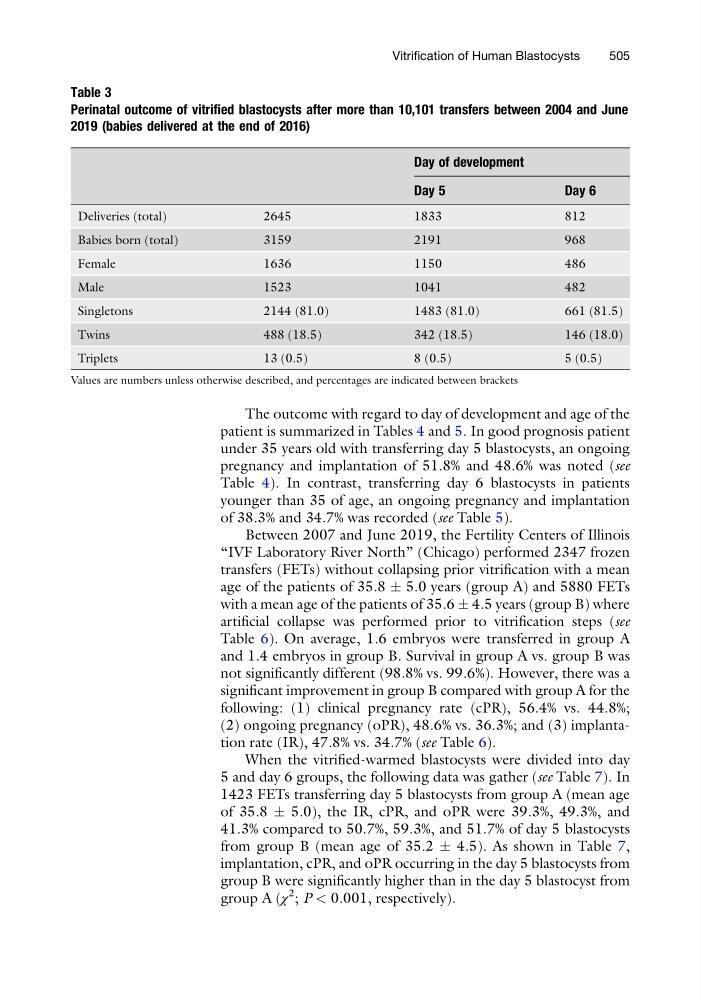
Table 3
Perinatal outcome of vitrified blastocysts after more than 10,101 transfers between 2004 and June
2019 (babies delivered at the end of 2016)
Day of development
Day 5
Day 6
Deliveries (total)
2645
1833
812
Babies born (total)
3159
2191
968
Female
1636
1150
486
Male
1523
1041
482
Singletons
2144 (81.0)
1483 (81.0)
661 (81.5)
Twins
488 (18.5)
342 (18.5)
146 (18.0)
Triplets
13 (0.5)
8 (0.5)
5 (0.5)
Values are numbers unless otherwise described, and percentages are indicated between brackets
Vitrification of Human Blastocysts
505
patient is summarized in Tables 4 and 5. In good prognosis patient
under 35 years old with transferring day 5 blastocysts, an ongoing
pregnancy and implantation of 51.8% and 48.6% was noted (see
Table 4). In contrast, transferring day 6 blastocysts in patients
younger than 35 of age, an ongoing pregnancy and implantation
of 38.3% and 34.7% was recorded (see Table 5).
Between 2007 and June 2019, the Fertility Centers of Illinois
“IVF Laboratory River North” (Chicago) performed 2347 frozen
transfers (FETs) without collapsing prior vitrification with a mean
age of the patients of 35.8 Æ 5.0 years (group A) and 5880 FETs
with a mean age of the patients of 35.6 Æ 4.5 years (group B) where
artificial collapse was performed prior to vitrification steps (see
Table 6). On average, 1.6 embryos were transferred in group A
and 1.4 embryos in group B. Survival in group A vs. group B was
not significantly different (98.8% vs. 99.6%). However, there was a
significant improvement in group B compared with group A for the
following: (1) clinical pregnancy rate (cPR), 56.4% vs. 44.8%;
(2) ongoing pregnancy (oPR), 48.6% vs. 36.3%; and (3) implantation rate (IR), 47.8% vs. 34.7% (see Table 6).
When the vitrified-warmed blastocysts were divided into day
5 and day 6 groups, the following data was gather (see Table 7). In
1423 FETs transferring day 5 blastocysts from group A (mean age
of 35.8 Æ 5.0), the IR, cPR, and oPR were 39.3%, 49.3%, and
41.3% compared to 50.7%, 59.3%, and 51.7% of day 5 blastocysts
from group B (mean age of 35.2 Æ 4.5). As shown in Table 7,
implantation, cPR, and oPR occurring in the day 5 blastocysts from
group B were significantly higher than in the day 5 blastocyst from
group A (χ
2
; P < 0.001, respectively).
Table 3
Perinatal outcome of vitrified blastocysts after more than 10,101 transfers between 2004 and June
2019 (babies delivered at the end of 2016)
Day of development
Day 5
Day 6
Deliveries (total)
2645
1833
812
Babies born (total)
3159
2191
968
Female
1636
1150
486
Male
1523
1041
482
Singletons
2144 (81.0)
1483 (81.0)
661 (81.5)
Twins
488 (18.5)
342 (18.5)
146 (18.0)
Triplets
13 (0.5)
8 (0.5)
5 (0.5)
Values are numbers unless otherwise described, and percentages are indicated between brackets
Vitrification of Human Blastocysts
505