

Hold the micropipettor (for 10–100 μL) 8 cm above the liquid
nitrogen (or clean liquid air) level, at a 45
angle. Drop 20 μL
aliquots of spermatozoa suspension directly into the cooling
agent (see Note 5).
3. Upon contact with the liquid agent, a sphere will form immediately which will float to the surface (see Note 6).
4. After solidification, use a small aseptic spoon to collect the
spheres, package into cryotubes, and store in liquid nitrogen
until further use (see Note 7).
3.3 Spermatozoa
Warming
1. Have the warming solution (HTF supplemented with 1% DSS)
pre-warmed to 37
C.
2. Warming is performed by quickly submerging spheres one by
one (not more than five spheres at once) into 5 mL warming
solution of 37
C. Accompany this procedure by gentle vortexing for 5–10 s (see Note 8).
3. Assess sperm survival after vitrification and warming:
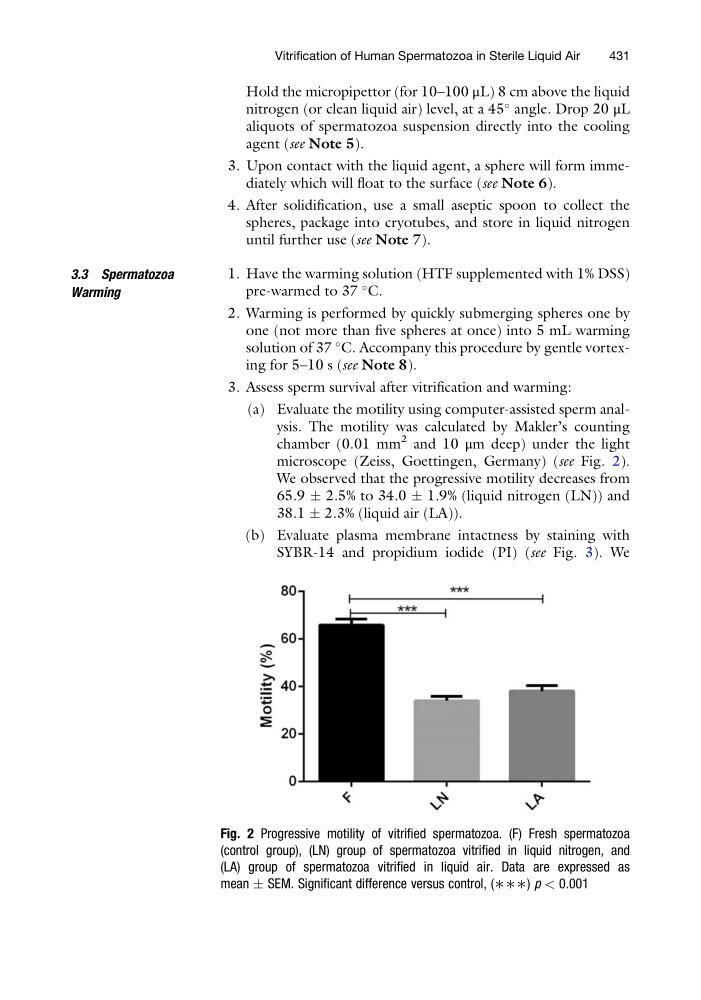
(a) Evaluate the motility using computer-assisted sperm analysis. The motility was calculated by Makler’s counting
chamber (0.01 mm
2 and 10 μm deep) under the light
microscope (Zeiss, Goettingen, Germany) (see Fig. 2).
We observed that the progressive motility decreases from
65.9 Æ 2.5% to 34.0 Æ 1.9% (liquid nitrogen (LN)) and
38.1 Æ 2.3% (liquid air (LA)).
(b) Evaluate plasma membrane intactness by staining with
SYBR-14 and propidium iodide (PI) (see Fig. 3). We
Fig. 2 Progressive motility of vitrified spermatozoa. (F) Fresh spermatozoa
(control group), (LN) group of spermatozoa vitrified in liquid nitrogen, and
(LA) group of spermatozoa vitrified in liquid air. Data are expressed as
mean Æ SEM. Significant difference versus control, (∗∗∗) p < 0.001
Vitrification of Human Spermatozoa in Sterile Liquid Air
431
nitrogen (or clean liquid air) level, at a 45
angle. Drop 20 μL
aliquots of spermatozoa suspension directly into the cooling
agent (see Note 5).
3. Upon contact with the liquid agent, a sphere will form immediately which will float to the surface (see Note 6).
4. After solidification, use a small aseptic spoon to collect the
spheres, package into cryotubes, and store in liquid nitrogen
until further use (see Note 7).
3.3 Spermatozoa
Warming
1. Have the warming solution (HTF supplemented with 1% DSS)
pre-warmed to 37
C.
2. Warming is performed by quickly submerging spheres one by
one (not more than five spheres at once) into 5 mL warming
solution of 37
C. Accompany this procedure by gentle vortexing for 5–10 s (see Note 8).
3. Assess sperm survival after vitrification and warming:
(a) Evaluate the motility using computer-assisted sperm analysis. The motility was calculated by Makler’s counting
chamber (0.01 mm
2 and 10 μm deep) under the light
microscope (Zeiss, Goettingen, Germany) (see Fig. 2).
We observed that the progressive motility decreases from
65.9 Æ 2.5% to 34.0 Æ 1.9% (liquid nitrogen (LN)) and
38.1 Æ 2.3% (liquid air (LA)).
(b) Evaluate plasma membrane intactness by staining with
SYBR-14 and propidium iodide (PI) (see Fig. 3). We
Fig. 2 Progressive motility of vitrified spermatozoa. (F) Fresh spermatozoa
(control group), (LN) group of spermatozoa vitrified in liquid nitrogen, and
(LA) group of spermatozoa vitrified in liquid air. Data are expressed as
mean Æ SEM. Significant difference versus control, (∗∗∗) p < 0.001
Vitrification of Human Spermatozoa in Sterile Liquid Air
431