

(a) Prepare density gradient medium by layering 1 mL of 45%
(v/v) density gradient medium over 1 mL of 90% (v/v)
density gradient medium.
(b) Place 1 mL of semen on top of the density gradient media
in 15 mL tube, and centrifuge at 300–400 Â g for
15–30 min.
(c) Remove the supernatant, and resuspend the recovered
pellet containing the spermatozoa in 5 mL basic medium
by gentle pipetting.
(d) Wash the spermatozoa via centrifugation (at 200 Â g for
4–10 min). Recover the pellet and resuspend the spermatozoa in basic medium.
(e) Determine the sperm concentration and motility and
dilute as indicated above.
3. Just prior to vitrification, dilute spermatozoa in vitrification
medium, by mixing equal volumes (i.e., 1:1) of sperm sample
and sucrose solution. This results in a final concentration of
0.25 M sucrose and 15 Â 10
6 spermatozoa/mL. Perform at
room temperature.
4. After dilution in vitrification medium, incubate the spermatozoa for 5 min at 37
C under 5% CO 2 atmospheric conditions.
3.2 Spermatozoa
Cooling
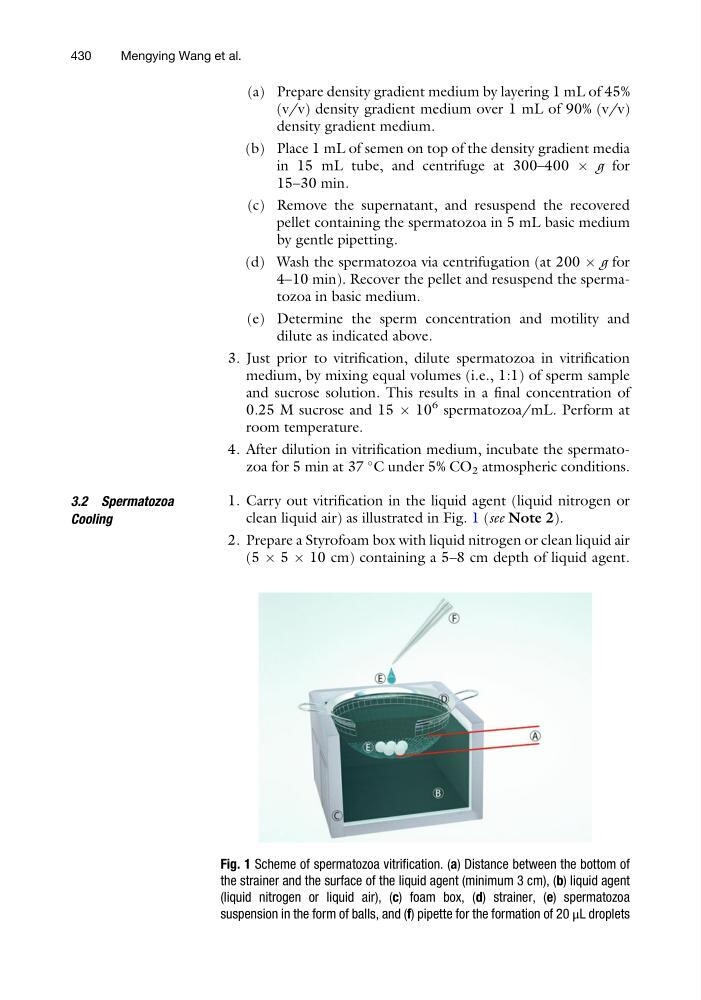
1. Carry out vitrification in the liquid agent (liquid nitrogen or
clean liquid air) as illustrated in Fig. 1 (see Note 2).
2. Prepare a Styrofoam box with liquid nitrogen or clean liquid air
(5 Â 5 Â 10 cm) containing a 5–8 cm depth of liquid agent.
Fig. 1 Scheme of spermatozoa vitrification. (a) Distance between the bottom of
the strainer and the surface of the liquid agent (minimum 3 cm), (b) liquid agent
(liquid nitrogen or liquid air), (c) foam box, (d) strainer, (e) spermatozoa
suspension in the form of balls, and (f) pipette for the formation of 20 μL droplets
430
Mengying Wang et al.
(v/v) density gradient medium over 1 mL of 90% (v/v)
density gradient medium.
(b) Place 1 mL of semen on top of the density gradient media
in 15 mL tube, and centrifuge at 300–400 Â g for
15–30 min.
(c) Remove the supernatant, and resuspend the recovered
pellet containing the spermatozoa in 5 mL basic medium
by gentle pipetting.
(d) Wash the spermatozoa via centrifugation (at 200 Â g for
4–10 min). Recover the pellet and resuspend the spermatozoa in basic medium.
(e) Determine the sperm concentration and motility and
dilute as indicated above.
3. Just prior to vitrification, dilute spermatozoa in vitrification
medium, by mixing equal volumes (i.e., 1:1) of sperm sample
and sucrose solution. This results in a final concentration of
0.25 M sucrose and 15 Â 10
6 spermatozoa/mL. Perform at
room temperature.
4. After dilution in vitrification medium, incubate the spermatozoa for 5 min at 37
C under 5% CO 2 atmospheric conditions.
3.2 Spermatozoa
Cooling
1. Carry out vitrification in the liquid agent (liquid nitrogen or
clean liquid air) as illustrated in Fig. 1 (see Note 2).
2. Prepare a Styrofoam box with liquid nitrogen or clean liquid air
(5 Â 5 Â 10 cm) containing a 5–8 cm depth of liquid agent.
Fig. 1 Scheme of spermatozoa vitrification. (a) Distance between the bottom of
the strainer and the surface of the liquid agent (minimum 3 cm), (b) liquid agent
(liquid nitrogen or liquid air), (c) foam box, (d) strainer, (e) spermatozoa
suspension in the form of balls, and (f) pipette for the formation of 20 μL droplets
430
Mengying Wang et al.