

decay coefficient, which is defined as the inverse of the penetration depth (d р ; in cm):
γ ¼
1
d p
¼
2n 1 π
ffiffiffiffiffiffiffiffiffiffiffiffiffiffiffiffiffiffiffiffiffiffiffiffiffiffiffiffiffiffiffiffiffi
sin θ
ð
Þ
2 À
n
n 1
2
r
λ
ð2Þ
where n 1 and n 2 are the refractive index values of the ATR
crystal and tissue (2.43 and 1.4, respectively), θ is the incident
angle of the infrared rays (45
), and λ the inverse of the wave
number position with maximum absorbance in the evaluated
region for the compound studied (e.g., 950 cm
À1 for dimethyl
sulfoxide, 1085 cm
À1 for ethylene glycol, and 1138 cm
À1 for
propylene glycol).
3.6 Spectral
Analysis: Membrane
Phase State and Phase
Behavior
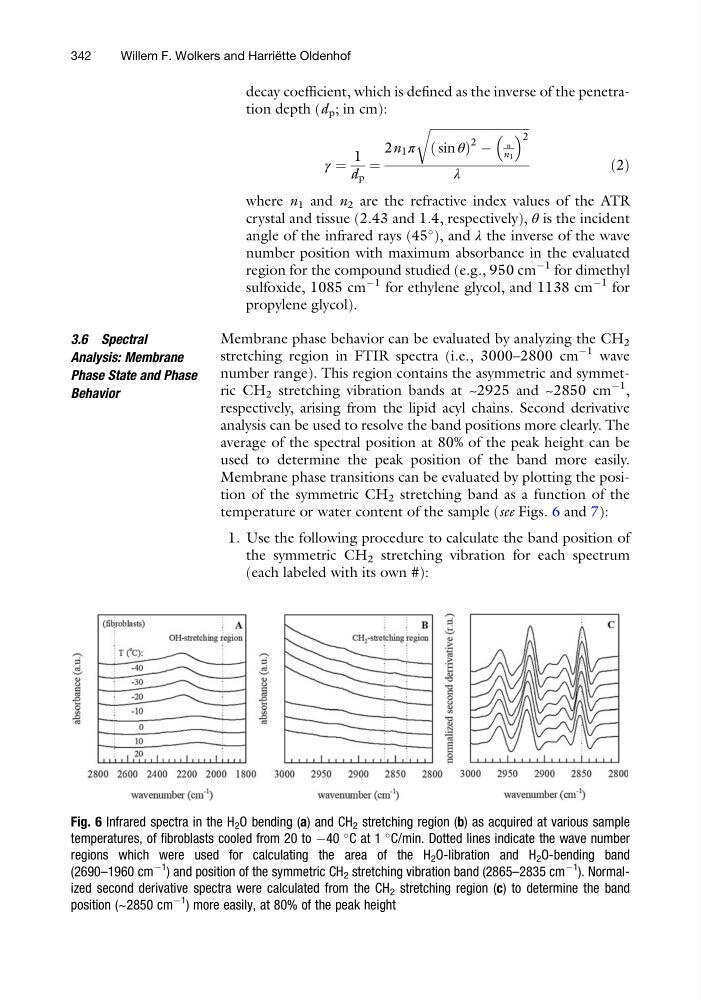
Membrane phase behavior can be evaluated by analyzing the CH 2
stretching region in FTIR spectra (i.e., 3000–2800 cm
À1 wave
number range). This region contains the asymmetric and symmetric CH 2 stretching vibration bands at ~2925 and ~2850 cm
À1 ,
respectively, arising from the lipid acyl chains. Second derivative
analysis can be used to resolve the band positions more clearly. The
average of the spectral position at 80% of the peak height can be
used to determine the peak position of the band more easily.
Membrane phase transitions can be evaluated by plotting the position of the symmetric CH 2 stretching band as a function of the
temperature or water content of the sample (see Figs. 6 and 7):
1. Use the following procedure to calculate the band position of
the symmetric CH 2 stretching vibration for each spectrum
(each labeled with its own #):
Fig. 6 Infrared spectra in the H 2 O bending (a) and CH 2 stretching region (b) as acquired at various sample
temperatures, of fibroblasts cooled from 20 to À40
C at 1
C/min. Dotted lines indicate the wave number
regions which were used for calculating the area of the H 2 O-libration and H 2 O-bending band
(2690–1960 cm
À1
) and position of the symmetric CH 2 stretching vibration band (2865–2835 cm
À1
). Normalized second derivative spectra were calculated from the CH 2 stretching region (c) to determine the band
position (~2850 cm
À1
) more easily, at 80% of the peak height
342
Willem F. Wolkers and Harrie ¨ tte Oldenhof
γ ¼
1
d p
¼
2n 1 π
ffiffiffiffiffiffiffiffiffiffiffiffiffiffiffiffiffiffiffiffiffiffiffiffiffiffiffiffiffiffiffiffiffi
sin θ
ð
Þ
2 À
n
n 1
2
r
λ
ð2Þ
where n 1 and n 2 are the refractive index values of the ATR
crystal and tissue (2.43 and 1.4, respectively), θ is the incident
angle of the infrared rays (45
), and λ the inverse of the wave
number position with maximum absorbance in the evaluated
region for the compound studied (e.g., 950 cm
À1 for dimethyl
sulfoxide, 1085 cm
À1 for ethylene glycol, and 1138 cm
À1 for
propylene glycol).
3.6 Spectral
Analysis: Membrane
Phase State and Phase
Behavior
Membrane phase behavior can be evaluated by analyzing the CH 2
stretching region in FTIR spectra (i.e., 3000–2800 cm
À1 wave
number range). This region contains the asymmetric and symmetric CH 2 stretching vibration bands at ~2925 and ~2850 cm
À1 ,
respectively, arising from the lipid acyl chains. Second derivative
analysis can be used to resolve the band positions more clearly. The
average of the spectral position at 80% of the peak height can be
used to determine the peak position of the band more easily.
Membrane phase transitions can be evaluated by plotting the position of the symmetric CH 2 stretching band as a function of the
temperature or water content of the sample (see Figs. 6 and 7):
1. Use the following procedure to calculate the band position of
the symmetric CH 2 stretching vibration for each spectrum
(each labeled with its own #):
Fig. 6 Infrared spectra in the H 2 O bending (a) and CH 2 stretching region (b) as acquired at various sample
temperatures, of fibroblasts cooled from 20 to À40
C at 1
C/min. Dotted lines indicate the wave number
regions which were used for calculating the area of the H 2 O-libration and H 2 O-bending band
(2690–1960 cm
À1
) and position of the symmetric CH 2 stretching vibration band (2865–2835 cm
À1
). Normalized second derivative spectra were calculated from the CH 2 stretching region (c) to determine the band
position (~2850 cm
À1
) more easily, at 80% of the peak height
342
Willem F. Wolkers and Harrie ¨ tte Oldenhof