

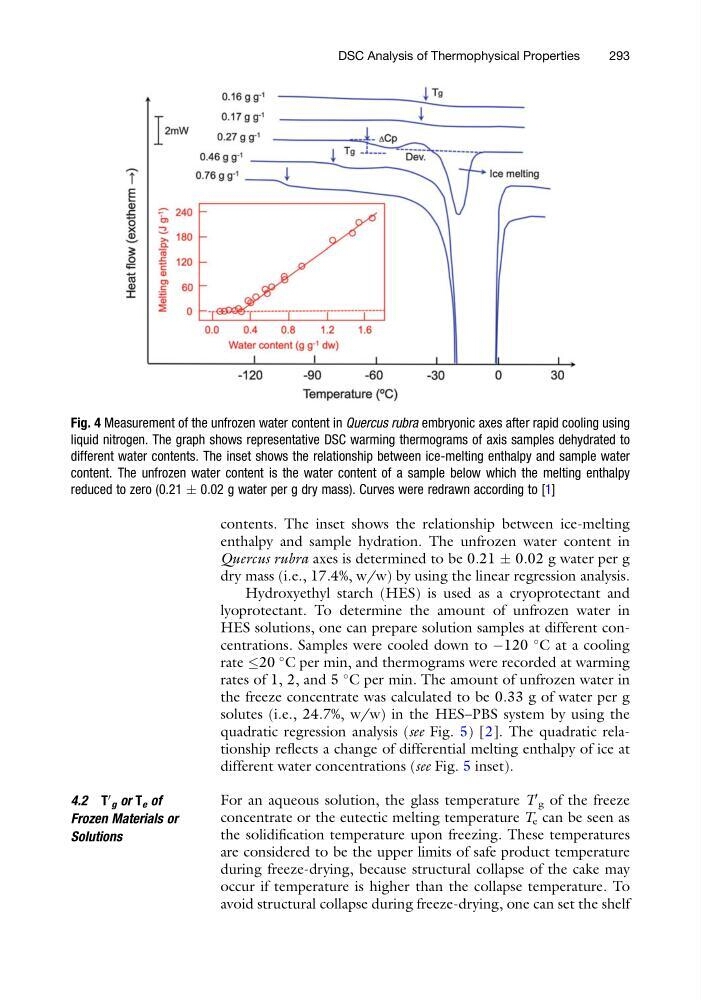
contents. The inset shows the relationship between ice-melting
enthalpy and sample hydration. The unfrozen water content in
Quercus rubra axes is determined to be 0.21 Æ 0.02 g water per g
dry mass (i.e., 17.4%, w/w) by using the linear regression analysis.
Hydroxyethyl starch (HES) is used as a cryoprotectant and
lyoprotectant. To determine the amount of unfrozen water in
HES solutions, one can prepare solution samples at different concentrations. Samples were cooled down to À120
C at a cooling
rate 20
C per min, and thermograms were recorded at warming
rates of 1, 2, and 5
C per min. The amount of unfrozen water in
the freeze concentrate was calculated to be 0.33 g of water per g
solutes (i.e., 24.7%, w/w) in the HES–PBS system by using the
quadratic regression analysis (see Fig. 5) [2]. The quadratic relationship reflects a change of differential melting enthalpy of ice at
different water concentrations (see Fig. 5 inset).
4.2 T
0
g or T e of
Frozen Materials or
Solutions
For an aqueous solution, the glass temperature T
0
g of the freeze
concentrate or the eutectic melting temperature T e can be seen as
the solidification temperature upon freezing. These temperatures
are considered to be the upper limits of safe product temperature
during freeze-drying, because structural collapse of the cake may
occur if temperature is higher than the collapse temperature. To
avoid structural collapse during freeze-drying, one can set the shelf
Fig. 4 Measurement of the unfrozen water content in Quercus rubra embryonic axes after rapid cooling using
liquid nitrogen. The graph shows representative DSC warming thermograms of axis samples dehydrated to
different water contents. The inset shows the relationship between ice-melting enthalpy and sample water
content. The unfrozen water content is the water content of a sample below which the melting enthalpy
reduced to zero (0.21 Æ 0.02 g water per g dry mass). Curves were redrawn according to [1]
DSC Analysis of Thermophysical Properties
293
enthalpy and sample hydration. The unfrozen water content in
Quercus rubra axes is determined to be 0.21 Æ 0.02 g water per g
dry mass (i.e., 17.4%, w/w) by using the linear regression analysis.
Hydroxyethyl starch (HES) is used as a cryoprotectant and
lyoprotectant. To determine the amount of unfrozen water in
HES solutions, one can prepare solution samples at different concentrations. Samples were cooled down to À120
C at a cooling
rate 20
C per min, and thermograms were recorded at warming
rates of 1, 2, and 5
C per min. The amount of unfrozen water in
the freeze concentrate was calculated to be 0.33 g of water per g
solutes (i.e., 24.7%, w/w) in the HES–PBS system by using the
quadratic regression analysis (see Fig. 5) [2]. The quadratic relationship reflects a change of differential melting enthalpy of ice at
different water concentrations (see Fig. 5 inset).
4.2 T
0
g or T e of
Frozen Materials or
Solutions
For an aqueous solution, the glass temperature T
0
g of the freeze
concentrate or the eutectic melting temperature T e can be seen as
the solidification temperature upon freezing. These temperatures
are considered to be the upper limits of safe product temperature
during freeze-drying, because structural collapse of the cake may
occur if temperature is higher than the collapse temperature. To
avoid structural collapse during freeze-drying, one can set the shelf
Fig. 4 Measurement of the unfrozen water content in Quercus rubra embryonic axes after rapid cooling using
liquid nitrogen. The graph shows representative DSC warming thermograms of axis samples dehydrated to
different water contents. The inset shows the relationship between ice-melting enthalpy and sample water
content. The unfrozen water content is the water content of a sample below which the melting enthalpy
reduced to zero (0.21 Æ 0.02 g water per g dry mass). Curves were redrawn according to [1]
DSC Analysis of Thermophysical Properties
293