

4 Specific Measurements of Thermal Properties for Biomaterials and Protectant
Solutions
4.1 Unfrozen Water
Content in Frozen
Materials or Solutions
The unfreezable water content is referred to the water content of a
sample, below which the ice-melting enthalpy is zero. The unfrozen
water content in frozen materials or solutions is the amount of
amorphous water in the freeze-concentrated domain. Theoretically,
the amount of unfreezable water should be equal to the unfrozen
water in maximally freeze-concentrated samples.
Figure 4 describes an example to determine the unfrozen water
content in Quercus rubra axes [1]. In order to determine the
unfrozen water content in a given freezing condition, one needs
to prepare a series of samples with different initial water contents or
hydration levels. Axis samples were first pre-dried to different water
contents. Samples were cooled rapidly (ca. 100–300
C per min)
with liquid nitrogen to À130
C, and thermal transition events of
cellular water were recorded during warming at 10
C per min.
Ice-melting enthalpies of all samples were measured. The amount
of ice formed in a sample can be quantified by integrating the
enthalpy of the freezing peak(s) and/or ice-melting peak(s). The
amount of unfrozen water in frozen materials or solutions can be
determined by plotting the enthalpic values of ice-melting against
sample water content (%) or hydration (g water per g dry mass) (see
Fig. 4 inset). DSC curves in Fig. 4 show representative warming
thermograms of axis samples that were pre-dried to different water
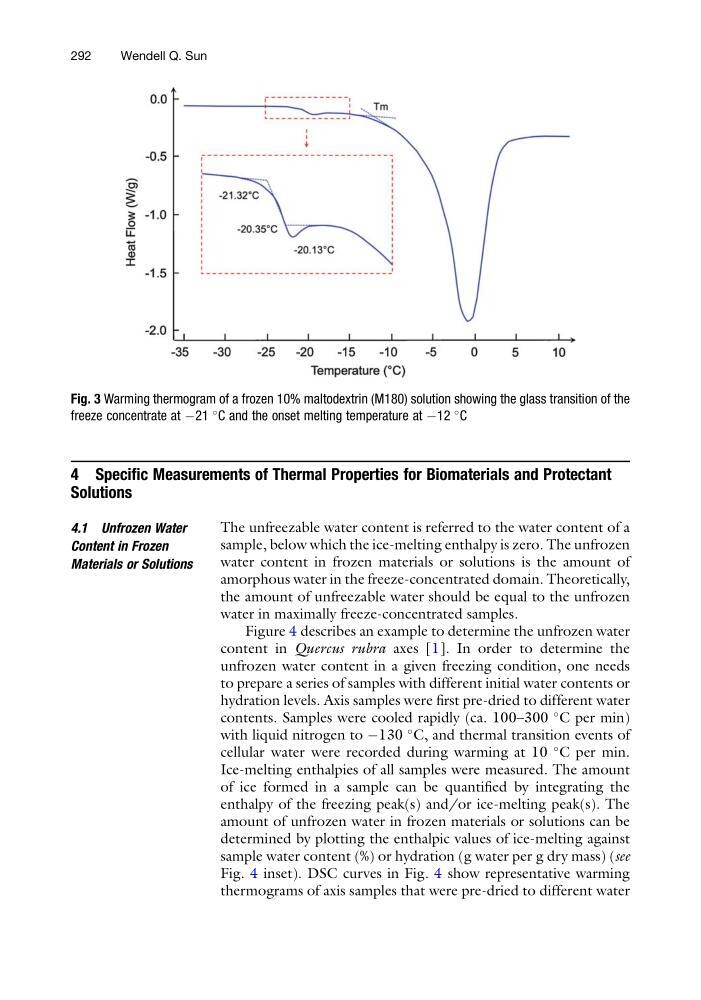
Fig. 3 Warming thermogram of a frozen 10% maltodextrin (M180) solution showing the glass transition of the
freeze concentrate at À21
C and the onset melting temperature at À12
C
292
Wendell Q. Sun
Solutions
4.1 Unfrozen Water
Content in Frozen
Materials or Solutions
The unfreezable water content is referred to the water content of a
sample, below which the ice-melting enthalpy is zero. The unfrozen
water content in frozen materials or solutions is the amount of
amorphous water in the freeze-concentrated domain. Theoretically,
the amount of unfreezable water should be equal to the unfrozen
water in maximally freeze-concentrated samples.
Figure 4 describes an example to determine the unfrozen water
content in Quercus rubra axes [1]. In order to determine the
unfrozen water content in a given freezing condition, one needs
to prepare a series of samples with different initial water contents or
hydration levels. Axis samples were first pre-dried to different water
contents. Samples were cooled rapidly (ca. 100–300
C per min)
with liquid nitrogen to À130
C, and thermal transition events of
cellular water were recorded during warming at 10
C per min.
Ice-melting enthalpies of all samples were measured. The amount
of ice formed in a sample can be quantified by integrating the
enthalpy of the freezing peak(s) and/or ice-melting peak(s). The
amount of unfrozen water in frozen materials or solutions can be
determined by plotting the enthalpic values of ice-melting against
sample water content (%) or hydration (g water per g dry mass) (see
Fig. 4 inset). DSC curves in Fig. 4 show representative warming
thermograms of axis samples that were pre-dried to different water
Fig. 3 Warming thermogram of a frozen 10% maltodextrin (M180) solution showing the glass transition of the
freeze concentrate at À21
C and the onset melting temperature at À12
C
292
Wendell Q. Sun