

considered as independent processes [61], and a three-parameter
model which takes solute-solvent interactions during transport
across the cellular membrane into account [62]. Once cell- and
CPA-specific Lp and Ps values are known, the abovementioned
models can be used to predict volume responses during various
CPA (un)loading, cooling, and warming procedures, and hence
applied to predict optimal cryopreservation protocols taking the
osmotic tolerance limits of the cell into account [63]. It should be
noted, however, that specific experimental conditions that are used
to derive Lp and Ps values may not be valid for all conditions
encountered during cryopreservation processing [31]. For example, the rate of water moving into a cell in hypotonic environment
often differs from that of the rate at which water moves out of a cell
in hypertonic medium. This phenomenon is referred to as rectification [31, 64, 65] and is relevant to accurately predict (hypertonic)
cell volume behavior during CPA loading and cooling/freezing
versus the (hypotonic) volume responses occurring during warming/thawing and CPA unloading (see Fig. 5b, d).
Vitrification solutions are comprised of high concentrations of
CPAs. Because of their tolerance limits, cells cannot be directly
exposed to a full-strength vitrification solution and therefore need
to be exposed to serial dilutions of the vitrification solution. During
the first step, cells are typically exposed to CPA concentrations
similar to those that are used in a standard cryopreservation procedure, which is done to load the cells with CPAs. Subsequent
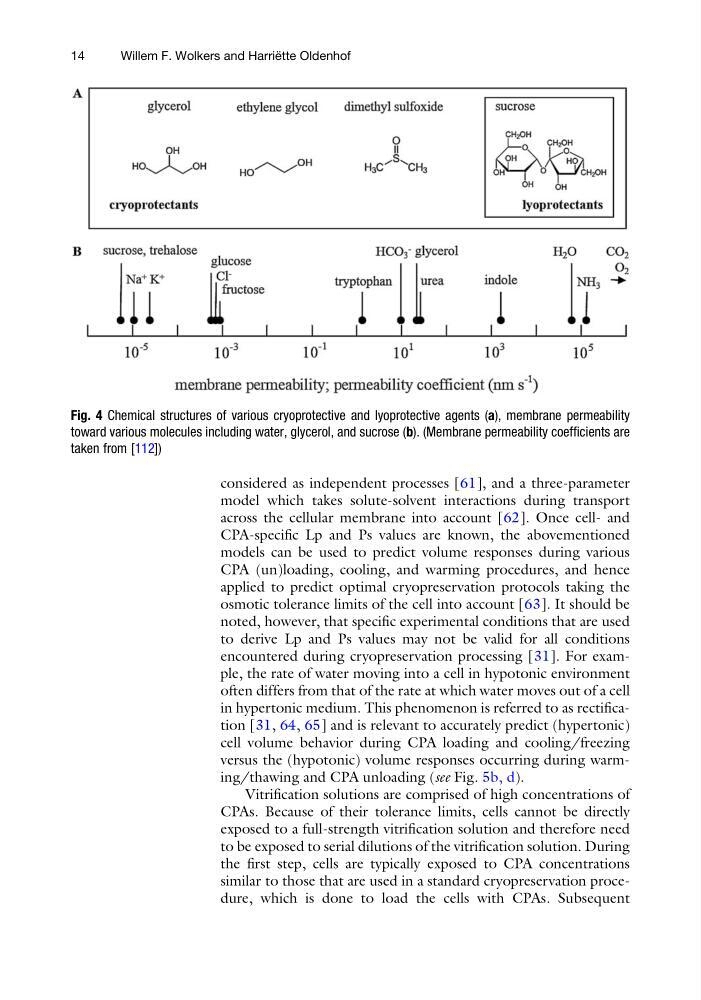
Fig. 4 Chemical structures of various cryoprotective and lyoprotective agents (a), membrane permeability
toward various molecules including water, glycerol, and sucrose (b). (Membrane permeability coefficients are
taken from [112])
14
Willem F. Wolkers and Harrie ¨ tte Oldenhof
model which takes solute-solvent interactions during transport
across the cellular membrane into account [62]. Once cell- and
CPA-specific Lp and Ps values are known, the abovementioned
models can be used to predict volume responses during various
CPA (un)loading, cooling, and warming procedures, and hence
applied to predict optimal cryopreservation protocols taking the
osmotic tolerance limits of the cell into account [63]. It should be
noted, however, that specific experimental conditions that are used
to derive Lp and Ps values may not be valid for all conditions
encountered during cryopreservation processing [31]. For example, the rate of water moving into a cell in hypotonic environment
often differs from that of the rate at which water moves out of a cell
in hypertonic medium. This phenomenon is referred to as rectification [31, 64, 65] and is relevant to accurately predict (hypertonic)
cell volume behavior during CPA loading and cooling/freezing
versus the (hypotonic) volume responses occurring during warming/thawing and CPA unloading (see Fig. 5b, d).
Vitrification solutions are comprised of high concentrations of
CPAs. Because of their tolerance limits, cells cannot be directly
exposed to a full-strength vitrification solution and therefore need
to be exposed to serial dilutions of the vitrification solution. During
the first step, cells are typically exposed to CPA concentrations
similar to those that are used in a standard cryopreservation procedure, which is done to load the cells with CPAs. Subsequent
Fig. 4 Chemical structures of various cryoprotective and lyoprotective agents (a), membrane permeability
toward various molecules including water, glycerol, and sucrose (b). (Membrane permeability coefficients are
taken from [112])
14
Willem F. Wolkers and Harrie ¨ tte Oldenhof