

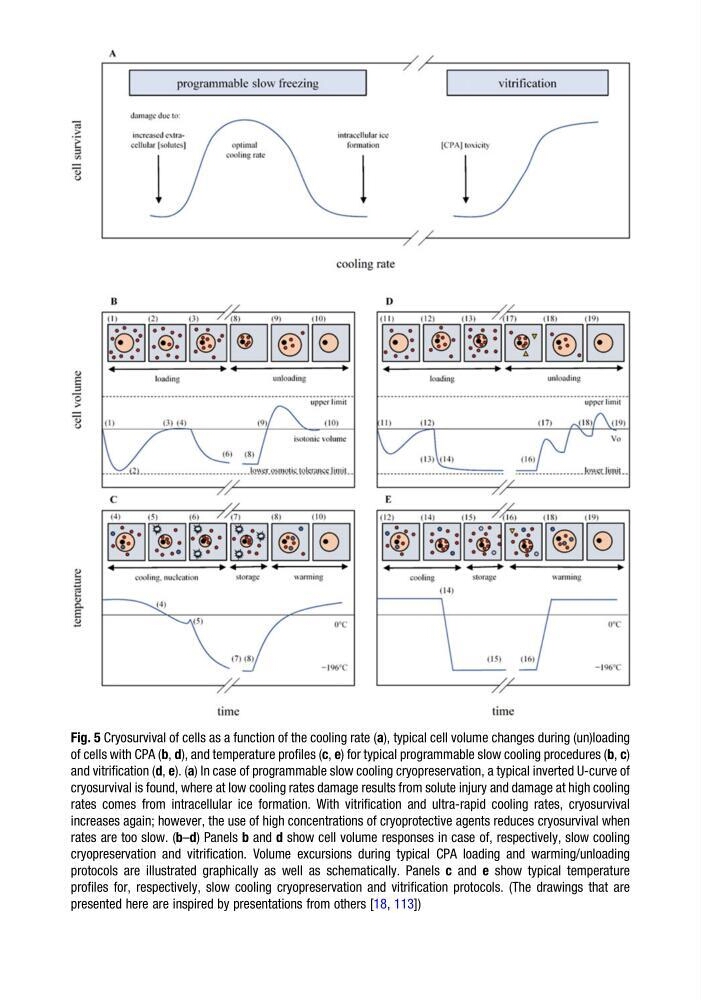
Fig. 5 Cryosurvival of cells as a function of the cooling rate (a), typical cell volume changes during (un)loading
of cells with CPA (b, d), and temperature profiles (c, e) for typical programmable slow cooling procedures (b, c)
and vitrification (d, e). (a) In case of programmable slow cooling cryopreservation, a typical inverted U-curve of
cryosurvival is found, where at low cooling rates damage results from solute injury and damage at high cooling
rates comes from intracellular ice formation. With vitrification and ultra-rapid cooling rates, cryosurvival
increases again; however, the use of high concentrations of cryoprotective agents reduces cryosurvival when
rates are too slow. (b–d) Panels b and d show cell volume responses in case of, respectively, slow cooling
cryopreservation and vitrification. Volume excursions during typical CPA loading and warming/unloading
protocols are illustrated graphically as well as schematically. Panels c and e show typical temperature
profiles for, respectively, slow cooling cryopreservation and vitrification protocols. (The drawings that are
presented here are inspired by presentations from others [18, 113])
of cells with CPA (b, d), and temperature profiles (c, e) for typical programmable slow cooling procedures (b, c)
and vitrification (d, e). (a) In case of programmable slow cooling cryopreservation, a typical inverted U-curve of
cryosurvival is found, where at low cooling rates damage results from solute injury and damage at high cooling
rates comes from intracellular ice formation. With vitrification and ultra-rapid cooling rates, cryosurvival
increases again; however, the use of high concentrations of cryoprotective agents reduces cryosurvival when
rates are too slow. (b–d) Panels b and d show cell volume responses in case of, respectively, slow cooling
cryopreservation and vitrification. Volume excursions during typical CPA loading and warming/unloading
protocols are illustrated graphically as well as schematically. Panels c and e show typical temperature
profiles for, respectively, slow cooling cryopreservation and vitrification protocols. (The drawings that are
presented here are inspired by presentations from others [18, 113])