

over 40 min of annealing time in the sucrose assay (SSA). In
addition, the mean grain size in the SSA compared to the SCA
crystals was much smaller. Crystals at an annealing time of 5 min
were too small to observe in the SSA. These results suggest that
using PBS as a solute is much more sensitive to ice recrystallization,
specifically between 20 and 40 min. The sandwich method showed
inhibition toward ice recrystallization which may be due to inhibitory effects generated from the high concentration of solute present in the 40% sucrose solution [42].
These results can be justified by understanding the mechanisms
of ice recrystallization. Ice recrystallization occurs though Ostwald
ripening and/or a grain boundary migration mechanism [2, 3, 66,
67]. The effect of the presence of solute on ice recrystallization can
be explained by both. According to the process of grain boundary
migration [55], solute particles are embedded within the boundary
between two ice grains creating a low free-energy system. If the
grain boundary were to migrate and escape the particle, its surface
area would increase resulting in an unfavorable rise in free energy.
Consequently, the presence of particles inhibits grain boundary
migration and therefore ice recrystallization. In the Ostwald ripening mechanism, bulk water is taken into account. For solutions with
smaller ice volumes (i.e., 40% sucrose), the rate of diffusion of a
water molecule from a smaller crystal through the bulk solution to a
larger crystal is dependent on several factors such as the solution
viscosity, ice volume fraction, and the temperature [67]. According
to this theory, the diffusion rate of the liquid phase is the ratelimiting process of ice recrystallization. Thus, a solution having a
high viscosity, such as 40% sucrose, would exhibit a depressed
recrystallization rate.
The splat assay (SCA) and sucrose assay (SSA) are often used to
generate a quantitative value representing the efficiency of a compound’s ability to inhibit ice recrystallization as a function of its
concentration (typically referred to as an IC50 value). To evaluate
the variance in quantitative values between the splat cooling and
sandwich method, an antifreeze protein isolated from barfin plaice
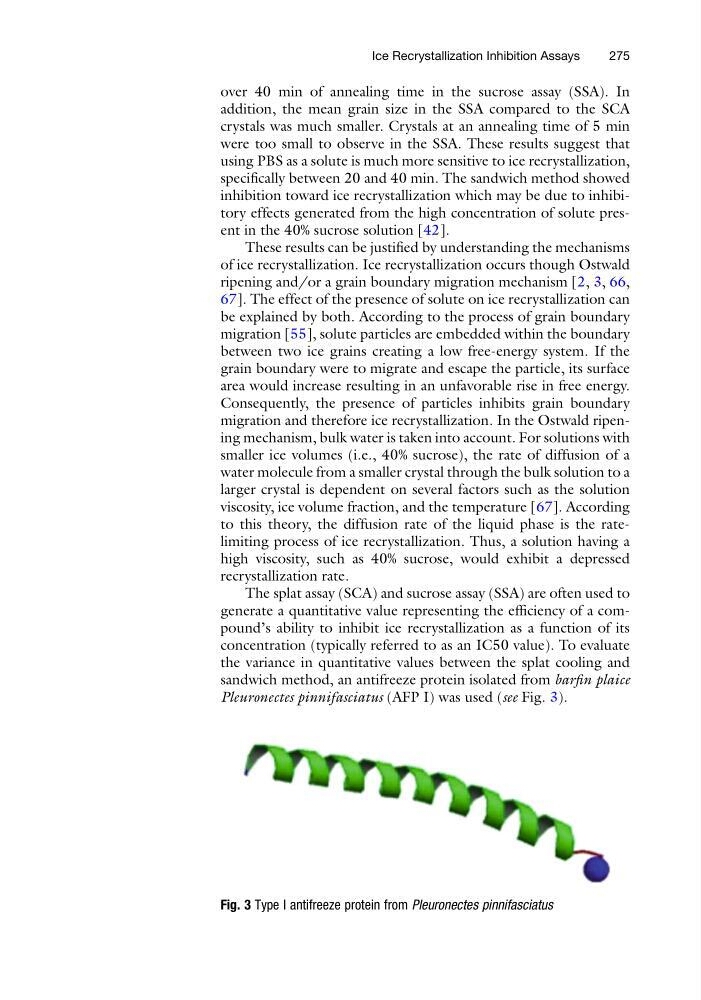
Pleuronectes pinnifasciatus (AFP I) was used (see Fig. 3).
Fig. 3 Type I antifreeze protein from Pleuronectes pinnifasciatus
Ice Recrystallization Inhibition Assays
275
addition, the mean grain size in the SSA compared to the SCA
crystals was much smaller. Crystals at an annealing time of 5 min
were too small to observe in the SSA. These results suggest that
using PBS as a solute is much more sensitive to ice recrystallization,
specifically between 20 and 40 min. The sandwich method showed
inhibition toward ice recrystallization which may be due to inhibitory effects generated from the high concentration of solute present in the 40% sucrose solution [42].
These results can be justified by understanding the mechanisms
of ice recrystallization. Ice recrystallization occurs though Ostwald
ripening and/or a grain boundary migration mechanism [2, 3, 66,
67]. The effect of the presence of solute on ice recrystallization can
be explained by both. According to the process of grain boundary
migration [55], solute particles are embedded within the boundary
between two ice grains creating a low free-energy system. If the
grain boundary were to migrate and escape the particle, its surface
area would increase resulting in an unfavorable rise in free energy.
Consequently, the presence of particles inhibits grain boundary
migration and therefore ice recrystallization. In the Ostwald ripening mechanism, bulk water is taken into account. For solutions with
smaller ice volumes (i.e., 40% sucrose), the rate of diffusion of a
water molecule from a smaller crystal through the bulk solution to a
larger crystal is dependent on several factors such as the solution
viscosity, ice volume fraction, and the temperature [67]. According
to this theory, the diffusion rate of the liquid phase is the ratelimiting process of ice recrystallization. Thus, a solution having a
high viscosity, such as 40% sucrose, would exhibit a depressed
recrystallization rate.
The splat assay (SCA) and sucrose assay (SSA) are often used to
generate a quantitative value representing the efficiency of a compound’s ability to inhibit ice recrystallization as a function of its
concentration (typically referred to as an IC50 value). To evaluate
the variance in quantitative values between the splat cooling and
sandwich method, an antifreeze protein isolated from barfin plaice
Pleuronectes pinnifasciatus (AFP I) was used (see Fig. 3).
Fig. 3 Type I antifreeze protein from Pleuronectes pinnifasciatus
Ice Recrystallization Inhibition Assays
275