

position turntable for 30 min (see Note 6). Use two samples for
quality control purposes to evaluate the moisture content.
(b) Microwave-assisted drying of sperm: Deposit a volume
of 40 μL of sperm solution on glass coverslips (Thermanox),
and dry using a commercial microwave oven (CEM SAM
225, Matthews, NC) set to 20% power in a table relative
humidity environment (11.0 Æ 0.7%) for 30 min.
3. Storage of oocytes: Store dried oocytes in glass vials at 11% RH
at ambient temperature (22–24
C).
4. (a) Rehydration of oocytes: Expose dried (stored) samples to
500 μL of H-MEM medium supplemented with 2.0 mM Lglutamine, 1.0 mM sodium pyruvate, 100 IU/mL penicillin, and 100 IU/mL streptomycin for 30 min.
(b) Rehydration of sperm: Rehydrate sperm samples in 1 mL
Hams-HEPES media at 38.5
C for 1 h with mild shaking.
3.2 Laser-Assisted
Drying of Proteins
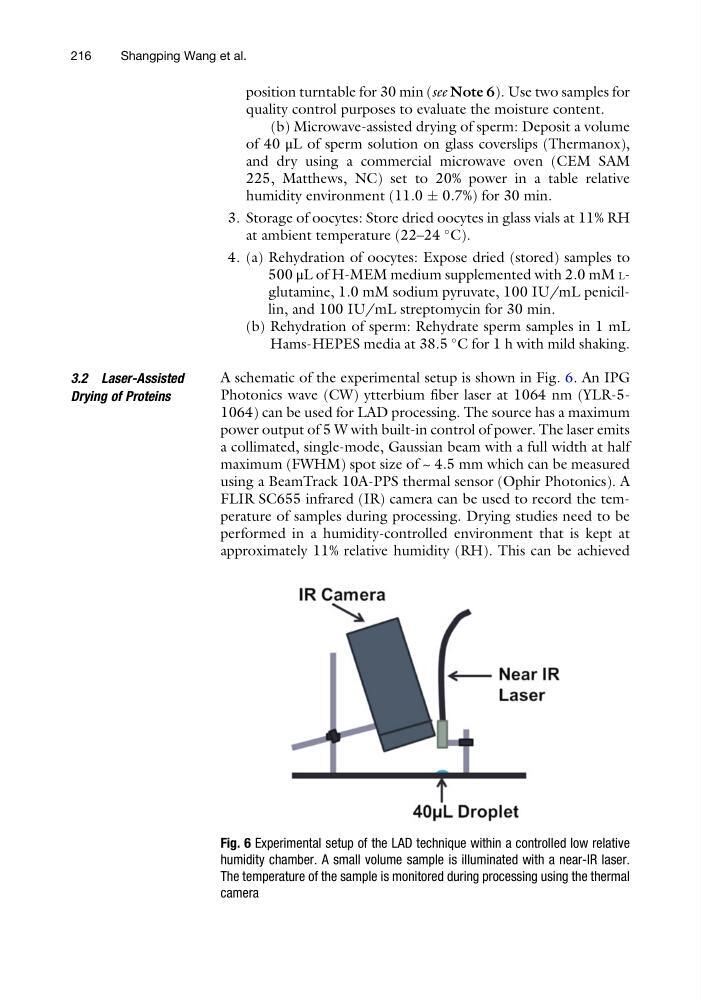
A schematic of the experimental setup is shown in Fig. 6. An IPG
Photonics wave (CW) ytterbium fiber laser at 1064 nm (YLR-51064) can be used for LAD processing. The source has a maximum
power output of 5 W with built-in control of power. The laser emits
a collimated, single-mode, Gaussian beam with a full width at half
maximum (FWHM) spot size of ~ 4.5 mm which can be measured
using a BeamTrack 10A-PPS thermal sensor (Ophir Photonics). A
FLIR SC655 infrared (IR) camera can be used to record the temperature of samples during processing. Drying studies need to be
performed in a humidity-controlled environment that is kept at
approximately 11% relative humidity (RH). This can be achieved
Fig. 6 Experimental setup of the LAD technique within a controlled low relative
humidity chamber. A small volume sample is illuminated with a near-IR laser.
The temperature of the sample is monitored during processing using the thermal
camera
216
Shangping Wang et al.
quality control purposes to evaluate the moisture content.
(b) Microwave-assisted drying of sperm: Deposit a volume
of 40 μL of sperm solution on glass coverslips (Thermanox),
and dry using a commercial microwave oven (CEM SAM
225, Matthews, NC) set to 20% power in a table relative
humidity environment (11.0 Æ 0.7%) for 30 min.
3. Storage of oocytes: Store dried oocytes in glass vials at 11% RH
at ambient temperature (22–24
C).
4. (a) Rehydration of oocytes: Expose dried (stored) samples to
500 μL of H-MEM medium supplemented with 2.0 mM Lglutamine, 1.0 mM sodium pyruvate, 100 IU/mL penicillin, and 100 IU/mL streptomycin for 30 min.
(b) Rehydration of sperm: Rehydrate sperm samples in 1 mL
Hams-HEPES media at 38.5
C for 1 h with mild shaking.
3.2 Laser-Assisted
Drying of Proteins
A schematic of the experimental setup is shown in Fig. 6. An IPG
Photonics wave (CW) ytterbium fiber laser at 1064 nm (YLR-51064) can be used for LAD processing. The source has a maximum
power output of 5 W with built-in control of power. The laser emits
a collimated, single-mode, Gaussian beam with a full width at half
maximum (FWHM) spot size of ~ 4.5 mm which can be measured
using a BeamTrack 10A-PPS thermal sensor (Ophir Photonics). A
FLIR SC655 infrared (IR) camera can be used to record the temperature of samples during processing. Drying studies need to be
performed in a humidity-controlled environment that is kept at
approximately 11% relative humidity (RH). This can be achieved
Fig. 6 Experimental setup of the LAD technique within a controlled low relative
humidity chamber. A small volume sample is illuminated with a near-IR laser.
The temperature of the sample is monitored during processing using the thermal
camera
216
Shangping Wang et al.