

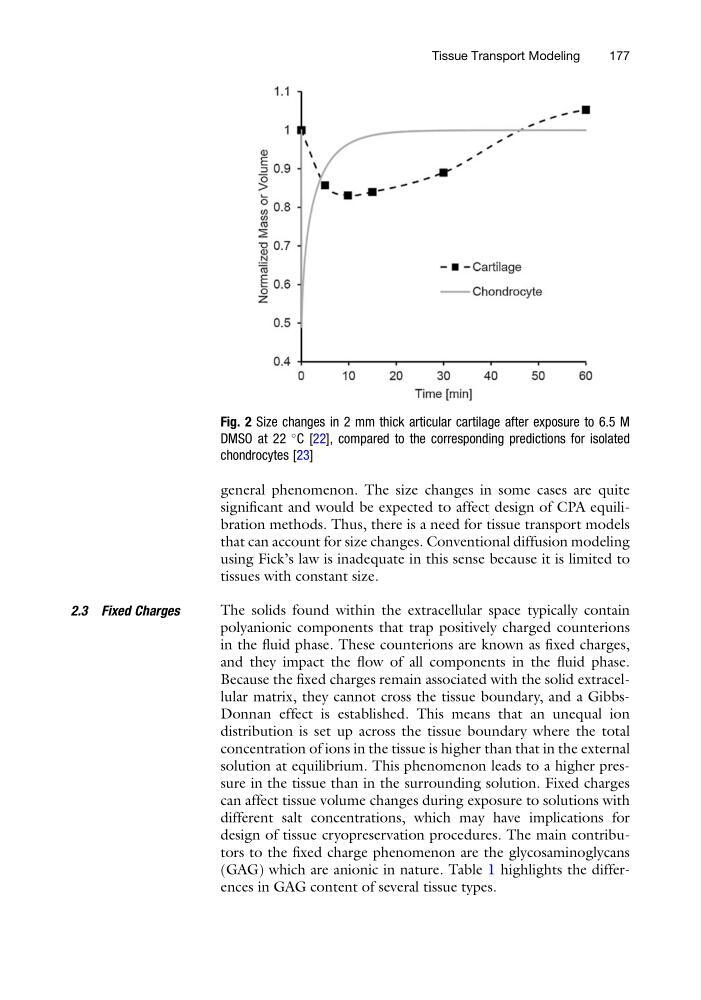
general phenomenon. The size changes in some cases are quite
significant and would be expected to affect design of CPA equilibration methods. Thus, there is a need for tissue transport models
that can account for size changes. Conventional diffusion modeling
using Fick’s law is inadequate in this sense because it is limited to
tissues with constant size.
2.3 Fixed Charges
The solids found within the extracellular space typically contain
polyanionic components that trap positively charged counterions
in the fluid phase. These counterions are known as fixed charges,
and they impact the flow of all components in the fluid phase.
Because the fixed charges remain associated with the solid extracellular matrix, they cannot cross the tissue boundary, and a GibbsDonnan effect is established. This means that an unequal ion
distribution is set up across the tissue boundary where the total
concentration of ions in the tissue is higher than that in the external
solution at equilibrium. This phenomenon leads to a higher pressure in the tissue than in the surrounding solution. Fixed charges
can affect tissue volume changes during exposure to solutions with
different salt concentrations, which may have implications for
design of tissue cryopreservation procedures. The main contributors to the fixed charge phenomenon are the glycosaminoglycans
(GAG) which are anionic in nature. Table 1 highlights the differences in GAG content of several tissue types.
Fig. 2 Size changes in 2 mm thick articular cartilage after exposure to 6.5 M
DMSO at 22
C [22], compared to the corresponding predictions for isolated
chondrocytes [23]
Tissue Transport Modeling
177
significant and would be expected to affect design of CPA equilibration methods. Thus, there is a need for tissue transport models
that can account for size changes. Conventional diffusion modeling
using Fick’s law is inadequate in this sense because it is limited to
tissues with constant size.
2.3 Fixed Charges
The solids found within the extracellular space typically contain
polyanionic components that trap positively charged counterions
in the fluid phase. These counterions are known as fixed charges,
and they impact the flow of all components in the fluid phase.
Because the fixed charges remain associated with the solid extracellular matrix, they cannot cross the tissue boundary, and a GibbsDonnan effect is established. This means that an unequal ion
distribution is set up across the tissue boundary where the total
concentration of ions in the tissue is higher than that in the external
solution at equilibrium. This phenomenon leads to a higher pressure in the tissue than in the surrounding solution. Fixed charges
can affect tissue volume changes during exposure to solutions with
different salt concentrations, which may have implications for
design of tissue cryopreservation procedures. The main contributors to the fixed charge phenomenon are the glycosaminoglycans
(GAG) which are anionic in nature. Table 1 highlights the differences in GAG content of several tissue types.
Fig. 2 Size changes in 2 mm thick articular cartilage after exposure to 6.5 M
DMSO at 22
C [22], compared to the corresponding predictions for isolated
chondrocytes [23]
Tissue Transport Modeling
177