

Figure 3 demonstrates how fixed charges influence the equilibrium tissue volume when bovine articular cartilage is exposed to
different concentrations of sodium chloride. As the sodium chloride concentration of the bath increases, water leaves the tissue to
maintain Donnan equilibrium, which results in a decrease in the
volume of the tissue. This shrinkage is expected to result in an
increase in the fixed charge concentration within the tissue.
2.4 Coupling
Between Cell
Membrane Transport
and Mass Transfer
in the Extracellular
Space
It is common to assume an infinite bath when modeling mass
transfer in cell suspensions because the cells occupy such a small
fraction of the sample volume. This assumption is equivalent to
neglecting the effects of cell membrane transport on the composition of the bath. Most tissues have much higher cell density, so
exchange of water and CPA between the cells and the surrounding
extracellular fluid has a non-negligible effect on the composition of
the extracellular fluid.
This coupling between cell membrane transport and mass
transfer in the extracellular fluid manifests itself in three key ways.
First, mass transfer in the extracellular space leads to the development of a spatial gradient in CPA concentration, which causes the
cell response at the center of the tissue to differ from that at the
tissue surface. This effect is illustrated in Fig. 4 for pancreatic islets.
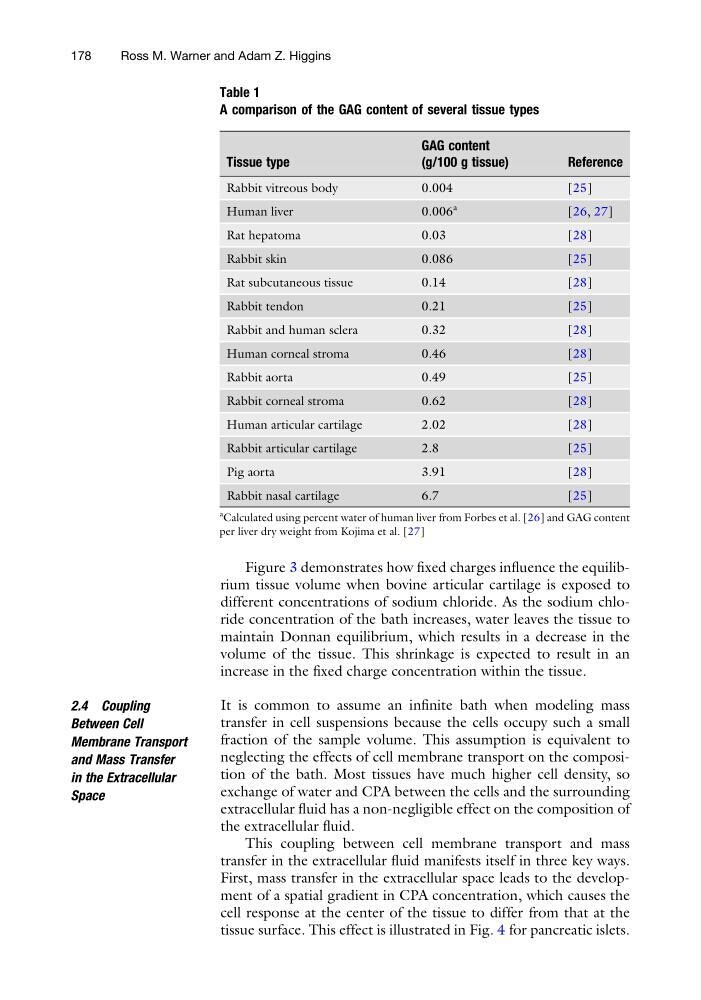
Table 1
A comparison of the GAG content of several tissue types
Tissue type
GAG content
(g/100 g tissue)
Reference
Rabbit vitreous body
0.004
[25]
Human liver
0.006
a
[26, 27]
Rat hepatoma
0.03
[28]
Rabbit skin
0.086
[25]
Rat subcutaneous tissue
0.14
[28]
Rabbit tendon
0.21
[25]
Rabbit and human sclera
0.32
[28]
Human corneal stroma
0.46
[28]
Rabbit aorta
0.49
[25]
Rabbit corneal stroma
0.62
[28]
Human articular cartilage
2.02
[28]
Rabbit articular cartilage
2.8
[25]
Pig aorta
3.91
[28]
Rabbit nasal cartilage
6.7
[25]
a
Calculated using percent water of human liver from Forbes et al. [26] and GAG content
per liver dry weight from Kojima et al. [27]
178
Ross M. Warner and Adam Z. Higgins
different concentrations of sodium chloride. As the sodium chloride concentration of the bath increases, water leaves the tissue to
maintain Donnan equilibrium, which results in a decrease in the
volume of the tissue. This shrinkage is expected to result in an
increase in the fixed charge concentration within the tissue.
2.4 Coupling
Between Cell
Membrane Transport
and Mass Transfer
in the Extracellular
Space
It is common to assume an infinite bath when modeling mass
transfer in cell suspensions because the cells occupy such a small
fraction of the sample volume. This assumption is equivalent to
neglecting the effects of cell membrane transport on the composition of the bath. Most tissues have much higher cell density, so
exchange of water and CPA between the cells and the surrounding
extracellular fluid has a non-negligible effect on the composition of
the extracellular fluid.
This coupling between cell membrane transport and mass
transfer in the extracellular fluid manifests itself in three key ways.
First, mass transfer in the extracellular space leads to the development of a spatial gradient in CPA concentration, which causes the
cell response at the center of the tissue to differ from that at the
tissue surface. This effect is illustrated in Fig. 4 for pancreatic islets.
Table 1
A comparison of the GAG content of several tissue types
Tissue type
GAG content
(g/100 g tissue)
Reference
Rabbit vitreous body
0.004
[25]
Human liver
0.006
a
[26, 27]
Rat hepatoma
0.03
[28]
Rabbit skin
0.086
[25]
Rat subcutaneous tissue
0.14
[28]
Rabbit tendon
0.21
[25]
Rabbit and human sclera
0.32
[28]
Human corneal stroma
0.46
[28]
Rabbit aorta
0.49
[25]
Rabbit corneal stroma
0.62
[28]
Human articular cartilage
2.02
[28]
Rabbit articular cartilage
2.8
[25]
Pig aorta
3.91
[28]
Rabbit nasal cartilage
6.7
[25]
a
Calculated using percent water of human liver from Forbes et al. [26] and GAG content
per liver dry weight from Kojima et al. [27]
178
Ross M. Warner and Adam Z. Higgins