

Note that this elegant approach may be generalized to systems with
permeating solutes (e.g., see Woelders and Chaveiro for the case
with one permeating solute [3]). The challenge here is that nonlinear cooling rates are difficult to achieve. Typically controlled rate
freezers achieve linear cooling rate protocols; however, there are
some controlled rate freezers that are more flexible in this regard
[122]. Nevertheless, with enough piecewise temperature versus
time intervals over a number of time steps, a reasonable approximation to any cooling profile may be made, and modeling can be
performed to ensure that these approximations do not cause excessive intracellular supercooling (in other words, one may use linear
interpolation to approximate any thermal profile).
PIF Models: Note that the same two optimization approaches
above apply for the more modern probability of ice formation
models. Namely, one can decide on a maximal acceptable likelihood
of intracellular ice formation and solve for a nonlinear (in time)
temperature profile. Or, one may prescribe a linear cooling protocol, and then observe that the likelihood of intracellular ice formation is still a monotonically increasing function with cooling rate.
See Karlsson et al. [123] for a complete example of this approach
with mouse oocytes. Alternatively, an excellent application of a
variant of this approach is given by Liu et al. [4] in which an
interrupted cooling protocol was developed.
Cost Function Approach: Anderson et al. [19] proposed adopting a
cost function approach to damage modeling during cooling. In
particular, their approach is to first account for solute effects by
adapting the cost function described above in Eq. 33, but include
the concentration of non-permeating solutes:
J SOL ¼
ð t
0
m
i
s ðtÞ
α s
þ m
i
n ðtÞ
α n ds,
ð43Þ
where as above, α s and α n are positive numbers. There are temperature dependent effects that should be accounted for, and the
relative impact of CPA and salt concentrations needs much
exploration.
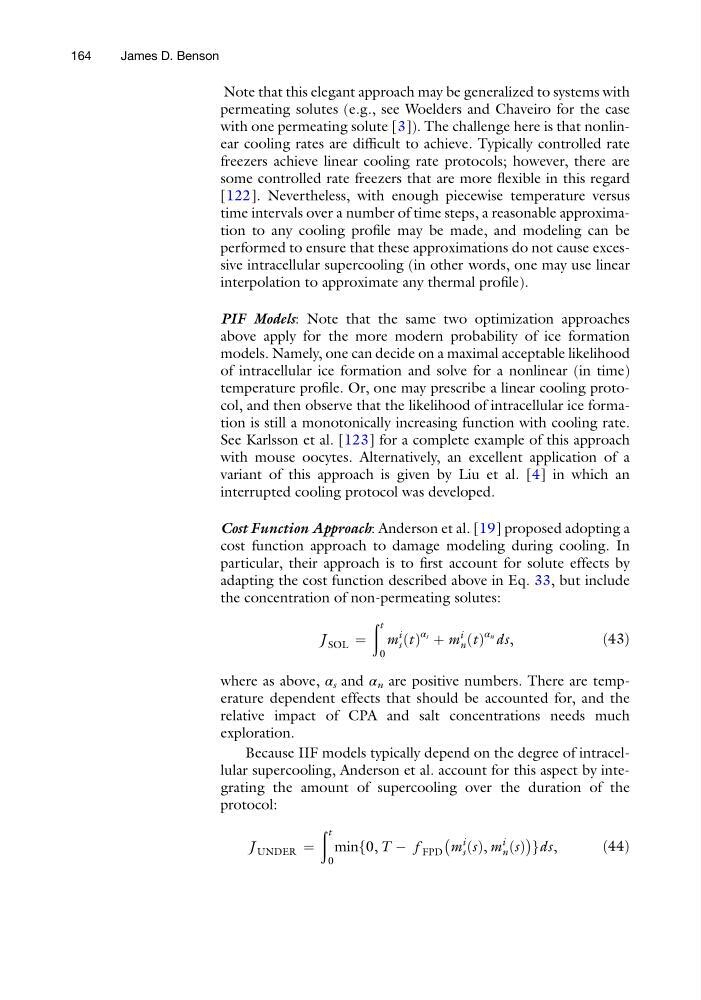
Because IIF models typically depend on the degree of intracellular supercooling, Anderson et al. account for this aspect by integrating the amount of supercooling over the duration of the
protocol:
J UNDER ¼
ð t
0
minf0, T À f FPD m
i
s ðsÞ, m
i
n ðsÞ
À
Á gds,
ð44Þ
164
James D. Benson
permeating solutes (e.g., see Woelders and Chaveiro for the case
with one permeating solute [3]). The challenge here is that nonlinear cooling rates are difficult to achieve. Typically controlled rate
freezers achieve linear cooling rate protocols; however, there are
some controlled rate freezers that are more flexible in this regard
[122]. Nevertheless, with enough piecewise temperature versus
time intervals over a number of time steps, a reasonable approximation to any cooling profile may be made, and modeling can be
performed to ensure that these approximations do not cause excessive intracellular supercooling (in other words, one may use linear
interpolation to approximate any thermal profile).
PIF Models: Note that the same two optimization approaches
above apply for the more modern probability of ice formation
models. Namely, one can decide on a maximal acceptable likelihood
of intracellular ice formation and solve for a nonlinear (in time)
temperature profile. Or, one may prescribe a linear cooling protocol, and then observe that the likelihood of intracellular ice formation is still a monotonically increasing function with cooling rate.
See Karlsson et al. [123] for a complete example of this approach
with mouse oocytes. Alternatively, an excellent application of a
variant of this approach is given by Liu et al. [4] in which an
interrupted cooling protocol was developed.
Cost Function Approach: Anderson et al. [19] proposed adopting a
cost function approach to damage modeling during cooling. In
particular, their approach is to first account for solute effects by
adapting the cost function described above in Eq. 33, but include
the concentration of non-permeating solutes:
J SOL ¼
ð t
0
m
i
s ðtÞ
α s
þ m
i
n ðtÞ
α n ds,
ð43Þ
where as above, α s and α n are positive numbers. There are temperature dependent effects that should be accounted for, and the
relative impact of CPA and salt concentrations needs much
exploration.
Because IIF models typically depend on the degree of intracellular supercooling, Anderson et al. account for this aspect by integrating the amount of supercooling over the duration of the
protocol:
J UNDER ¼
ð t
0
minf0, T À f FPD m
i
s ðsÞ, m
i
n ðsÞ
À
Á gds,
ð44Þ
164
James D. Benson