

dW
dt
¼ ÀL p ðT ÞART p=1:86:
ð40Þ
Next, using the Boyle van ’t Hoff relationship, the intracellular
water may be expressed directly in terms of osmolality: W ¼ N/π,
which is combined with π ¼ À(θ + p)/1.86 to get W ¼ À1.86N/
(θ + p). Differentiating this expression with respect to T noting
θ ¼ T À 273.15 yields
dW
dT
¼
1:86N
ðθ þ pÞ
2
:
ð41Þ
Finally, using the chain rule and Eqs. 40 and 41,
ÀCR
opt
¼
dT
dt
¼
dW =dt
dW =dT
,
¼
ÀL p ðT ÞART p=1:86
1:86N
ðθ þ pÞ
2
:
,
¼ À
L p ðT ÞART pðθ þ pÞ
2
1:86
2 N
:
ð42Þ
40%
45%
50%
0
1
2
3
4
5
6
1.6
1.7
1.8
1.9
2.0
Cooling Rate (ºC/min)
Supercooling (ºC) at Plunge Temperature
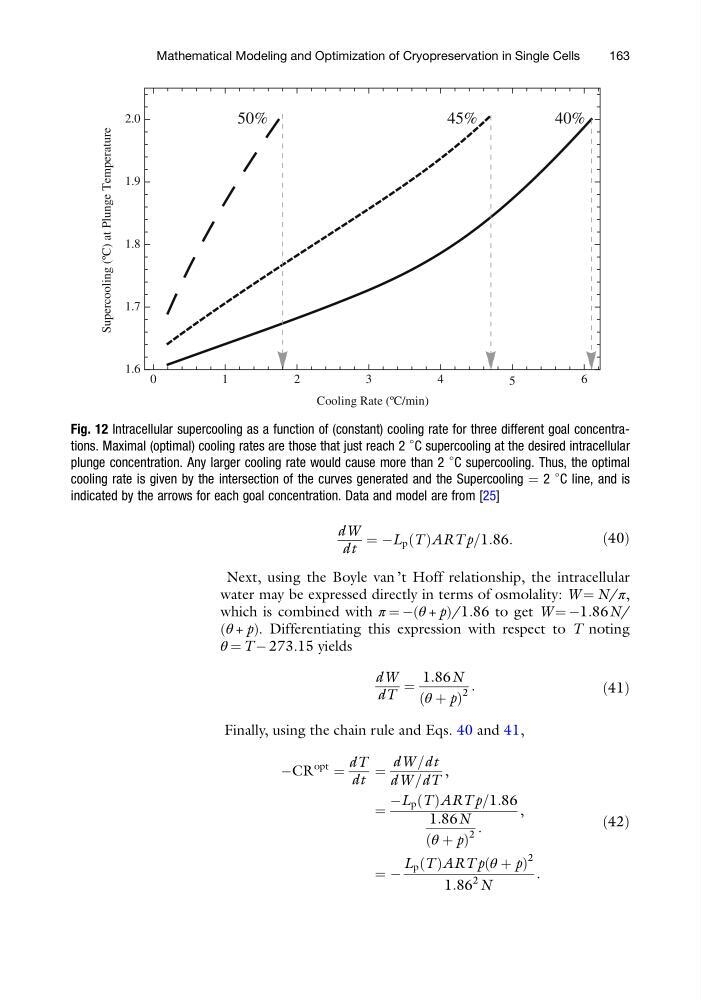
Fig. 12 Intracellular supercooling as a function of (constant) cooling rate for three different goal concentrations. Maximal (optimal) cooling rates are those that just reach 2
∘
C supercooling at the desired intracellular
plunge concentration. Any larger cooling rate would cause more than 2
∘ C supercooling. Thus, the optimal
cooling rate is given by the intersection of the curves generated and the Supercooling ¼ 2
∘ C line, and is
indicated by the arrows for each goal concentration. Data and model are from [25]
Mathematical Modeling and Optimization of Cryopreservation in Single Cells
163
dt
¼ ÀL p ðT ÞART p=1:86:
ð40Þ
Next, using the Boyle van ’t Hoff relationship, the intracellular
water may be expressed directly in terms of osmolality: W ¼ N/π,
which is combined with π ¼ À(θ + p)/1.86 to get W ¼ À1.86N/
(θ + p). Differentiating this expression with respect to T noting
θ ¼ T À 273.15 yields
dW
dT
¼
1:86N
ðθ þ pÞ
2
:
ð41Þ
Finally, using the chain rule and Eqs. 40 and 41,
ÀCR
opt
¼
dT
dt
¼
dW =dt
dW =dT
,
¼
ÀL p ðT ÞART p=1:86
1:86N
ðθ þ pÞ
2
:
,
¼ À
L p ðT ÞART pðθ þ pÞ
2
1:86
2 N
:
ð42Þ
40%
45%
50%
0
1
2
3
4
5
6
1.6
1.7
1.8
1.9
2.0
Cooling Rate (ºC/min)
Supercooling (ºC) at Plunge Temperature
Fig. 12 Intracellular supercooling as a function of (constant) cooling rate for three different goal concentrations. Maximal (optimal) cooling rates are those that just reach 2
∘
C supercooling at the desired intracellular
plunge concentration. Any larger cooling rate would cause more than 2
∘ C supercooling. Thus, the optimal
cooling rate is given by the intersection of the curves generated and the Supercooling ¼ 2
∘ C line, and is
indicated by the arrows for each goal concentration. Data and model are from [25]
Mathematical Modeling and Optimization of Cryopreservation in Single Cells
163