

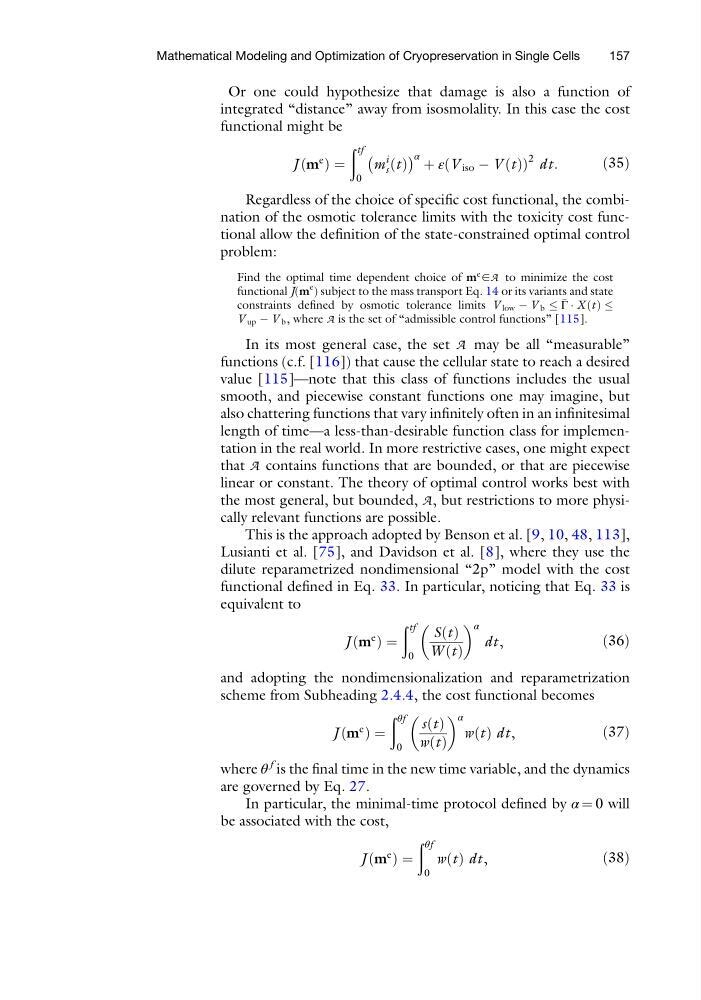
Or one could hypothesize that damage is also a function of
integrated “distance” away from isosmolality. In this case the cost
functional might be
J ðm
e
Þ ¼
ð tf
0
m
i
s ðtÞ
À
Á α þ ε V iso À V ðtÞ
ð
Þ
2 dt:
ð35Þ
Regardless of the choice of specific cost functional, the combination of the osmotic tolerance limits with the toxicity cost functional allow the definition of the state-constrained optimal control
problem:
Find the optimal time dependent choice of m
e ∈A to minimize the cost
functional J(m
e
) subject to the mass transport Eq. 14 or its variants and state
constraints defined by osmotic tolerance limits V low À V b
Γ Á X ðtÞ
V up À V b , where A is the set of “admissible control functions” [115].
In its most general case, the set A may be all “measurable”
functions (c.f. [116]) that cause the cellular state to reach a desired
value [115]—note that this class of functions includes the usual
smooth, and piecewise constant functions one may imagine, but
also chattering functions that vary infinitely often in an infinitesimal
length of time—a less-than-desirable function class for implementation in the real world. In more restrictive cases, one might expect
that A contains functions that are bounded, or that are piecewise
linear or constant. The theory of optimal control works best with
the most general, but bounded, A, but restrictions to more physically relevant functions are possible.
This is the approach adopted by Benson et al. [9, 10, 48, 113],
Lusianti et al. [75], and Davidson et al. [8], where they use the
dilute reparametrized nondimensional “2p” model with the cost
functional defined in Eq. 33. In particular, noticing that Eq. 33 is
equivalent to
J ðm
e
Þ ¼
ð tf
0
SðtÞ
W ðtÞ
α
dt,
ð36Þ
and adopting the nondimensionalization and reparametrization
scheme from Subheading 2.4.4, the cost functional becomes
J ðm
e
Þ ¼
ð θf
0
sðtÞ
wðtÞ
α
wðtÞ dt,
ð37Þ
where θ
f is the final time in the new time variable, and the dynamics
are governed by Eq. 27.
In particular, the minimal-time protocol defined by α ¼ 0 will
be associated with the cost,
J ðm
e
Þ ¼
ð θf
0
wðtÞ dt,
ð38Þ
Mathematical Modeling and Optimization of Cryopreservation in Single Cells
157
integrated “distance” away from isosmolality. In this case the cost
functional might be
J ðm
e
Þ ¼
ð tf
0
m
i
s ðtÞ
À
Á α þ ε V iso À V ðtÞ
ð
Þ
2 dt:
ð35Þ
Regardless of the choice of specific cost functional, the combination of the osmotic tolerance limits with the toxicity cost functional allow the definition of the state-constrained optimal control
problem:
Find the optimal time dependent choice of m
e ∈A to minimize the cost
functional J(m
e
) subject to the mass transport Eq. 14 or its variants and state
constraints defined by osmotic tolerance limits V low À V b
Γ Á X ðtÞ
V up À V b , where A is the set of “admissible control functions” [115].
In its most general case, the set A may be all “measurable”
functions (c.f. [116]) that cause the cellular state to reach a desired
value [115]—note that this class of functions includes the usual
smooth, and piecewise constant functions one may imagine, but
also chattering functions that vary infinitely often in an infinitesimal
length of time—a less-than-desirable function class for implementation in the real world. In more restrictive cases, one might expect
that A contains functions that are bounded, or that are piecewise
linear or constant. The theory of optimal control works best with
the most general, but bounded, A, but restrictions to more physically relevant functions are possible.
This is the approach adopted by Benson et al. [9, 10, 48, 113],
Lusianti et al. [75], and Davidson et al. [8], where they use the
dilute reparametrized nondimensional “2p” model with the cost
functional defined in Eq. 33. In particular, noticing that Eq. 33 is
equivalent to
J ðm
e
Þ ¼
ð tf
0
SðtÞ
W ðtÞ
α
dt,
ð36Þ
and adopting the nondimensionalization and reparametrization
scheme from Subheading 2.4.4, the cost functional becomes
J ðm
e
Þ ¼
ð θf
0
sðtÞ
wðtÞ
α
wðtÞ dt,
ð37Þ
where θ
f is the final time in the new time variable, and the dynamics
are governed by Eq. 27.
In particular, the minimal-time protocol defined by α ¼ 0 will
be associated with the cost,
J ðm
e
Þ ¼
ð θf
0
wðtÞ dt,
ð38Þ
Mathematical Modeling and Optimization of Cryopreservation in Single Cells
157