

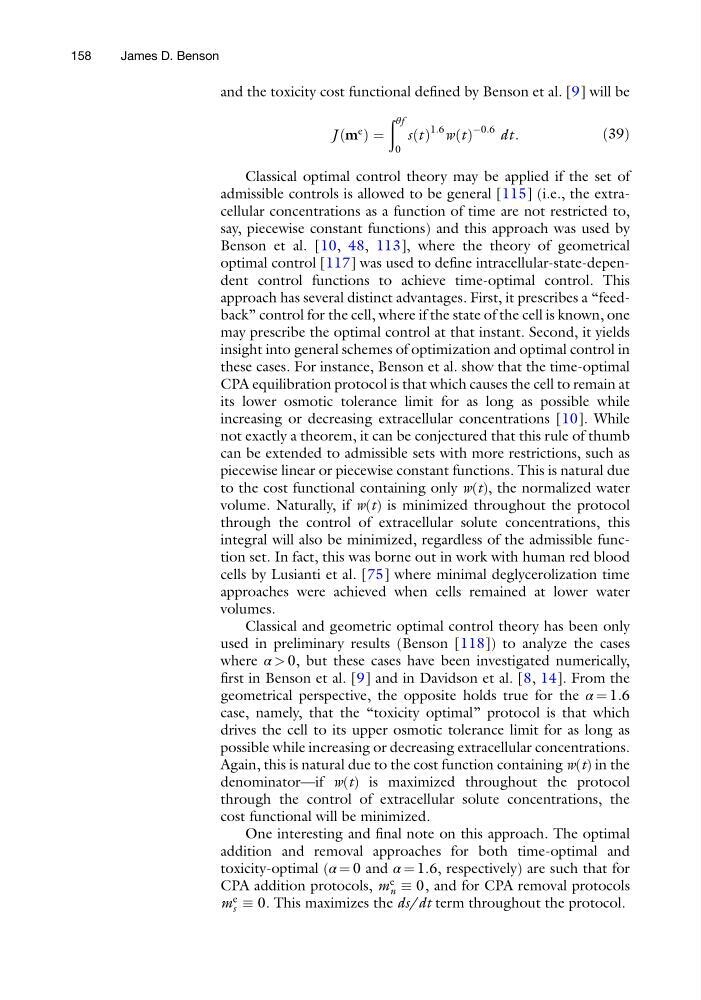
and the toxicity cost functional defined by Benson et al. [9] will be
J ðm
e
Þ ¼
ð θf
0
sðtÞ
1:6 wðtÞ
À0:6 dt:
ð39Þ
Classical optimal control theory may be applied if the set of
admissible controls is allowed to be general [115] (i.e., the extracellular concentrations as a function of time are not restricted to,
say, piecewise constant functions) and this approach was used by
Benson et al. [10, 48, 113], where the theory of geometrical
optimal control [117] was used to define intracellular-state-dependent control functions to achieve time-optimal control. This
approach has several distinct advantages. First, it prescribes a “feedback” control for the cell, where if the state of the cell is known, one
may prescribe the optimal control at that instant. Second, it yields
insight into general schemes of optimization and optimal control in
these cases. For instance, Benson et al. show that the time-optimal
CPA equilibration protocol is that which causes the cell to remain at
its lower osmotic tolerance limit for as long as possible while
increasing or decreasing extracellular concentrations [10]. While
not exactly a theorem, it can be conjectured that this rule of thumb
can be extended to admissible sets with more restrictions, such as
piecewise linear or piecewise constant functions. This is natural due
to the cost functional containing only w(t), the normalized water
volume. Naturally, if w(t) is minimized throughout the protocol
through the control of extracellular solute concentrations, this
integral will also be minimized, regardless of the admissible function set. In fact, this was borne out in work with human red blood
cells by Lusianti et al. [75] where minimal deglycerolization time
approaches were achieved when cells remained at lower water
volumes.
Classical and geometric optimal control theory has been only
used in preliminary results (Benson [118]) to analyze the cases
where α > 0, but these cases have been investigated numerically,
first in Benson et al. [9] and in Davidson et al. [8, 14]. From the
geometrical perspective, the opposite holds true for the α ¼ 1.6
case, namely, that the “toxicity optimal” protocol is that which
drives the cell to its upper osmotic tolerance limit for as long as
possible while increasing or decreasing extracellular concentrations.
Again, this is natural due to the cost function containing w(t) in the
denominator—if w(t) is maximized throughout the protocol
through the control of extracellular solute concentrations, the
cost functional will be minimized.
One interesting and final note on this approach. The optimal
addition and removal approaches for both time-optimal and
toxicity-optimal (α ¼ 0 and α ¼ 1.6, respectively) are such that for
CPA addition protocols, m
e
n 0, and for CPA removal protocols
m
e
s 0. This maximizes the ds/dt term throughout the protocol.
158
James D. Benson
J ðm
e
Þ ¼
ð θf
0
sðtÞ
1:6 wðtÞ
À0:6 dt:
ð39Þ
Classical optimal control theory may be applied if the set of
admissible controls is allowed to be general [115] (i.e., the extracellular concentrations as a function of time are not restricted to,
say, piecewise constant functions) and this approach was used by
Benson et al. [10, 48, 113], where the theory of geometrical
optimal control [117] was used to define intracellular-state-dependent control functions to achieve time-optimal control. This
approach has several distinct advantages. First, it prescribes a “feedback” control for the cell, where if the state of the cell is known, one
may prescribe the optimal control at that instant. Second, it yields
insight into general schemes of optimization and optimal control in
these cases. For instance, Benson et al. show that the time-optimal
CPA equilibration protocol is that which causes the cell to remain at
its lower osmotic tolerance limit for as long as possible while
increasing or decreasing extracellular concentrations [10]. While
not exactly a theorem, it can be conjectured that this rule of thumb
can be extended to admissible sets with more restrictions, such as
piecewise linear or piecewise constant functions. This is natural due
to the cost functional containing only w(t), the normalized water
volume. Naturally, if w(t) is minimized throughout the protocol
through the control of extracellular solute concentrations, this
integral will also be minimized, regardless of the admissible function set. In fact, this was borne out in work with human red blood
cells by Lusianti et al. [75] where minimal deglycerolization time
approaches were achieved when cells remained at lower water
volumes.
Classical and geometric optimal control theory has been only
used in preliminary results (Benson [118]) to analyze the cases
where α > 0, but these cases have been investigated numerically,
first in Benson et al. [9] and in Davidson et al. [8, 14]. From the
geometrical perspective, the opposite holds true for the α ¼ 1.6
case, namely, that the “toxicity optimal” protocol is that which
drives the cell to its upper osmotic tolerance limit for as long as
possible while increasing or decreasing extracellular concentrations.
Again, this is natural due to the cost function containing w(t) in the
denominator—if w(t) is maximized throughout the protocol
through the control of extracellular solute concentrations, the
cost functional will be minimized.
One interesting and final note on this approach. The optimal
addition and removal approaches for both time-optimal and
toxicity-optimal (α ¼ 0 and α ¼ 1.6, respectively) are such that for
CPA addition protocols, m
e
n 0, and for CPA removal protocols
m
e
s 0. This maximizes the ds/dt term throughout the protocol.
158
James D. Benson