

cooling protocols, but there is still an inherent toxicity due to
exposure to CPAs and this toxicity is concentration and time
dependent [110–112].
The simplest approach to minimize this toxicity is to attempt to
determine a minimal-time equilibration protocol. However, if
accumulated cell damage is also concentration dependent, then in
order to determine an optimal protocol, there must be a way to
quantify the cumulative effects of the cell concentration. These
effects are succinctly summarized with the definition of a “toxicity
cost functional” (seeNote 6), first defined in terms of time only in
Benson [113] and then, more generally, in terms of a concentration
dependent power law in Benson et al. [9].
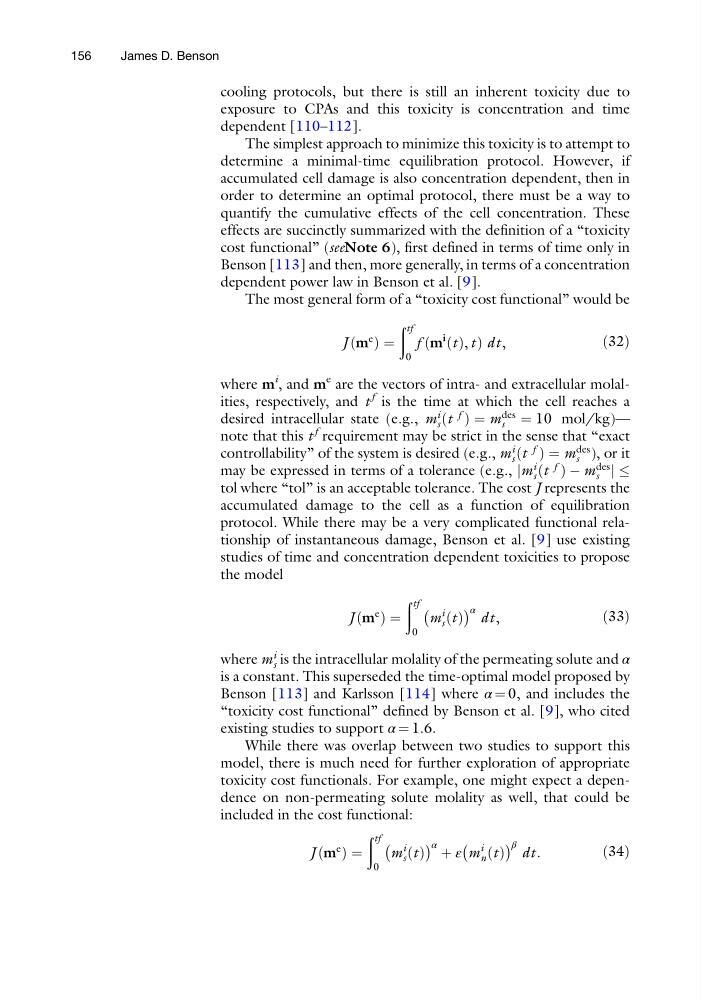
The most general form of a “toxicity cost functional” would be
J ðm
e
Þ ¼
ð tf
0
f ðm
i
ðtÞ, tÞ dt,
ð32Þ
where m
i
, and m
e are the vectors of intra- and extracellular molalities, respectively, and t
f is the time at which the cell reaches a
desired intracellular state (e.g., m
i
s ðt
f
Þ ¼ m
des
s
¼ 10 mol/kg)—
note that this t
f requirement may be strict in the sense that “exact
controllability” of the system is desired (e.g., m
i
s ðt
f
Þ ¼ m
des
s ), or it
may be expressed in terms of a tolerance (e.g., jm
i
s ðt
f
Þ À m
des
s j
tol where “tol” is an acceptable tolerance. The cost J represents the
accumulated damage to the cell as a function of equilibration
protocol. While there may be a very complicated functional relationship of instantaneous damage, Benson et al. [9] use existing
studies of time and concentration dependent toxicities to propose
the model
J ðm
e
Þ ¼
ð tf
0
m
i
s ðtÞ
À
Á α dt,
ð33Þ
where m
i
s is the intracellular molality of the permeating solute and α
is a constant. This superseded the time-optimal model proposed by
Benson [113] and Karlsson [114] where α ¼ 0, and includes the
“toxicity cost functional” defined by Benson et al. [9], who cited
existing studies to support α ¼ 1.6.
While there was overlap between two studies to support this
model, there is much need for further exploration of appropriate
toxicity cost functionals. For example, one might expect a dependence on non-permeating solute molality as well, that could be
included in the cost functional:
J ðm
e
Þ ¼
ð tf
0
m
i
s ðtÞ
À
Á α þ ε m
i
n ðtÞ
À
Á β dt:
ð34Þ
156
James D. Benson
exposure to CPAs and this toxicity is concentration and time
dependent [110–112].
The simplest approach to minimize this toxicity is to attempt to
determine a minimal-time equilibration protocol. However, if
accumulated cell damage is also concentration dependent, then in
order to determine an optimal protocol, there must be a way to
quantify the cumulative effects of the cell concentration. These
effects are succinctly summarized with the definition of a “toxicity
cost functional” (seeNote 6), first defined in terms of time only in
Benson [113] and then, more generally, in terms of a concentration
dependent power law in Benson et al. [9].
The most general form of a “toxicity cost functional” would be
J ðm
e
Þ ¼
ð tf
0
f ðm
i
ðtÞ, tÞ dt,
ð32Þ
where m
i
, and m
e are the vectors of intra- and extracellular molalities, respectively, and t
f is the time at which the cell reaches a
desired intracellular state (e.g., m
i
s ðt
f
Þ ¼ m
des
s
¼ 10 mol/kg)—
note that this t
f requirement may be strict in the sense that “exact
controllability” of the system is desired (e.g., m
i
s ðt
f
Þ ¼ m
des
s ), or it
may be expressed in terms of a tolerance (e.g., jm
i
s ðt
f
Þ À m
des
s j
tol where “tol” is an acceptable tolerance. The cost J represents the
accumulated damage to the cell as a function of equilibration
protocol. While there may be a very complicated functional relationship of instantaneous damage, Benson et al. [9] use existing
studies of time and concentration dependent toxicities to propose
the model
J ðm
e
Þ ¼
ð tf
0
m
i
s ðtÞ
À
Á α dt,
ð33Þ
where m
i
s is the intracellular molality of the permeating solute and α
is a constant. This superseded the time-optimal model proposed by
Benson [113] and Karlsson [114] where α ¼ 0, and includes the
“toxicity cost functional” defined by Benson et al. [9], who cited
existing studies to support α ¼ 1.6.
While there was overlap between two studies to support this
model, there is much need for further exploration of appropriate
toxicity cost functionals. For example, one might expect a dependence on non-permeating solute molality as well, that could be
included in the cost functional:
J ðm
e
Þ ¼
ð tf
0
m
i
s ðtÞ
À
Á α þ ε m
i
n ðtÞ
À
Á β dt:
ð34Þ
156
James D. Benson