

may be confounding effects, such as temperature, concentration, or
duration away from isosmotic volumes, but these have yet to be
definitively explored.
Osmotic tolerance limits are critical to optimization of CPA
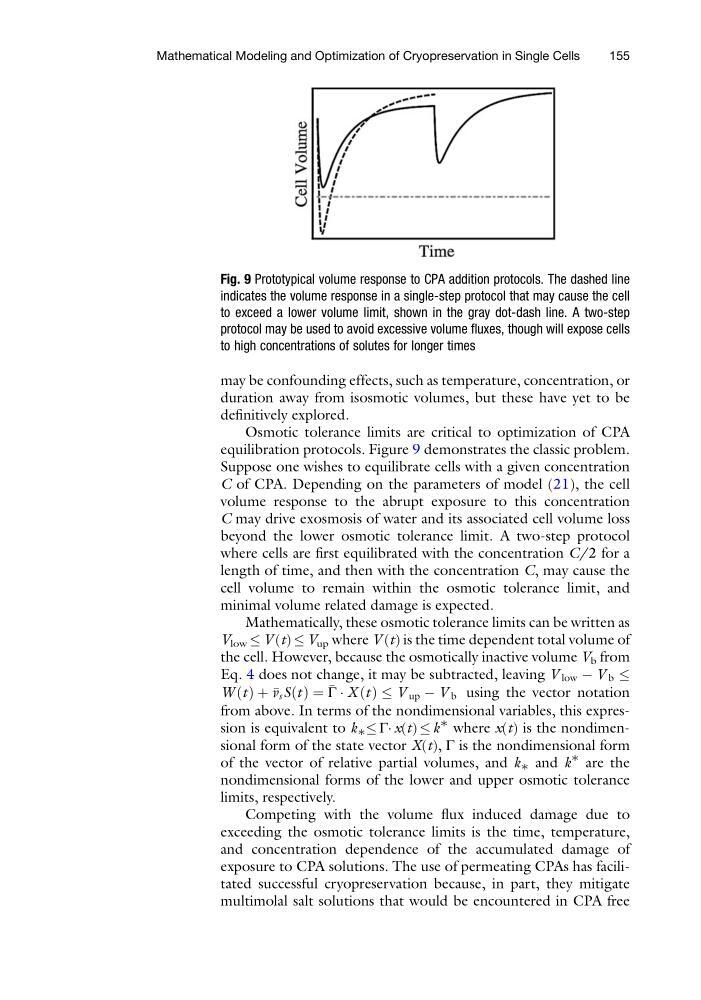
equilibration protocols. Figure 9 demonstrates the classic problem.
Suppose one wishes to equilibrate cells with a given concentration
C of CPA. Depending on the parameters of model (21), the cell
volume response to the abrupt exposure to this concentration
C may drive exosmosis of water and its associated cell volume loss
beyond the lower osmotic tolerance limit. A two-step protocol
where cells are first equilibrated with the concentration C/2 for a
length of time, and then with the concentration C, may cause the
cell volume to remain within the osmotic tolerance limit, and
minimal volume related damage is expected.
Mathematically, these osmotic tolerance limits can be written as
V low V (t) V up where V (t) is the time dependent total volume of
the cell. However, because the osmotically inactive volume V b from
Eq. 4 does not change, it may be subtracted, leaving V low À V b
W ðtÞ þ
v s SðtÞ ¼
Γ Á X ðtÞ V up À V b using the vector notation
from above. In terms of the nondimensional variables, this expression is equivalent to k ∗ ΓÁ x(t) k
∗ where x(t) is the nondimensional form of the state vector X(t), Γ is the nondimensional form
of the vector of relative partial volumes, and k ∗ and k
∗ are the
nondimensional forms of the lower and upper osmotic tolerance
limits, respectively.
Competing with the volume flux induced damage due to
exceeding the osmotic tolerance limits is the time, temperature,
and concentration dependence of the accumulated damage of
exposure to CPA solutions. The use of permeating CPAs has facilitated successful cryopreservation because, in part, they mitigate
multimolal salt solutions that would be encountered in CPA free
Fig. 9 Prototypical volume response to CPA addition protocols. The dashed line
indicates the volume response in a single-step protocol that may cause the cell
to exceed a lower volume limit, shown in the gray dot-dash line. A two-step
protocol may be used to avoid excessive volume fluxes, though will expose cells
to high concentrations of solutes for longer times
Mathematical Modeling and Optimization of Cryopreservation in Single Cells
155
duration away from isosmotic volumes, but these have yet to be
definitively explored.
Osmotic tolerance limits are critical to optimization of CPA
equilibration protocols. Figure 9 demonstrates the classic problem.
Suppose one wishes to equilibrate cells with a given concentration
C of CPA. Depending on the parameters of model (21), the cell
volume response to the abrupt exposure to this concentration
C may drive exosmosis of water and its associated cell volume loss
beyond the lower osmotic tolerance limit. A two-step protocol
where cells are first equilibrated with the concentration C/2 for a
length of time, and then with the concentration C, may cause the
cell volume to remain within the osmotic tolerance limit, and
minimal volume related damage is expected.
Mathematically, these osmotic tolerance limits can be written as
V low V (t) V up where V (t) is the time dependent total volume of
the cell. However, because the osmotically inactive volume V b from
Eq. 4 does not change, it may be subtracted, leaving V low À V b
W ðtÞ þ
v s SðtÞ ¼
Γ Á X ðtÞ V up À V b using the vector notation
from above. In terms of the nondimensional variables, this expression is equivalent to k ∗ ΓÁ x(t) k
∗ where x(t) is the nondimensional form of the state vector X(t), Γ is the nondimensional form
of the vector of relative partial volumes, and k ∗ and k
∗ are the
nondimensional forms of the lower and upper osmotic tolerance
limits, respectively.
Competing with the volume flux induced damage due to
exceeding the osmotic tolerance limits is the time, temperature,
and concentration dependence of the accumulated damage of
exposure to CPA solutions. The use of permeating CPAs has facilitated successful cryopreservation because, in part, they mitigate
multimolal salt solutions that would be encountered in CPA free
Fig. 9 Prototypical volume response to CPA addition protocols. The dashed line
indicates the volume response in a single-step protocol that may cause the cell
to exceed a lower volume limit, shown in the gray dot-dash line. A two-step
protocol may be used to avoid excessive volume fluxes, though will expose cells
to high concentrations of solutes for longer times
Mathematical Modeling and Optimization of Cryopreservation in Single Cells
155