

3 Optimization
3.1 CPA Equilibration
Protocols
Cryoprotective agents are necessary for the successful cryopreservation of cells in suspension. These CPAs work in concentrations
usually exceeding 1 mol/kg. Therefore, as discussed above, the
abrupt exposure of cells to these high concentrations may cause
damage due to excessive water volume flux (see Fig. 6).
The equilibration of cells with and from high concentrations of
cryoprotectant agents is an important part of nearly all cryopreservation procedures. While the biophysics of the equilibration processes is dependent on many parameters including cell type, CPA
type, temperature, among others, the protocol used to achieve
equilibration can have a dramatically damaging effect on cell viability, even before any cooling has occurred. This damage is understood to be dominated by both physical and biochemical effects
[9]. The former is linked to transport driven volume fluxes causing
cells to exceed volume limits, and the latter due to cytotoxicity,
whether acute or accumulated, of CPAs.
In the cryobiological literature, osmotic tolerance limits are
total cell volume limits within which the cell can shrink or swell
with minimal damage. These limits have been explored in a wide
variety of cell types [5, 25, 27, 31, 35, 96–109]. These limits are
assumed to be hard limits, even though they are usually defined by a
fixed decrease in population viability; e.g. the relative volume limits
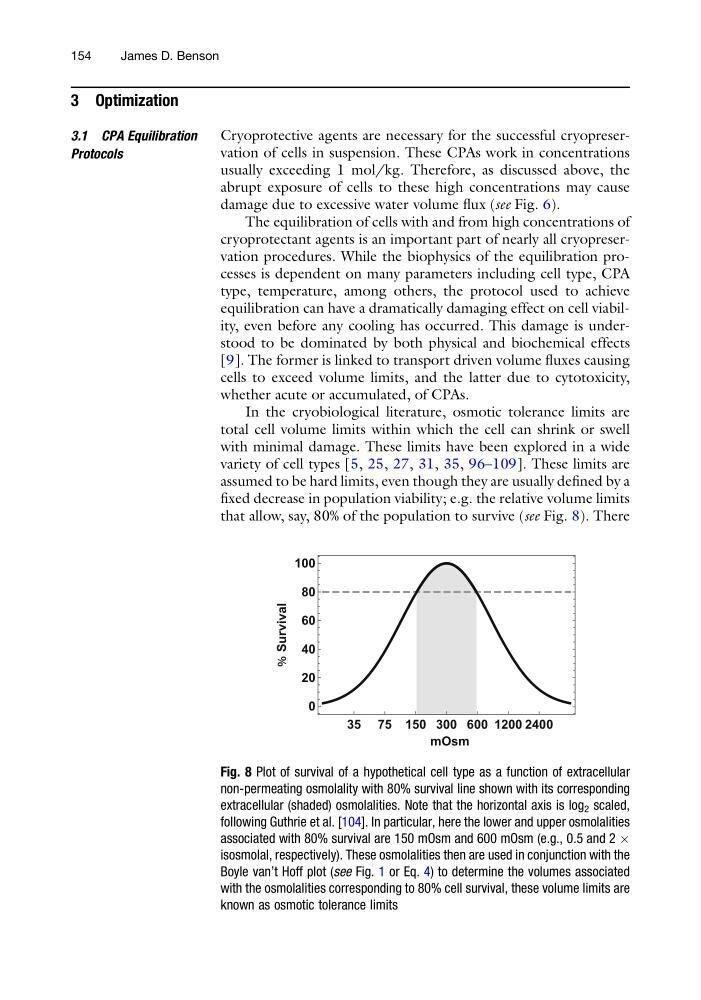
that allow, say, 80% of the population to survive (see Fig. 8). There
35 75 150 300 600 1200 2400
0
20
40
60
80
100
mOsm
% Survival
Fig. 8 Plot of survival of a hypothetical cell type as a function of extracellular
non-permeating osmolality with 80% survival line shown with its corresponding
extracellular (shaded) osmolalities. Note that the horizontal axis is log 2 scaled,
following Guthrie et al. [104]. In particular, here the lower and upper osmolalities
associated with 80% survival are 150 mOsm and 600 mOsm (e.g., 0.5 and 2 Â
isosmolal, respectively). These osmolalities then are used in conjunction with the
Boyle van’t Hoff plot (see Fig. 1 or Eq. 4) to determine the volumes associated
with the osmolalities corresponding to 80% cell survival, these volume limits are
known as osmotic tolerance limits
154
James D. Benson
3.1 CPA Equilibration
Protocols
Cryoprotective agents are necessary for the successful cryopreservation of cells in suspension. These CPAs work in concentrations
usually exceeding 1 mol/kg. Therefore, as discussed above, the
abrupt exposure of cells to these high concentrations may cause
damage due to excessive water volume flux (see Fig. 6).
The equilibration of cells with and from high concentrations of
cryoprotectant agents is an important part of nearly all cryopreservation procedures. While the biophysics of the equilibration processes is dependent on many parameters including cell type, CPA
type, temperature, among others, the protocol used to achieve
equilibration can have a dramatically damaging effect on cell viability, even before any cooling has occurred. This damage is understood to be dominated by both physical and biochemical effects
[9]. The former is linked to transport driven volume fluxes causing
cells to exceed volume limits, and the latter due to cytotoxicity,
whether acute or accumulated, of CPAs.
In the cryobiological literature, osmotic tolerance limits are
total cell volume limits within which the cell can shrink or swell
with minimal damage. These limits have been explored in a wide
variety of cell types [5, 25, 27, 31, 35, 96–109]. These limits are
assumed to be hard limits, even though they are usually defined by a
fixed decrease in population viability; e.g. the relative volume limits
that allow, say, 80% of the population to survive (see Fig. 8). There
35 75 150 300 600 1200 2400
0
20
40
60
80
100
mOsm
% Survival
Fig. 8 Plot of survival of a hypothetical cell type as a function of extracellular
non-permeating osmolality with 80% survival line shown with its corresponding
extracellular (shaded) osmolalities. Note that the horizontal axis is log 2 scaled,
following Guthrie et al. [104]. In particular, here the lower and upper osmolalities
associated with 80% survival are 150 mOsm and 600 mOsm (e.g., 0.5 and 2 Â
isosmolal, respectively). These osmolalities then are used in conjunction with the
Boyle van’t Hoff plot (see Fig. 1 or Eq. 4) to determine the volumes associated
with the osmolalities corresponding to 80% cell survival, these volume limits are
known as osmotic tolerance limits
154
James D. Benson