

dw
dθ
¼ Àð
m
e
s ðT Þ þ
m
e
n ðT ÞÞw À s À 1,
ds
dθ
¼ bðT Þ
m
e
s ðT Þw À s
À
Á
dT
dθ
¼ gðθÞw:
ð31Þ
Under most conditions
m
e
n ðT Þ and
m
e
n ðT Þ will be nonlinear,
however, so even with constant g(θ), a closed-form analytic solution is unlikely to be found, though other techniques exist due to
the linear nature of the ODE. Nevertheless, the avoidance of dividing by the small w term that is nearly always encountered during
equilibrium cooling protocols may make this worth the effort.
2.4.5 Effects
of the Selection
of Chemical Potential
Approximation
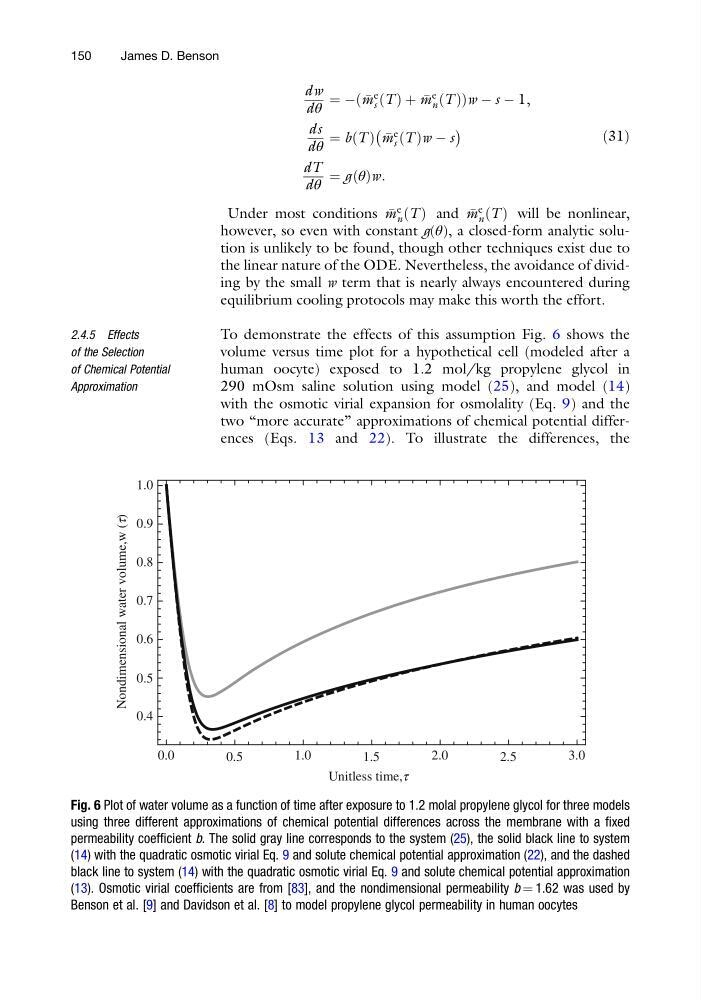
To demonstrate the effects of this assumption Fig. 6 shows the
volume versus time plot for a hypothetical cell (modeled after a
human oocyte) exposed to 1.2 mol/kg propylene glycol in
290 mOsm saline solution using model (25), and model (14)
with the osmotic virial expansion for osmolality (Eq. 9) and the
two “more accurate” approximations of chemical potential differences (Eqs. 13 and 22). To illustrate the differences, the
0.0
0.5
1.0
1.5
2.0
2.5
3.0
0.4
0.5
0.6
0.7
0.8
0.9
1.0
Unitless time,t
Nondimensional water volume,w (t)
Fig. 6 Plot of water volume as a function of time after exposure to 1.2 molal propylene glycol for three models
using three different approximations of chemical potential differences across the membrane with a fixed
permeability coefficient b. The solid gray line corresponds to the system (25), the solid black line to system
(14) with the quadratic osmotic virial Eq. 9 and solute chemical potential approximation (22), and the dashed
black line to system (14) with the quadratic osmotic virial Eq. 9 and solute chemical potential approximation
(13). Osmotic virial coefficients are from [83], and the nondimensional permeability b ¼ 1.62 was used by
Benson et al. [9] and Davidson et al. [8] to model propylene glycol permeability in human oocytes
150
James D. Benson
dθ
¼ Àð
m
e
s ðT Þ þ
m
e
n ðT ÞÞw À s À 1,
ds
dθ
¼ bðT Þ
m
e
s ðT Þw À s
À
Á
dT
dθ
¼ gðθÞw:
ð31Þ
Under most conditions
m
e
n ðT Þ and
m
e
n ðT Þ will be nonlinear,
however, so even with constant g(θ), a closed-form analytic solution is unlikely to be found, though other techniques exist due to
the linear nature of the ODE. Nevertheless, the avoidance of dividing by the small w term that is nearly always encountered during
equilibrium cooling protocols may make this worth the effort.
2.4.5 Effects
of the Selection
of Chemical Potential
Approximation
To demonstrate the effects of this assumption Fig. 6 shows the
volume versus time plot for a hypothetical cell (modeled after a
human oocyte) exposed to 1.2 mol/kg propylene glycol in
290 mOsm saline solution using model (25), and model (14)
with the osmotic virial expansion for osmolality (Eq. 9) and the
two “more accurate” approximations of chemical potential differences (Eqs. 13 and 22). To illustrate the differences, the
0.0
0.5
1.0
1.5
2.0
2.5
3.0
0.4
0.5
0.6
0.7
0.8
0.9
1.0
Unitless time,t
Nondimensional water volume,w (t)
Fig. 6 Plot of water volume as a function of time after exposure to 1.2 molal propylene glycol for three models
using three different approximations of chemical potential differences across the membrane with a fixed
permeability coefficient b. The solid gray line corresponds to the system (25), the solid black line to system
(14) with the quadratic osmotic virial Eq. 9 and solute chemical potential approximation (22), and the dashed
black line to system (14) with the quadratic osmotic virial Eq. 9 and solute chemical potential approximation
(13). Osmotic virial coefficients are from [83], and the nondimensional permeability b ¼ 1.62 was used by
Benson et al. [9] and Davidson et al. [8] to model propylene glycol permeability in human oocytes
150
James D. Benson