

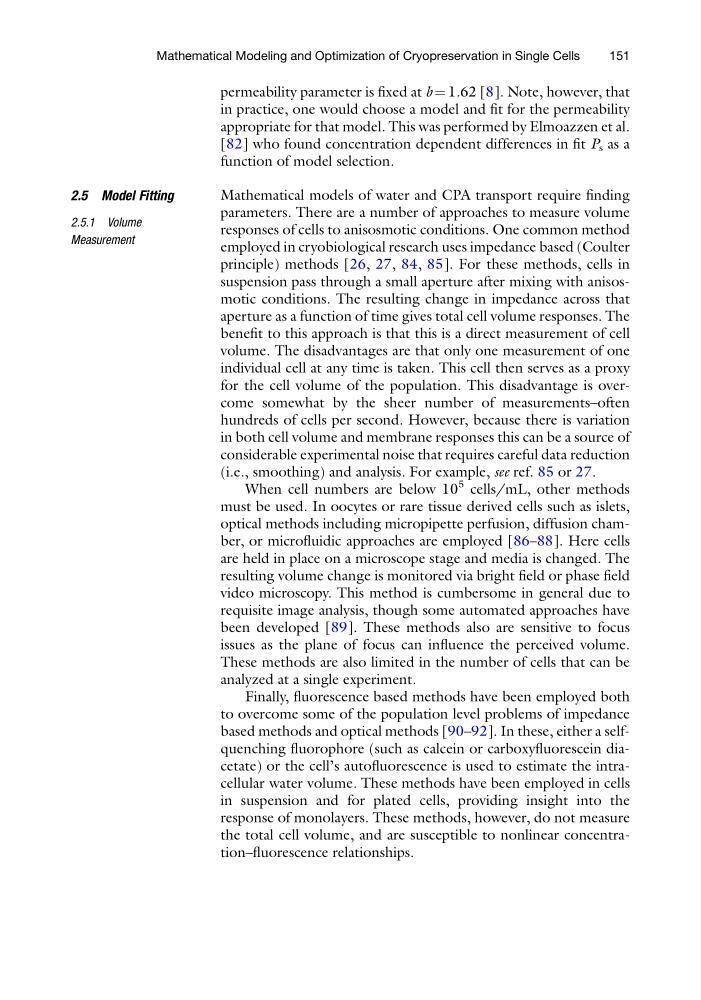
permeability parameter is fixed at b ¼ 1.62 [8]. Note, however, that
in practice, one would choose a model and fit for the permeability
appropriate for that model. This was performed by Elmoazzen et al.
[82] who found concentration dependent differences in fit P s as a
function of model selection.
2.5 Model Fitting
2.5.1 Volume
Measurement
Mathematical models of water and CPA transport require finding
parameters. There are a number of approaches to measure volume
responses of cells to anisosmotic conditions. One common method
employed in cryobiological research uses impedance based (Coulter
principle) methods [26, 27, 84, 85]. For these methods, cells in
suspension pass through a small aperture after mixing with anisosmotic conditions. The resulting change in impedance across that
aperture as a function of time gives total cell volume responses. The
benefit to this approach is that this is a direct measurement of cell
volume. The disadvantages are that only one measurement of one
individual cell at any time is taken. This cell then serves as a proxy
for the cell volume of the population. This disadvantage is overcome somewhat by the sheer number of measurements–often
hundreds of cells per second. However, because there is variation
in both cell volume and membrane responses this can be a source of
considerable experimental noise that requires careful data reduction
(i.e., smoothing) and analysis. For example, see ref. 85 or 27.
When cell numbers are below 10
5 cells/mL, other methods
must be used. In oocytes or rare tissue derived cells such as islets,
optical methods including micropipette perfusion, diffusion chamber, or microfluidic approaches are employed [86–88]. Here cells
are held in place on a microscope stage and media is changed. The
resulting volume change is monitored via bright field or phase field
video microscopy. This method is cumbersome in general due to
requisite image analysis, though some automated approaches have
been developed [89]. These methods also are sensitive to focus
issues as the plane of focus can influence the perceived volume.
These methods are also limited in the number of cells that can be
analyzed at a single experiment.
Finally, fluorescence based methods have been employed both
to overcome some of the population level problems of impedance
based methods and optical methods [90–92]. In these, either a selfquenching fluorophore (such as calcein or carboxyfluorescein diacetate) or the cell’s autofluorescence is used to estimate the intracellular water volume. These methods have been employed in cells
in suspension and for plated cells, providing insight into the
response of monolayers. These methods, however, do not measure
the total cell volume, and are susceptible to nonlinear concentration–fluorescence relationships.
Mathematical Modeling and Optimization of Cryopreservation in Single Cells
151
in practice, one would choose a model and fit for the permeability
appropriate for that model. This was performed by Elmoazzen et al.
[82] who found concentration dependent differences in fit P s as a
function of model selection.
2.5 Model Fitting
2.5.1 Volume
Measurement
Mathematical models of water and CPA transport require finding
parameters. There are a number of approaches to measure volume
responses of cells to anisosmotic conditions. One common method
employed in cryobiological research uses impedance based (Coulter
principle) methods [26, 27, 84, 85]. For these methods, cells in
suspension pass through a small aperture after mixing with anisosmotic conditions. The resulting change in impedance across that
aperture as a function of time gives total cell volume responses. The
benefit to this approach is that this is a direct measurement of cell
volume. The disadvantages are that only one measurement of one
individual cell at any time is taken. This cell then serves as a proxy
for the cell volume of the population. This disadvantage is overcome somewhat by the sheer number of measurements–often
hundreds of cells per second. However, because there is variation
in both cell volume and membrane responses this can be a source of
considerable experimental noise that requires careful data reduction
(i.e., smoothing) and analysis. For example, see ref. 85 or 27.
When cell numbers are below 10
5 cells/mL, other methods
must be used. In oocytes or rare tissue derived cells such as islets,
optical methods including micropipette perfusion, diffusion chamber, or microfluidic approaches are employed [86–88]. Here cells
are held in place on a microscope stage and media is changed. The
resulting volume change is monitored via bright field or phase field
video microscopy. This method is cumbersome in general due to
requisite image analysis, though some automated approaches have
been developed [89]. These methods also are sensitive to focus
issues as the plane of focus can influence the perceived volume.
These methods are also limited in the number of cells that can be
analyzed at a single experiment.
Finally, fluorescence based methods have been employed both
to overcome some of the population level problems of impedance
based methods and optical methods [90–92]. In these, either a selfquenching fluorophore (such as calcein or carboxyfluorescein diacetate) or the cell’s autofluorescence is used to estimate the intracellular water volume. These methods have been employed in cells
in suspension and for plated cells, providing insight into the
response of monolayers. These methods, however, do not measure
the total cell volume, and are susceptible to nonlinear concentration–fluorescence relationships.
Mathematical Modeling and Optimization of Cryopreservation in Single Cells
151