

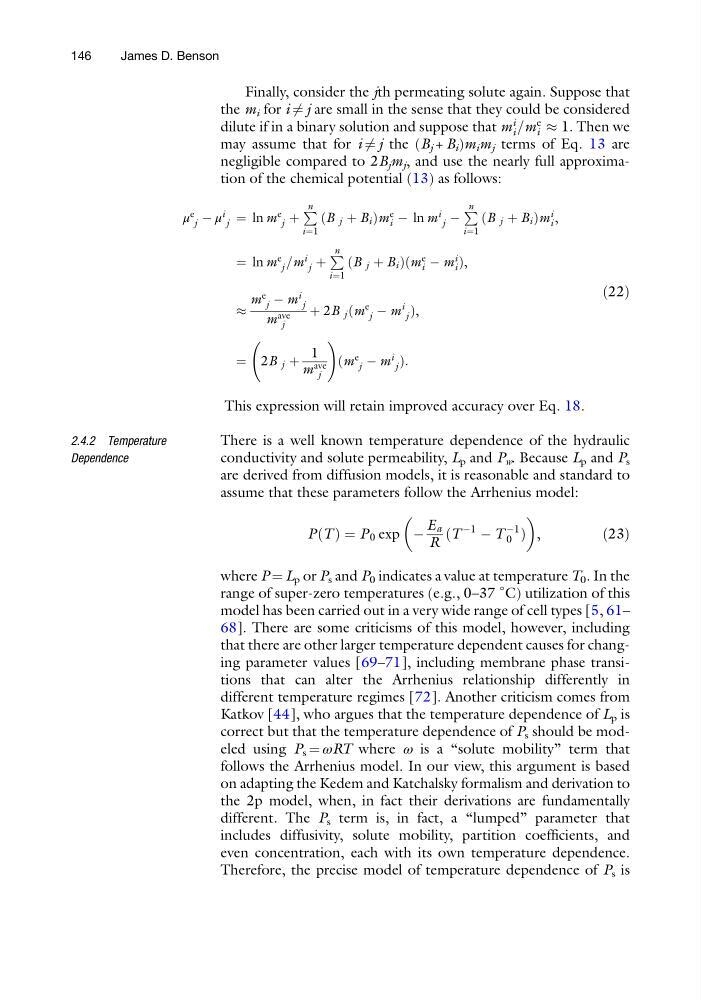
Finally, consider the jth permeating solute again. Suppose that
the m i for i 6 ¼ j are small in the sense that they could be considered
dilute if in a binary solution and suppose that m
i
i =m
e
i % 1. Then we
may assume that for i 6 ¼ j the (B j + B i )m i m j terms of Eq. 13 are
negligible compared to 2B j m j , and use the nearly full approximation of the chemical potential (13) as follows:
μ
e
j À μ
i
j ¼ ln m
e
j þ
P n
i¼1
ðB j þ B i Þm
e
i À ln m
i
j À
P n
i¼1
ðB j þ B i Þm
i
i ,
¼ ln m
e
j =m
i
j þ
P n
i¼1
ðB j þ B i Þðm
e
i À m
i
i Þ,
%
m
e
j À m
i
j
m ave
j
þ 2B j ðm
e
j À m
i
j Þ,
¼ 2B j þ
1
m ave
j
!
ðm
e
j À m
i
j Þ:
ð22Þ
This expression will retain improved accuracy over Eq. 18.
2.4.2 Temperature
Dependence
There is a well known temperature dependence of the hydraulic
conductivity and solute permeability, L p and P w . Because L p and P s
are derived from diffusion models, it is reasonable and standard to
assume that these parameters follow the Arrhenius model:
PðT Þ ¼ P 0 exp À
E a
R
ðT
À1
À T
À1
0 Þ
,
ð23Þ
where P ¼ L p or P s and P 0 indicates a value at temperature T 0 . In the
range of super-zero temperatures (e.g., 0–37
∘
C) utilization of this
model has been carried out in a very wide range of cell types [5, 61–
68]. There are some criticisms of this model, however, including
that there are other larger temperature dependent causes for changing parameter values [69–71], including membrane phase transitions that can alter the Arrhenius relationship differently in
different temperature regimes [72]. Another criticism comes from
Katkov [44], who argues that the temperature dependence of L p is
correct but that the temperature dependence of P s should be modeled using P s ¼ ωRT where ω is a “solute mobility” term that
follows the Arrhenius model. In our view, this argument is based
on adapting the Kedem and Katchalsky formalism and derivation to
the 2p model, when, in fact their derivations are fundamentally
different. The P s term is, in fact, a “lumped” parameter that
includes diffusivity, solute mobility, partition coefficients, and
even concentration, each with its own temperature dependence.
Therefore, the precise model of temperature dependence of P s is
146
James D. Benson
the m i for i 6 ¼ j are small in the sense that they could be considered
dilute if in a binary solution and suppose that m
i
i =m
e
i % 1. Then we
may assume that for i 6 ¼ j the (B j + B i )m i m j terms of Eq. 13 are
negligible compared to 2B j m j , and use the nearly full approximation of the chemical potential (13) as follows:
μ
e
j À μ
i
j ¼ ln m
e
j þ
P n
i¼1
ðB j þ B i Þm
e
i À ln m
i
j À
P n
i¼1
ðB j þ B i Þm
i
i ,
¼ ln m
e
j =m
i
j þ
P n
i¼1
ðB j þ B i Þðm
e
i À m
i
i Þ,
%
m
e
j À m
i
j
m ave
j
þ 2B j ðm
e
j À m
i
j Þ,
¼ 2B j þ
1
m ave
j
!
ðm
e
j À m
i
j Þ:
ð22Þ
This expression will retain improved accuracy over Eq. 18.
2.4.2 Temperature
Dependence
There is a well known temperature dependence of the hydraulic
conductivity and solute permeability, L p and P w . Because L p and P s
are derived from diffusion models, it is reasonable and standard to
assume that these parameters follow the Arrhenius model:
PðT Þ ¼ P 0 exp À
E a
R
ðT
À1
À T
À1
0 Þ
,
ð23Þ
where P ¼ L p or P s and P 0 indicates a value at temperature T 0 . In the
range of super-zero temperatures (e.g., 0–37
∘
C) utilization of this
model has been carried out in a very wide range of cell types [5, 61–
68]. There are some criticisms of this model, however, including
that there are other larger temperature dependent causes for changing parameter values [69–71], including membrane phase transitions that can alter the Arrhenius relationship differently in
different temperature regimes [72]. Another criticism comes from
Katkov [44], who argues that the temperature dependence of L p is
correct but that the temperature dependence of P s should be modeled using P s ¼ ωRT where ω is a “solute mobility” term that
follows the Arrhenius model. In our view, this argument is based
on adapting the Kedem and Katchalsky formalism and derivation to
the 2p model, when, in fact their derivations are fundamentally
different. The P s term is, in fact, a “lumped” parameter that
includes diffusivity, solute mobility, partition coefficients, and
even concentration, each with its own temperature dependence.
Therefore, the precise model of temperature dependence of P s is
146
James D. Benson