

specific parameters [see ref. 52, for a brief review]. This measurement, in essence, is very similar to measuring freezing point depression of specific mixtures, and as such there was little historic interest
in their utilization in cryobiology. However, two models have been
proposed that are accurate enough for solutions of interest in
cryobiology yet require no mixture specific data. In particular,
both models base their predictions on data from models of osmolality of binary solutions such as glycerol and water or sodium
chloride and water. The osmolality of these binary solutions are
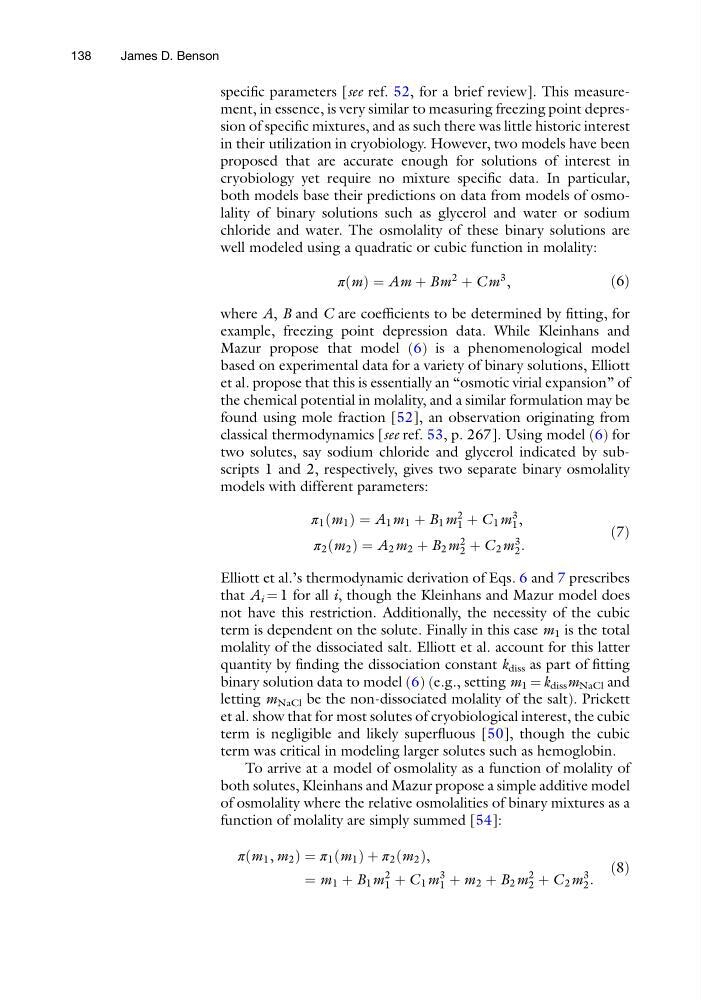
well modeled using a quadratic or cubic function in molality:
πðmÞ ¼ Am þ Bm
2
þ Cm
3 ,
ð6Þ
where A, B and C are coefficients to be determined by fitting, for
example, freezing point depression data. While Kleinhans and
Mazur propose that model (6) is a phenomenological model
based on experimental data for a variety of binary solutions, Elliott
et al. propose that this is essentially an “osmotic virial expansion” of
the chemical potential in molality, and a similar formulation may be
found using mole fraction [52], an observation originating from
classical thermodynamics [see ref. 53, p. 267]. Using model (6) for
two solutes, say sodium chloride and glycerol indicated by subscripts 1 and 2, respectively, gives two separate binary osmolality
models with different parameters:
π 1 ðm 1 Þ ¼ A 1 m 1 þ B 1 m
2
1 þ C 1 m
3
1 ,
π 2 ðm 2 Þ ¼ A 2 m 2 þ B 2 m
2
2 þ C 2 m
3
2 :
ð7Þ
Elliott et al.’s thermodynamic derivation of Eqs. 6 and 7 prescribes
that A i ¼ 1 for all i, though the Kleinhans and Mazur model does
not have this restriction. Additionally, the necessity of the cubic
term is dependent on the solute. Finally in this case m 1 is the total
molality of the dissociated salt. Elliott et al. account for this latter
quantity by finding the dissociation constant k diss as part of fitting
binary solution data to model (6) (e.g., setting m 1 ¼ k diss m NaCl and
letting m NaCl be the non-dissociated molality of the salt). Prickett
et al. show that for most solutes of cryobiological interest, the cubic
term is negligible and likely superfluous [50], though the cubic
term was critical in modeling larger solutes such as hemoglobin.
To arrive at a model of osmolality as a function of molality of
both solutes, Kleinhans and Mazur propose a simple additive model
of osmolality where the relative osmolalities of binary mixtures as a
function of molality are simply summed [54]:
πðm 1 , m 2 Þ ¼ π 1 ðm 1 Þ þ π 2 ðm 2 Þ,
¼ m 1 þ B 1 m
2
1 þ C 1 m
3
1 þ m 2 þ B 2 m
2
2 þ C 2 m
3
2 :
ð8Þ
138
James D. Benson
in their utilization in cryobiology. However, two models have been
proposed that are accurate enough for solutions of interest in
cryobiology yet require no mixture specific data. In particular,
both models base their predictions on data from models of osmolality of binary solutions such as glycerol and water or sodium
chloride and water. The osmolality of these binary solutions are
well modeled using a quadratic or cubic function in molality:
πðmÞ ¼ Am þ Bm
2
þ Cm
3 ,
ð6Þ
where A, B and C are coefficients to be determined by fitting, for
example, freezing point depression data. While Kleinhans and
Mazur propose that model (6) is a phenomenological model
based on experimental data for a variety of binary solutions, Elliott
et al. propose that this is essentially an “osmotic virial expansion” of
the chemical potential in molality, and a similar formulation may be
found using mole fraction [52], an observation originating from
classical thermodynamics [see ref. 53, p. 267]. Using model (6) for
two solutes, say sodium chloride and glycerol indicated by subscripts 1 and 2, respectively, gives two separate binary osmolality
models with different parameters:
π 1 ðm 1 Þ ¼ A 1 m 1 þ B 1 m
2
1 þ C 1 m
3
1 ,
π 2 ðm 2 Þ ¼ A 2 m 2 þ B 2 m
2
2 þ C 2 m
3
2 :
ð7Þ
Elliott et al.’s thermodynamic derivation of Eqs. 6 and 7 prescribes
that A i ¼ 1 for all i, though the Kleinhans and Mazur model does
not have this restriction. Additionally, the necessity of the cubic
term is dependent on the solute. Finally in this case m 1 is the total
molality of the dissociated salt. Elliott et al. account for this latter
quantity by finding the dissociation constant k diss as part of fitting
binary solution data to model (6) (e.g., setting m 1 ¼ k diss m NaCl and
letting m NaCl be the non-dissociated molality of the salt). Prickett
et al. show that for most solutes of cryobiological interest, the cubic
term is negligible and likely superfluous [50], though the cubic
term was critical in modeling larger solutes such as hemoglobin.
To arrive at a model of osmolality as a function of molality of
both solutes, Kleinhans and Mazur propose a simple additive model
of osmolality where the relative osmolalities of binary mixtures as a
function of molality are simply summed [54]:
πðm 1 , m 2 Þ ¼ π 1 ðm 1 Þ þ π 2 ðm 2 Þ,
¼ m 1 þ B 1 m
2
1 þ C 1 m
3
1 þ m 2 þ B 2 m
2
2 þ C 2 m
3
2 :
ð8Þ
138
James D. Benson