

78
2 The Interaction of Electromagnetic Waves with Water
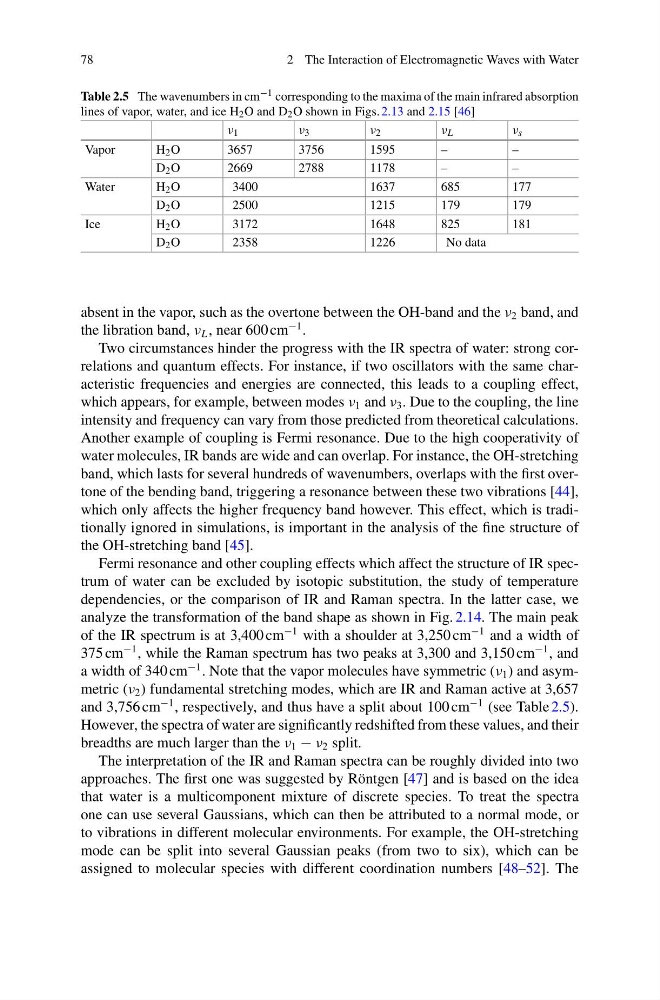
Table 2.5 The wavenumbers in cm −1 corresponding to the maxima of the main infrared absorption
lines of vapor, water, and ice H 2 O and D 2 O shown in Figs. 2.13 and 2.15 [46]
ν 1
ν 3
ν 2
ν L
ν s
Vapor
H 2 O
3657
3756
1595
–
–
D 2 O
2669
2788
1178
–
–
Water
H 2 O
3400
1637
685
177
D 2 O
2500
1215
179
179
Ice
H 2 O
3172
1648
825
181
D 2 O
2358
1226
No data
absent in the vapor, such as the overtone between the OH-band and the ν 2 band, and
the libration band, ν L , near 600 cm
−1 .
Two circumstances hinder the progress with the IR spectra of water: strong correlations and quantum effects. For instance, if two oscillators with the same characteristic frequencies and energies are connected, this leads to a coupling effect,
which appears, for example, between modes ν 1 and ν 3 . Due to the coupling, the line
intensity and frequency can vary from those predicted from theoretical calculations.
Another example of coupling is Fermi resonance. Due to the high cooperativity of
water molecules, IR bands are wide and can overlap. For instance, the OH-stretching
band, which lasts for several hundreds of wavenumbers, overlaps with the first overtone of the bending band, triggering a resonance between these two vibrations [44],
which only affects the higher frequency band however. This effect, which is traditionally ignored in simulations, is important in the analysis of the fine structure of
the OH-stretching band [45].
Fermi resonance and other coupling effects which affect the structure of IR spectrum of water can be excluded by isotopic substitution, the study of temperature
dependencies, or the comparison of IR and Raman spectra. In the latter case, we
analyze the transformation of the band shape as shown in Fig. 2.14. The main peak
of the IR spectrum is at 3,400 cm
−1 with a shoulder at 3,250 cm
−1 and a width of
375 cm
−1 , while the Raman spectrum has two peaks at 3,300 and 3,150 cm
−1 , and
a width of 340 cm
−1 . Note that the vapor molecules have symmetric (ν 1 ) and asymmetric (ν 2 ) fundamental stretching modes, which are IR and Raman active at 3,657
and 3,756 cm
−1 , respectively, and thus have a split about 100 cm
−1 (see Table 2.5).
However, the spectra of water are significantly redshifted from these values, and their
breadths are much larger than the ν 1 − ν 2 split.
The interpretation of the IR and Raman spectra can be roughly divided into two
approaches. The first one was suggested by Röntgen [47] and is based on the idea
that water is a multicomponent mixture of discrete species. To treat the spectra
one can use several Gaussians, which can then be attributed to a normal mode, or
to vibrations in different molecular environments. For example, the OH-stretching
mode can be split into several Gaussian peaks (from two to six), which can be
assigned to molecular species with different coordination numbers [48–52]. The
2 The Interaction of Electromagnetic Waves with Water
Table 2.5 The wavenumbers in cm −1 corresponding to the maxima of the main infrared absorption
lines of vapor, water, and ice H 2 O and D 2 O shown in Figs. 2.13 and 2.15 [46]
ν 1
ν 3
ν 2
ν L
ν s
Vapor
H 2 O
3657
3756
1595
–
–
D 2 O
2669
2788
1178
–
–
Water
H 2 O
3400
1637
685
177
D 2 O
2500
1215
179
179
Ice
H 2 O
3172
1648
825
181
D 2 O
2358
1226
No data
absent in the vapor, such as the overtone between the OH-band and the ν 2 band, and
the libration band, ν L , near 600 cm
−1 .
Two circumstances hinder the progress with the IR spectra of water: strong correlations and quantum effects. For instance, if two oscillators with the same characteristic frequencies and energies are connected, this leads to a coupling effect,
which appears, for example, between modes ν 1 and ν 3 . Due to the coupling, the line
intensity and frequency can vary from those predicted from theoretical calculations.
Another example of coupling is Fermi resonance. Due to the high cooperativity of
water molecules, IR bands are wide and can overlap. For instance, the OH-stretching
band, which lasts for several hundreds of wavenumbers, overlaps with the first overtone of the bending band, triggering a resonance between these two vibrations [44],
which only affects the higher frequency band however. This effect, which is traditionally ignored in simulations, is important in the analysis of the fine structure of
the OH-stretching band [45].
Fermi resonance and other coupling effects which affect the structure of IR spectrum of water can be excluded by isotopic substitution, the study of temperature
dependencies, or the comparison of IR and Raman spectra. In the latter case, we
analyze the transformation of the band shape as shown in Fig. 2.14. The main peak
of the IR spectrum is at 3,400 cm
−1 with a shoulder at 3,250 cm
−1 and a width of
375 cm
−1 , while the Raman spectrum has two peaks at 3,300 and 3,150 cm
−1 , and
a width of 340 cm
−1 . Note that the vapor molecules have symmetric (ν 1 ) and asymmetric (ν 2 ) fundamental stretching modes, which are IR and Raman active at 3,657
and 3,756 cm
−1 , respectively, and thus have a split about 100 cm
−1 (see Table 2.5).
However, the spectra of water are significantly redshifted from these values, and their
breadths are much larger than the ν 1 − ν 2 split.
The interpretation of the IR and Raman spectra can be roughly divided into two
approaches. The first one was suggested by Röntgen [47] and is based on the idea
that water is a multicomponent mixture of discrete species. To treat the spectra
one can use several Gaussians, which can then be attributed to a normal mode, or
to vibrations in different molecular environments. For example, the OH-stretching
mode can be split into several Gaussian peaks (from two to six), which can be
assigned to molecular species with different coordination numbers [48–52]. The